
参与西非国家经济共同体-疟疾研究与培训联盟倡议的七个国家的审评模式和监管时间表比较:确定改进机会
Comparison of the review models and regulatory timelines of seven countries participating in the ECOWAS-MRH initiative: identifying opportunities for improvement.
作者信息
Owusu-Asante Mercy, Darko Delese Mimi, Seaneke Seth, Nacoulma Aminata, Traore Oula Ibrahim Olivier, Adeyeye Mojisola Christianah, Akinyemi Abayomi, Assane Coulibaly, Clamoungou Clarisse Épse Kaul Meledje, Ndao Oumy Kalsoum, Kande Rokhaya Ndiaye, Komeh James, Mansaray Sheku, Lamboni Dalkoi, Agba Maheza, Salek Sam, Walker Stuart
机构信息
School of Life and Medical Sciences, University of Hertfordshire, Hatfield, United Kingdom.
Food and Drugs Authority, Accra, Ghana.
出版信息
Front Med (Lausanne). 2025 Jul 14;12:1587761. doi: 10.3389/fmed.2025.1587761. eCollection 2025.
INTRODUCTION
National regulatory medicines authorities (NRAs) are mandated to ensure timely access to high-quality, safe and efficacious medical products, primarily achieved through a marketing authorisation procedure established in each country. The aim of this study which was similar to that carried out in the SADC and EAC regions, was to assess and compare the review models and regulatory timelines of seven of the national medicines regulatory authorities (NRAs) of the Economic Community of West African States-Medicines Regulatory Harmonization (ECOWAS- MRH) initiative, Burkina Faso, Cote d'Ivoire, Ghana, Nigeria, Senegal, Sierra Leone and Togo, in order to identify opportunities for improvement. The NRAs were included in the study based on their active participation in the regional initiative.
METHODS
The Optimising Efficiencies in Regulatory Agencies (OpERA) questionnaire was completed by each of the NRAs to facilitate the assessment of the review models and regulatory timelines.
RESULTS
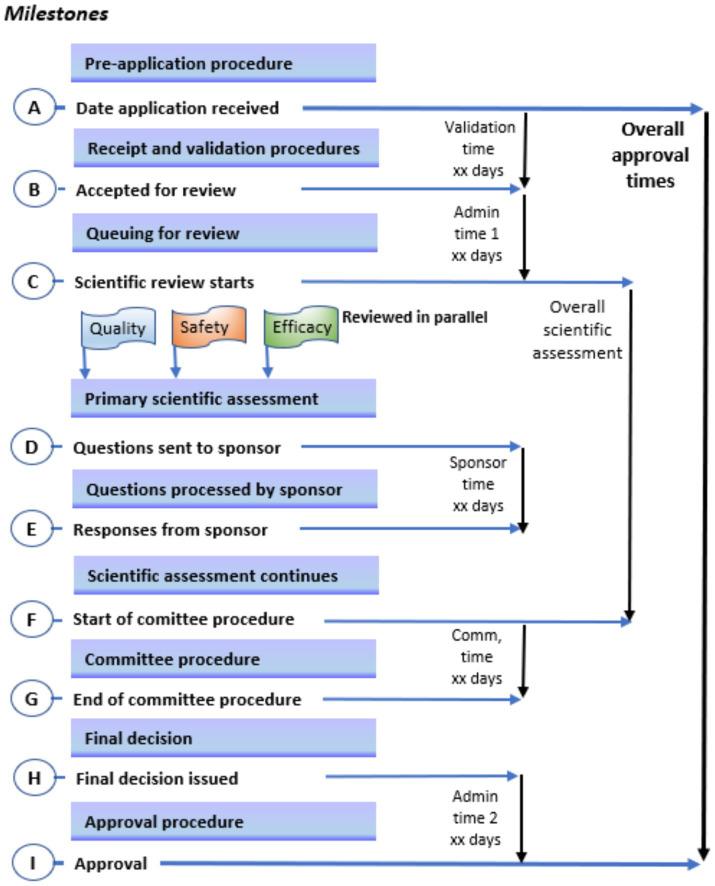
The authorities employ the three types of scientific review models, verification review (type 1), abridged review (type 2) and full review (type 3). Five of the NRAs deploy the fast track/priority review model in which a rapid assessment is carried out to obtain pharmacological, marketing/commercialisation, pharmacovigilance and additional clinical trial information. In Cote d'Ivoire, the priority review is used by the authority for WHO-prequalified medicines and stringent regulatory authority-approved medicines. Data requirements for the applications are essentially the same among the seven authorities. Applicants are required to provide a completed dossier in the common technical document format to support an application for marketing authorisation irrespective of the review model. Differences were noted with regard to comparison of the key features of the regulatory systems for medicines: as previously mentioned, five of the authorities required submission of a CPP with the application or before authorization. 25% of the review staff were physicians in five of the NRAs. Furthermore, procedures to allow the company response time to be measured and differentiated in the overall processing time were not available in Burkina Faso. In addition, there were differences reported in the targets for the key milestones in the full review process. These issues ultimately led to differences in the overall approval times for medicines that were processed via the full review pathway. The extent of the scientific review is dependent on the type of review model that is deployed in processing the application. Recommendations for improvement for the seven regulatory authorities include: publication of targets and timelines for key milestones; recognition of the ECOWAS-MRH initiative as a reference to expedite their approvals at the country level; and development of robust information technology systems.
CONCLUSION
This comparative study of the review models and regulatory timelines of countries participating in the ECOWAS-MRH initiative has highlighted both the similarities among the authorities and also the differences to be addressed in order to improve upon the regulatory systems in these countries.
引言
国家药品监管当局(NRAs)的职责是确保及时获取高质量、安全且有效的医疗产品,这主要通过各国设立的上市许可程序来实现。本研究的目的与在南部非洲发展共同体(SADC)和东非共同体(EAC)地区开展的研究类似,旨在评估和比较西非国家经济共同体 - 药品监管协调(ECOWAS - MRH)倡议中的七个国家药品监管当局(NRAs),即布基纳法索、科特迪瓦、加纳、尼日利亚、塞内加尔、塞拉利昂和多哥的审评模式和监管时间线,以找出改进的机会。这些NRAs因积极参与该区域倡议而被纳入研究。
方法
每个NRAs都填写了监管机构效率优化(OpERA)问卷,以促进对审评模式和监管时间线的评估。
结果
这些当局采用三种科学审评模式,即验证审评(1型)、简化审评(2型)和全面审评(3型)。其中五个NRAs采用快速通道/优先审评模式,对药物进行快速评估以获取药理学、上市/商业化、药物警戒和额外的临床试验信息。在科特迪瓦,当局对世界卫生组织预认证药品和严格监管当局批准的药品采用优先审评。七个当局对申请的数据要求基本相同。无论采用何种审评模式,申请人都需提供以通用技术文档格式完整的卷宗,以支持上市许可申请。在药品监管系统的关键特征比较方面存在差异:如前所述,五个当局要求在申请时或授权前提交药品主文件(CPP)。五个NRAs中有25%的审评人员是医生。此外,布基纳法索没有用于衡量公司响应时间并在整体处理时间中区分的程序。此外,在全面审评过程中关键里程碑的目标方面也有不同的报告。这些问题最终导致通过全面审评途径处理的药品在总体批准时间上存在差异。科学审评的程度取决于处理申请时所采用的审评模式类型。对这七个监管当局的改进建议包括:公布关键里程碑的目标和时间线;认可ECOWAS - MRH倡议作为在国家层面加快审批的参考;以及开发强大的信息技术系统。
结论
这项对参与ECOWAS - MRH倡议国家的审评模式和监管时间线的比较研究,既突出了各当局之间的相似之处,也强调了为改进这些国家的监管系统需要解决的差异。
 Zotero 插件