
神经病理性疼痛患者药物治疗的安全性:来自现实生活场景中门诊护理的数据。
The Safety of Drug Treatment in Patients with Neuropathic Pain: Data from Ambulatory Care in a Real-Life Setting.
作者信息
Vocca Cristina, Rania Vincenzo, Siniscalchi Antonio, Palleria Caterina, Marcianò Gianmarco, Galati Cecilia, Catarisano Luca, Mastrangelo Valentina, Corasaniti Franco, Monea Francesco, Muraca Lucia, Citraro Rita, D'Agostino Bruno, Gallelli Luca, De Sarro Giovambattista
机构信息
Pain Medicine Room, Complex Operative Unit of Clinical Pharmacology and Pharmacovigilance, Renato Dulbecco University Hospital, 88100 Catanzaro, Italy.
Department of Neurology and Stroke Unit, Annunziata Hospital of Cosenza, 87100 Cosenza, Italy.
出版信息
Reports (MDPI). 2023 Dec 1;6(4):57. doi: 10.3390/reports6040057.
INTRODUCTION
Drug treatment can be related to the development of adverse drug reactions (ADRs).
AIM
In this paper, we evaluated ADRs in patients admitted to the Ambulatory of Pain Medicine of the University Hospital Renato Dulbecco in Catanzaro.
METHODS
We conducted a prospective analysis between 1 February 2021 and 20 July 2023 on patients with neuropathic pain referred to the Ambulatory of Pain Medicine of "Renato Dulbecco" University Hospital in Catanzaro (Calabria, Italy). Patients aged >18 years with clinical signs of neurologic pain and a score upon completing the Douleur Neuropathique en 4 Questions (DN4) questionnaire of ≥4 were included. The association between drugs and ADR or between drugs and drug-drug-interactions (DDIs) was evaluated using Naranjo's probability scale and Drug Interaction Probability Scale (DIPS), respectively.
RESULTS
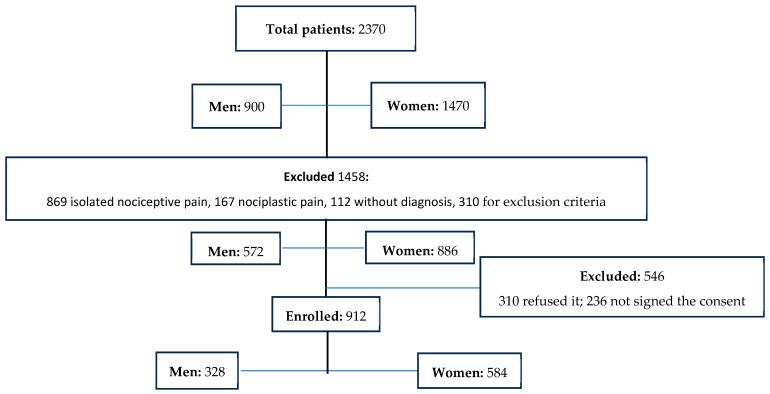
During the study period, we analyzed 2370 patients referred to the ambulatory of pain medicine. After the evaluation of inclusion and exclusion criteria, 33.5% of patients were enrolled. All patients presented at least one comorbidity and daily used a mean of five drugs (range 3-11). Using the Naranjo score, the development of ADRs was documented in 112 patients (score 6). Using parametric and non-parametric statistical analysis, we failed to report an association between ADR and dosage or ADR and patient characteristics.
CONCLUSION
Our results show the development of ADRs in 18% of patients with neuropathic pain. This low percentage of drug interaction could be a limitation in real life because it is probably due to the site of the study and the appropriate prescription of drugs. Therefore, it shows that it is necessary to motivate healthcare to pay attention to the prescription of drugs in poly-treated patients to reduce the risk of ADRs.
引言
药物治疗可能与药物不良反应(ADR)的发生有关。
目的
在本文中,我们评估了卡坦扎罗雷纳托·杜尔贝科大学医院疼痛医学门诊收治患者的药物不良反应情况。
方法
我们于2021年2月1日至2023年7月20日对转诊至意大利南部卡拉布里亚大区卡坦扎罗市“雷纳托·杜尔贝科”大学医院疼痛医学门诊的神经性疼痛患者进行了前瞻性分析。纳入年龄大于18岁、有神经性疼痛临床体征且完成《神经病理性疼痛4问题问卷》(DN4)后得分≥4分的患者。分别使用纳兰霍概率量表和药物相互作用概率量表(DIPS)评估药物与ADR之间或药物与药物相互作用(DDI)之间的关联。
结果
在研究期间,我们分析了2370名转诊至疼痛医学门诊的患者。在评估纳入和排除标准后,33.5%的患者被纳入研究。所有患者均至少有一种合并症,平均每天使用五种药物(范围为3 - 11种)。使用纳兰霍评分,记录到112名患者发生了药物不良反应(评分为6分)。通过参数和非参数统计分析,我们未发现药物不良反应与剂量或药物不良反应与患者特征之间存在关联。
结论
我们的结果显示,18%的神经性疼痛患者发生了药物不良反应。这种较低的药物相互作用发生率在现实生活中可能是一个局限性,因为这可能与研究地点和药物的合理处方有关。因此,这表明有必要促使医护人员关注多重用药患者的药物处方,以降低药物不良反应的风险。
 Zotero 插件