
炎症性肠病患者对mRNA疫苗体液免疫反应受损的相关因素:来自RisCoin研究的匹配队列分析
Factors Associated with Impaired Humoral Immune Response to mRNA Vaccines in Patients with Inflammatory Bowel Disease: A Matched-Cohort Analysis from the RisCoin Study.
作者信息
Csollarova Katarina, Koletzko Leandra, Le Thi Thu Giang, Wratil Paul R, Zhelyazkova Ana, Breiteneicher Simone, Stern Marcel, Lupoli Gaia, Schwerd Tobias, Choukér Alexander, Hornung Veit, Keppler Oliver T, Adorjan Kristina, Török Helga Paula, Koletzko Sibylle
机构信息
Department of Pediatrics, Dr. von Hauner Children's Hospital, LMU University Hospital Munich, 80337 Munich, Germany.
Department of Medicine II, LMU University Hospital Munich, 81377 Munich, Germany.
出版信息
Vaccines (Basel). 2025 Jun 23;13(7):673. doi: 10.3390/vaccines13070673.
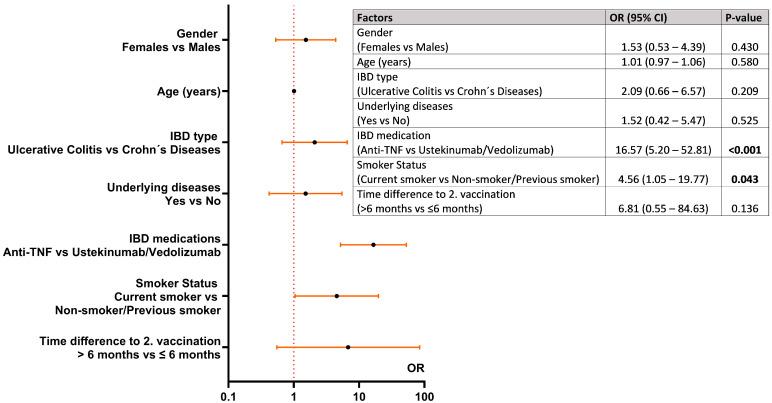
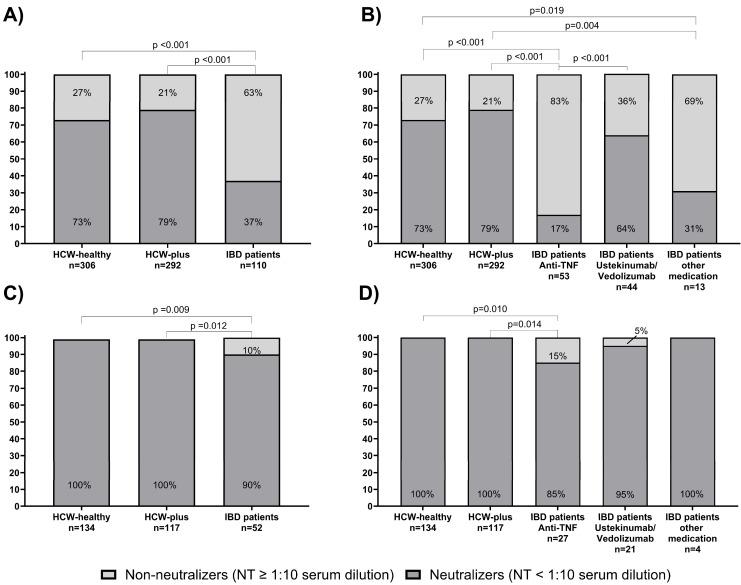
The SARS-CoV-2 pandemic challenged patients with inflammatory bowel disease (IBD) under immunosuppressive therapies. We used data from the RisCoin cohort to investigate factors associated with a poor immune response to mRNA vaccination in these patients. : From 4115 RisCoin participants, we matched 110 IBD patients by age and time interval since the second mRNA vaccination with 306 healthcare workers (HCW) without comorbidities (HCW-healthy) and 292 with medical conditions (HCW-plus); all were SARS-CoV-2 infection naïve. Basic questionnaires collected data on medication, COVID-19 vaccinations and side-effects, dietary patterns, lifestyle factors, and self-perceived stress. Main outcomes included anti-spike immunoglobulin levels and antibody-mediated live-virus neutralization immunity (NT) to the Omicron BA.1 variant (threshold NT ≥ 10 defined as IC50 values ≥1:10 serum dilution) after the second (baseline) and third vaccinations. : At baseline, IBD patients treated with anti-TNF but not those under vedolizumab or ustekinumab therapy had lower anti-spike levels compared to HCW-healthy and HCW-plus (166 versus 1384 and 1258 BAU/mL, respectively; < 0.0001). Anti-TNF compared to vedolizumab/ustekinumab-treated patients reached NT titers above threshold in 17% versus 64%, respectively, and HCW-subgroups in 73% and 79% (all < 0.0001). Current smokers showed a four to five times increased risk for non-neutralizing immunity compared to non-smokers. After the third vaccination, NT titers did not reach threshold in 15% anti-TNF compared to 5% vedolizumab/ustekinumab-treated patients and none of HCW ( < 0.01). Patients with IBD reported fewer clinical symptoms after vaccination. Perceived stress was not increased. : Our findings support individualized schedules for mRNA-based vaccines in IBD patients with different immunosuppressive therapies and enforcement of non-smoking.
严重急性呼吸综合征冠状病毒2(SARS-CoV-2)大流行给接受免疫抑制治疗的炎症性肠病(IBD)患者带来了挑战。我们利用RisCoin队列的数据,调查这些患者中与mRNA疫苗免疫反应不佳相关的因素。:在4115名RisCoin参与者中,我们根据年龄和自第二次mRNA疫苗接种后的时间间隔,将110名IBD患者与306名无合并症的医护人员(HCW-健康组)和292名有医疗状况的医护人员(HCW-加病组)进行匹配;所有人员均未感染过SARS-CoV-2。基本问卷收集了关于用药、新冠病毒疫苗接种及副作用、饮食模式、生活方式因素和自我感知压力的数据。主要结局包括第二次(基线)和第三次疫苗接种后针对奥密克戎BA.1变体的抗刺突免疫球蛋白水平以及抗体介导的活病毒中和免疫力(NT)(NT阈值≥10定义为IC50值≥1:10血清稀释度)。:在基线时,与HCW-健康组和HCW-加病组相比,接受抗TNF治疗的IBD患者而非接受维多珠单抗或乌司奴单抗治疗的患者,其抗刺突水平较低(分别为166与1384和1258 BAU/mL;<0.0001)。与接受维多珠单抗/乌司奴单抗治疗的患者相比,接受抗TNF治疗的患者达到NT滴度阈值以上的比例分别为17%和64%,HCW-亚组的这一比例为73%和79%(均<0.0001)。与不吸烟者相比,当前吸烟者出现非中和免疫力的风险增加四至五倍。第三次疫苗接种后,15%接受抗TNF治疗的患者NT滴度未达到阈值,而接受维多珠单抗/乌司奴单抗治疗的患者为5%,HCW均未出现这种情况(<0.01)。IBD患者报告接种疫苗后的临床症状较少。自我感知压力未增加。:我们的研究结果支持为接受不同免疫抑制治疗的IBD患者制定基于mRNA疫苗的个性化接种计划,并加强戒烟措施。
 Zotero 插件