
量化采用太阳能对减少二氧化碳排放的影响。
Quantifying effects of solar power adoption on CO emissions reduction.
作者信息
Biswas Arpita, Qiu Minghao, Braun Danielle, Dominici Francesca, Mork Daniel
机构信息
Department of Computer Science, Rutgers University, New Brunswick, NJ, USA.
School of Marine and Atmospheric Sciences, Stony Brook University, Stony Brook, NY, USA.
出版信息
Sci Adv. 2025 Aug;11(31):eadq5660. doi: 10.1126/sciadv.adq5660. Epub 2025 Jul 30.
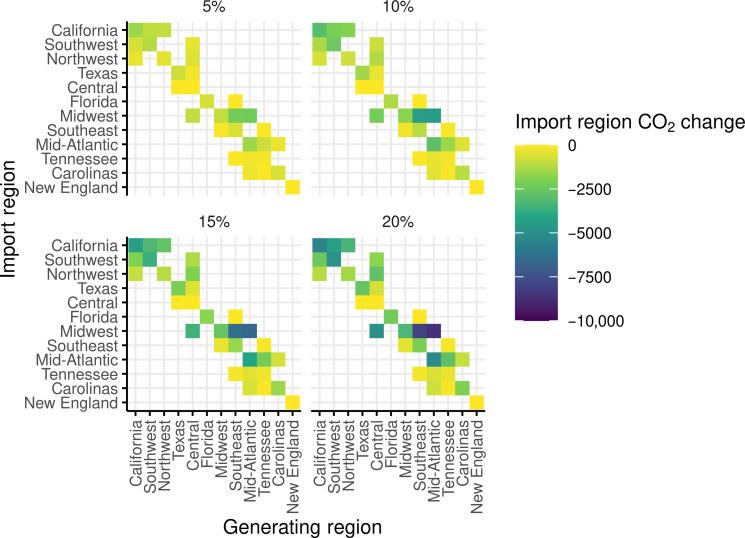
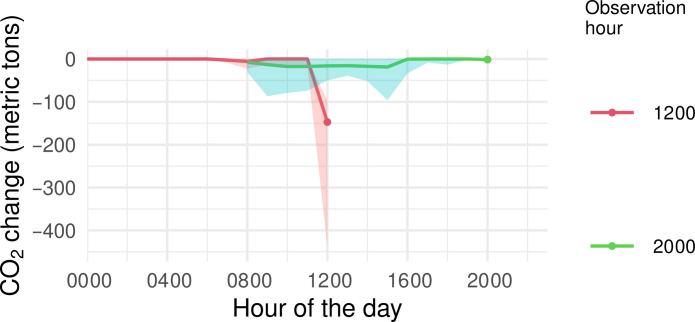
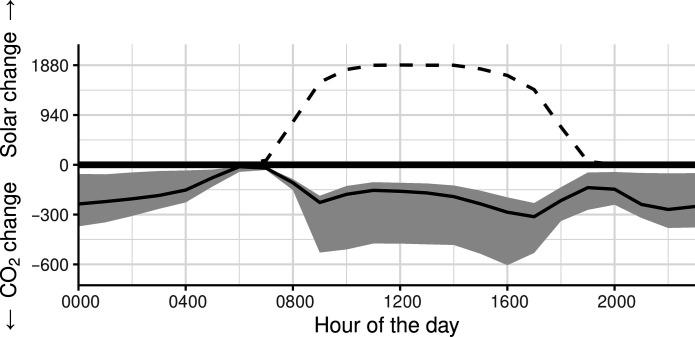
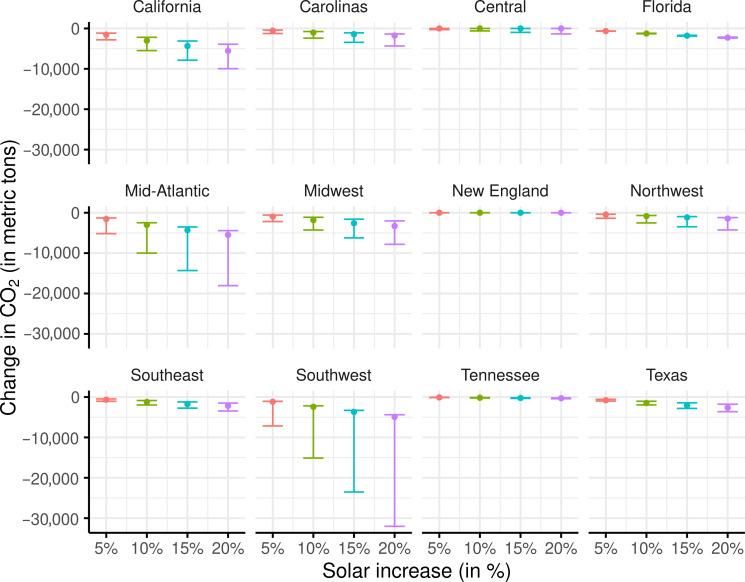
We quantify the effect of solar power adoption in reducing carbon dioxide (CO) emissions from the US electricity sector using 5 years of Energy Information Administration data, starting 1 July 2018. By tailoring a distributed lag statistical model, we estimate the immediate and time-lagged effects of increased solar generation on reducing CO emissions within a region. Our analysis highlights how solar adoption in one region affects CO emissions in neighboring regions, emphasizing the potential for collaborative efforts. We estimate that a 15% increase in solar generation is associated with an annual reduction of 8.54 million metric tons (MMT) of CO emissions, contributing 12.38% toward the yearly target of 69 MMT CO reductions needed to cut 1380 MMT of CO in 20 years, as per the Environmental Protection Agency rule on fossil fuel power plants. This study offers insights for policymakers and stakeholders in achieving CO reduction targets through increased solar generation.
我们利用美国能源信息署从2018年7月1日起的5年数据,对采用太阳能发电减少美国电力部门二氧化碳(CO)排放的效果进行了量化。通过定制一个分布滞后统计模型,我们估计了太阳能发电量增加对减少一个地区内CO排放的即时和滞后影响。我们的分析突出了一个地区采用太阳能如何影响邻近地区的CO排放,强调了合作努力的潜力。我们估计,太阳能发电量增加15%与每年减少854万公吨(MMT)的CO排放相关,按照环境保护局关于化石燃料发电厂的规定,这为20年内削减1380 MMT的CO所需的每年69 MMT CO减排目标贡献了12.38%。这项研究为政策制定者和利益相关者通过增加太阳能发电量实现CO减排目标提供了见解。


 Zotero 插件