
肢带型肌营养不良症2型(LGMDR2)进展的建模:纵向脂肪分数分析
Modeling of Dysferlinopathy (LGMDR2) Progression: A Longitudinal Fat Fraction Analysis.
作者信息
Bolano-Diaz Carla Florencia, Reyngoudt Harmen, Wilson Ian J, James Meredith K, Smith Fiona Elizabeth, Caldas de Almeida Araujo Ericky, Gordish-Dressman Heather, Hilsden Heather, Rufibach Laura E, Wallace Dorothy, Ward Louise, Stramare Roberto, Rampado Alessandro, Smith Mark, Boisserie Jean-Marc, Le Louer Julien, Foster Sheryl, Peduto Anthony, Sato Noriko, Tamaru Takeshi, Sawyer Anne Marie, Day John W, Jones Kristi J, Walter Maggie Christine, Stojkovic Tanya, Mori-Yoshimura Madoka, Mendell Jerry R, Pegoraro Elena, Straub Volker, Blamire Andrew M, Carlier Pierre, Diaz-Manera Jordi
机构信息
The John Walton Muscular Dystrophy Research Centre, Translational and Clinical Research Institute, Newcastle University and Newcastle Hospitals NHS Foundation Trust, Central Parkway, Newcastle Upon Tyne, United Kingdom.
NMR Laboratory, Neuromuscular Investigation Centre, Institute of Myology, Paris, France.
出版信息
Neurol Genet. 2025 Jul 29;11(4):e200283. doi: 10.1212/NXG.0000000000200283. eCollection 2025 Aug.
BACKGROUND AND OBJECTIVES
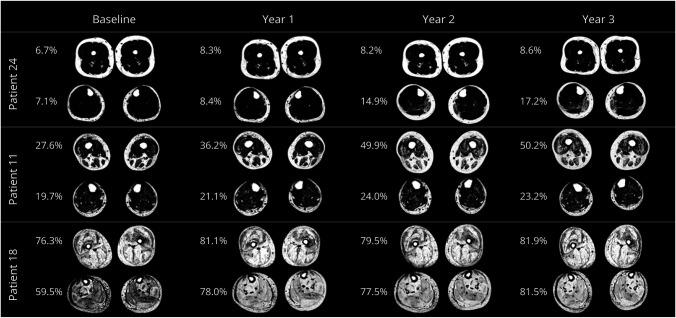
Limb-girdle muscular dystrophy R2 (LGMDR2) is characterized by progressive muscle weakness usually leading to severe disability. The rate of progression and disease severity is variable among patients, although factors influencing this variability are not completely understood. The Dysferlinopathy Clinical Outcome Study is a natural history study that followed patients with LGMDR2 for 3 consecutive years using functional outcome measures and skeletal muscle MRI.The aim of our study was to develop statistical models able to describe fat fraction (FF) progression of the lower limbs in patients with LGMDR2 using clinical and radiologic variables to better understand which factors influence disease progression and improve the design of future clinical trials.
METHODS
We used linear-mixed modeling to analyze changes in FF over time according to patients' age. We calculated the average FF trajectory for each muscle of the lower limbs. We built 2 multivariate models for each segment adding other clinical factors and using likelihood ratio test and residuals' analysis to determine whether they better fitted observed FF values.
RESULTS
Muscles that participated in the same joint movement progressed similarly over time. FF was expected to be higher the older patients were and the earlier the age at symptom onset. Women had absolute FF values 8.8% higher than men in the lower leg. No differences in FF trajectory were seen based on ethnic groups (White, Asian, Black, or Hispanic), genetic variants, or residual dysferlin expression. Although multivariate models showed a better global fit to the data, there was no improvement in representing individual patient variability.
DISCUSSION
In conclusion, this study provides a better understanding of skeletal muscle fat replacement progression in the lower limb muscles of patients with LGMDR2, highlighting the influence of age at symptom onset, sex, and baseline motor function, which should be considered in the design and analysis of clinical trials. Although complex models improved the overall data fit, they did not improve the accuracy in identifying changes at a patient level, underlying the need for further research and validation and the fact that other variables we have not measured are probably influencing progression.
背景与目的
肢带型肌营养不良R2型(LGMDR2)的特征是进行性肌无力,通常会导致严重残疾。尽管影响这种变异性的因素尚未完全明确,但患者之间的疾病进展速度和严重程度存在差异。Dysferlinopathy临床结果研究是一项自然史研究,使用功能结局指标和骨骼肌MRI对LGMDR2患者进行了连续3年的随访。我们研究的目的是开发统计模型,利用临床和放射学变量来描述LGMDR2患者下肢脂肪分数(FF)的进展情况,以便更好地了解哪些因素影响疾病进展,并改进未来临床试验的设计。
方法
我们使用线性混合模型根据患者年龄分析FF随时间的变化。我们计算了下肢各肌肉的平均FF轨迹。我们为每个节段建立了2个多变量模型,加入其他临床因素,并使用似然比检验和残差分析来确定它们是否能更好地拟合观察到的FF值。
结果
参与相同关节运动的肌肉随时间的进展相似。患者年龄越大、症状出现时的年龄越早,FF预计越高。小腿中女性的绝对FF值比男性高8.8%。基于种族(白人、亚洲人、黑人或西班牙裔)、基因变异或残余dysferlin表达,未观察到FF轨迹的差异。尽管多变量模型对数据的整体拟合更好,但在反映个体患者变异性方面没有改善。
讨论
总之,本研究更好地了解了LGMDR2患者下肢肌肉中骨骼肌脂肪替代的进展情况,突出了症状出现时的年龄、性别和基线运动功能的影响,在临床试验的设计和分析中应予以考虑。尽管复杂模型改善了整体数据拟合,但它们并没有提高在个体患者水平上识别变化的准确性,这表明需要进一步的研究和验证,而且我们未测量的其他变量可能正在影响疾病进展。

 Zotero 插件