
一个将过去和未来流行病规模相联系的概念性疾病循环模型。
A Conceptual Disease Cycle Model to Link the Size of Past and Future Epidemics.
作者信息
Paplauskas Sam
机构信息
Biological and Environmental Sciences University of Stirling Stirling Scotland, UK.
出版信息
Ecol Evol. 2025 Jul 28;15(8):e71868. doi: 10.1002/ece3.71868. eCollection 2025 Aug.
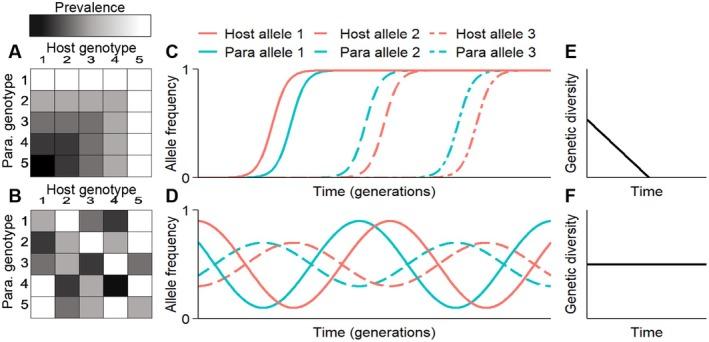
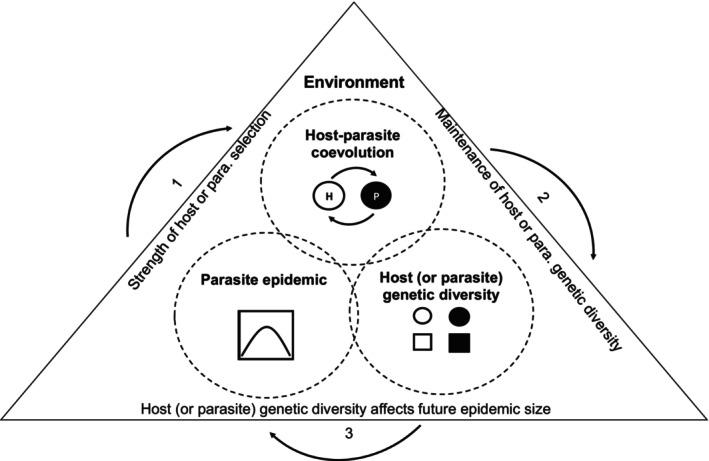
Populations of humans, animals, and plants face ongoing threats from infectious disease epidemics. While host-parasite coevolution plays a central role in shaping these dynamics, epidemics are often studied in isolation. I propose a simple "Disease Cycle" model that connects past and future epidemic sizes within the context of environmental change and evolutionary feedbacks. Drawing on recent evo-epidemiological research, I highlight three key themes: (i) how epidemics influence the strength and direction of natural selection, (ii) how host and parasite diversity shift through evolving resistance and infectivity, and (iii) how genetic diversity in either population may affect future epidemic severity. Although gaps remain, current evidence supports this integrative model. Future research should explore how the Disease Cycle applies to non-model organisms with low coevolutionary potential. This framework encourages a more holistic view of epidemics as dynamic outcomes of host-parasite coevolution.
人类、动物和植物群体面临着传染病流行带来的持续威胁。虽然宿主 - 寄生虫协同进化在塑造这些动态过程中起着核心作用,但流行病往往被孤立地研究。我提出了一个简单的“疾病循环”模型,该模型在环境变化和进化反馈的背景下将过去和未来的流行病规模联系起来。借鉴近期的进化流行病学研究,我突出了三个关键主题:(i)流行病如何影响自然选择的强度和方向,(ii)宿主和寄生虫的多样性如何通过进化抗性和传染性而发生变化,以及(iii)任一群体中的遗传多样性如何影响未来流行病的严重程度。尽管仍存在差距,但现有证据支持这一综合模型。未来的研究应探索“疾病循环”如何适用于协同进化潜力较低的非模式生物。这个框架鼓励将流行病视为宿主 - 寄生虫协同进化的动态结果,从而形成更全面的观点。

 Zotero 插件