
一项关于肥胖与蒽环类药物及曲妥珠单抗在乳腺癌和淋巴瘤治疗中所致心脏毒性相关性的回顾性分析。
A retrospective analysis of the association of obesity with anthracycline- and trastuzumab-induced cardiotoxicity in the treatment of breast cancer and lymphoma.
作者信息
Huff Mallorie L, Gupta Ranju, Gupta Rahul, Schadler Kelly C, Duka Shae, Histon-Figliolini Vienna, Kalter Joshua, Joshi Amogh M, Ahmad Nadeem V, Aronow Wilbert S, Sundlof Deborah W
机构信息
Lehigh Valley Health Network, United States.
Lehigh Valley Health Network, Allentown, PA, United States.
出版信息
Arch Med Sci. 2024 Jul 28;21(3):779-788. doi: 10.5114/aoms/190869. eCollection 2025.
INTRODUCTION
Trastuzumab and anthracyclines are mainstays of chemotherapy in breast cancer and lymphoma patients but may cause significant cardiotoxicity, which may result in alterations to chemotherapy dose, schedule, or agent. Obesity is increasingly prevalent in the United States and is a significant risk factor for both cardiovascular disease and certain cancers. We aimed to assess the relationship between obesity and the risk of developing chemotherapy-associated cardiotoxicity.
MATERIAL AND METHODS
A retrospective chart review was conducted of all patients who received trastuzumab or anthracyclines over a 5-year period from January 1, 2008, to December 31, 2012 at our tertiary care center in the Northeastern United States. Obesity was defined as a body mass index (BMI) ≥ 30 kg/m. Cardiotoxicity was defined as demonstrated left ventricular ejection fraction less than 50% or demonstrated ischemia or infarction on echocardiogram or cardiac catheterization. Bivariate analyses were conducted to determine the association between demographic and clinical variables with cardiotoxicity status. Two multivariate logistic regression models were generated to assess whether BMI was independently associated with cardiotoxicity.
RESULTS
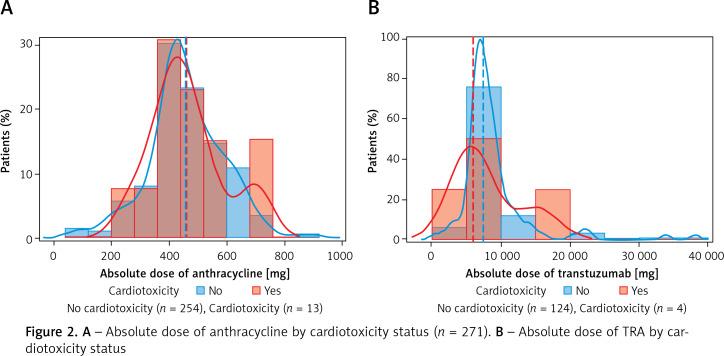
Of the 368 patients receiving either trastuzumab or anthracyclines, 16 patients developed cardiotoxicity. Demographically, age, race, BMI, body surface area (BSA), and overall weight did not differ between the patients who developed cardiotoxicity and those who did not. The mean dose of anthracycline and trastuzumab did not differ between the patients who developed cardiotoxicity and those who did not. Obesity was not found to increase the odds of developing cardiotoxicity and was slightly protective. A non-significant decrease in the odds of developing cardiotoxicity was found for every one-unit increase in BMI. In a multivariable model using BMI as a continuous predictor and controlling for BMI, age, hypertension, chemotherapy type, and coronary artery disease, the only significant predictor of cardiotoxicity was a previous history of arrhythmia.
CONCLUSIONS
Obesity was not a significant risk factor for patients developing cardiotoxicity from trastuzumab- or anthracycline-based chemotherapy and may be a protective factor for cardiotoxicity. Additional studies with greater statistical power are needed to further evaluate this effect and independently evaluate obesity as a risk factor for cardiotoxicity.
引言
曲妥珠单抗和蒽环类药物是乳腺癌和淋巴瘤患者化疗的主要药物,但可能会引起严重的心脏毒性,这可能导致化疗剂量、疗程或药物的改变。肥胖在美国日益普遍,是心血管疾病和某些癌症的重要危险因素。我们旨在评估肥胖与化疗相关心脏毒性发生风险之间的关系。
材料与方法
对2008年1月1日至2012年12月31日在美国东北部我们的三级医疗中心接受曲妥珠单抗或蒽环类药物治疗的所有患者进行回顾性病历审查。肥胖定义为体重指数(BMI)≥30kg/m²。心脏毒性定义为经证实左心室射血分数低于50%,或经超声心动图或心脏导管检查证实有缺血或梗死。进行双变量分析以确定人口统计学和临床变量与心脏毒性状态之间的关联。生成两个多变量逻辑回归模型以评估BMI是否与心脏毒性独立相关。
结果
在368例接受曲妥珠单抗或蒽环类药物治疗的患者中,有16例发生了心脏毒性。在人口统计学方面,发生心脏毒性的患者与未发生心脏毒性的患者在年龄、种族、BMI、体表面积(BSA)和总体重方面没有差异。发生心脏毒性的患者与未发生心脏毒性的患者之间蒽环类药物和曲妥珠单抗的平均剂量没有差异。未发现肥胖会增加发生心脏毒性的几率,反而有轻微的保护作用。发现BMI每增加一个单位,发生心脏毒性的几率有不显著的降低。在一个以BMI作为连续预测变量并控制BMI、年龄、高血压、化疗类型和冠状动脉疾病的多变量模型中,心脏毒性的唯一显著预测因素是既往心律失常病史。
结论
肥胖不是接受基于曲妥珠单抗或蒽环类药物化疗的患者发生心脏毒性的显著危险因素,可能是心脏毒性的一个保护因素。需要进行更具统计学效力的进一步研究,以进一步评估这种效应,并独立评估肥胖作为心脏毒性危险因素的情况。

 Zotero 插件