
构建基于社区的小儿非酒精性脂肪性肝病初级筛查及基于医院的确诊筛查路径。
Construction of a community-based primary screening and hospital-based confirmatory screening pathway in pediatric nonalcoholic fatty liver disease.
作者信息
Yao Ming-Jie, Xing Yun-Fei, Liu Shu-Hong, Peng Ya-Fei, Yang Shu-Han, Chen Juan-Juan, Zhao Jing-Min, Wang Hui
机构信息
Department of Anatomy and Embryology, School of Basic Medical Sciences, Peking University Health Science Center, Beijing 100191, China.
Department of Maternal and Child Health, School of Public Health, Peking University Health Science Center, Beijing 100191, China.
出版信息
World J Gastroenterol. 2025 Jul 28;31(28):108321. doi: 10.3748/wjg.v31.i28.108321.
BACKGROUND
Fibrosis is a critical event in the progression of pediatric nonalcoholic fatty liver disease (NAFLD).
AIM
To develop less invasive models based on machine learning (ML) to predict significant fibrosis in Chinese NAFLD children.
METHODS
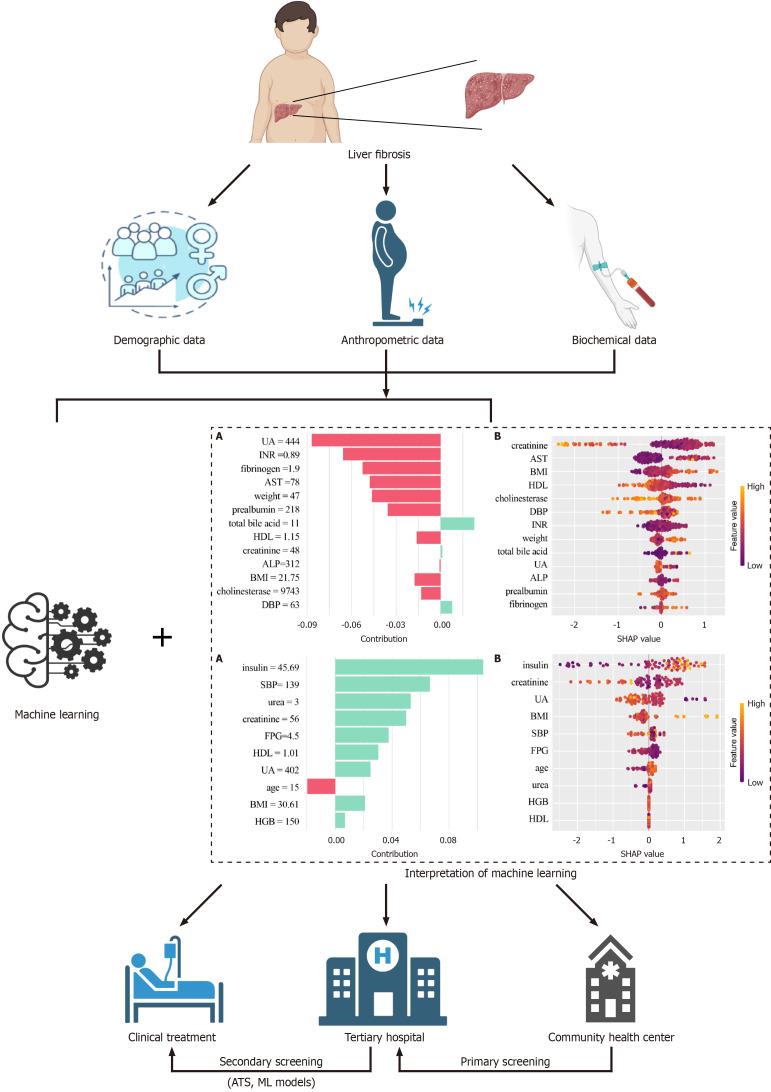
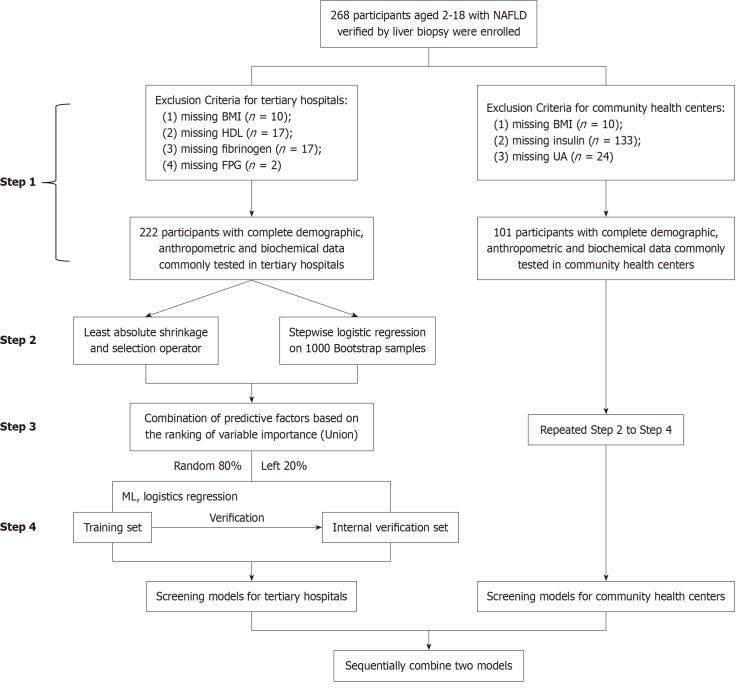
In this cross-sectional study, 222 and 101 NAFLD children with available liver biopsy data were included in the development of screening models for tertiary hospitals and community health centers, respectively. Predictive factors were selected using least absolute shrinkage and selection operator regression and stepwise logistic regression analyses. Logistic regression (LR) and other ML models were applied to construct the prediction models.
RESULTS
Simplified indicators of the ATS and BIU indices were constructed for tertiary hospitals and community health centers, respectively. When models based on the ATS and BIU parameter combinations were constructed, the random forest (RF) model demonstrated higher screening accuracy compared to the LR model (0.80 and 0.79 for the RF model and 0.72 and 0.77 for the LR model, respectively). Using cutoff values of 90% for sensitivity and 90% for specificity, the RF models could effectively identify and exclude NAFLD children with significant fibrosis in the internal validation set (with positive predictive values and negative prediction values exceeding 0.80), which could prevent liver biopsy in 60% and 71.4% of NAFLD children, respectively.
CONCLUSION
This study developed new models for predicting significant fibrosis in NAFLD children in tertiary hospitals and community health centers, which can serve as preliminary screening tools to detect the risk population in a timely manner.
背景
纤维化是儿童非酒精性脂肪性肝病(NAFLD)进展中的关键事件。
目的
基于机器学习(ML)开发侵入性较小的模型,以预测中国NAFLD儿童的显著纤维化。
方法
在这项横断面研究中,分别有222名和101名有可用肝活检数据的NAFLD儿童被纳入三级医院和社区卫生中心筛查模型的开发。使用最小绝对收缩和选择算子回归以及逐步逻辑回归分析来选择预测因素。应用逻辑回归(LR)和其他ML模型构建预测模型。
结果
分别为三级医院和社区卫生中心构建了ATS和BIU指数的简化指标。当构建基于ATS和BIU参数组合的模型时,随机森林(RF)模型显示出比LR模型更高的筛查准确性(RF模型分别为0.80和0.79,LR模型分别为0.72和0.77)。使用灵敏度90%和特异度90%的截断值,RF模型可以在内部验证集中有效识别和排除有显著纤维化的NAFLD儿童(阳性预测值和阴性预测值超过0.80),这可以分别避免60%和71.4%的NAFLD儿童进行肝活检。
结论
本研究为三级医院和社区卫生中心的NAFLD儿童预测显著纤维化开发了新模型,可作为及时检测风险人群的初步筛查工具。
 Zotero 插件