
从短期使用罗莫单抗快速转换为抗吸收治疗:26例病例分析。
Early transition from short-term romosozumab to antiresorptive therapies: analysis of 26 cases.
作者信息
Everts-Graber Judith, Ferrari Serge, Popp Albrecht, Hars Magaly, Wenger Mathias, Oser Sven, Studer Ueli, Steiner Christian, Ziswiler Hans-Rudolf, Schmid Gernot, Reichenbach Stephan, Lehmann Thomas, Lamy Olivier, Rodriguez Elena Gonzalez
机构信息
Department of Rheumatology and Immunology, Inselspital, Bern University Hospital, University of Bern, Anna-Seiler-Haus, Freiburgstrasse 20, 3010, Bern, Switzerland.
OsteoRheuma Bern, Bahnhofplatz 1, Bern, Switzerland.
出版信息
Arch Osteoporos. 2025 Jul 31;20(1):106. doi: 10.1007/s11657-025-01598-1.
UNLABELLED
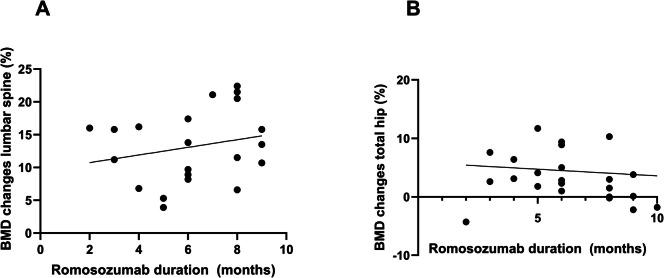
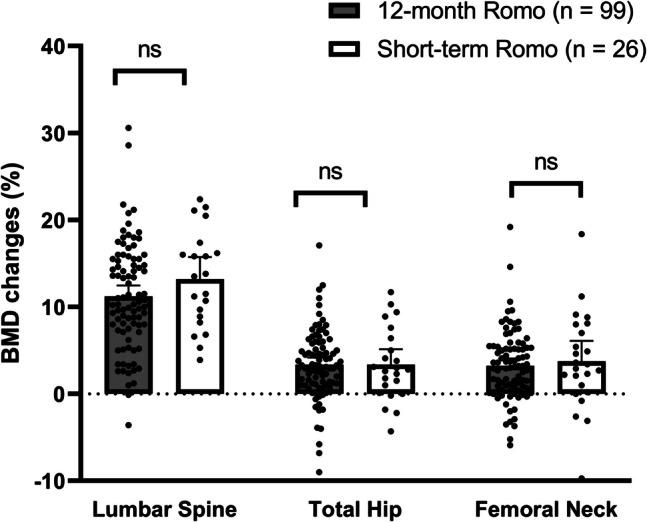
This multicentre, retrospective case series analysed bone mineral density (BMD) changes in 26 patients who switched early from romosozumab (3-10 months) to antiresorptives. BMD gains over 12 months were similar to those in patients (n = 99) completing the full 12-month course.
BACKGROUND
Romosozumab is typically administered for a duration of 12 months before transitioning to antiresorptive therapies. This study analysed the bone mineral density (BMD) changes of patients who were prematurely switched to an antiresorptive regimen.
METHODS
This multicentre, retrospective case series investigated the BMD response to romosozumab administered for 3 to 10 months, followed by subsequent antiresorptive therapy, across four bone centres in Switzerland. BMD measurements at the lumbar spine, total hip and femoral neck were conducted at the initiation of romosozumab and again 12 months later. The study compared the BMD changes in patients who received short-term romosozumab with those in a cohort of patients who completed the full 12-month course.
RESULTS
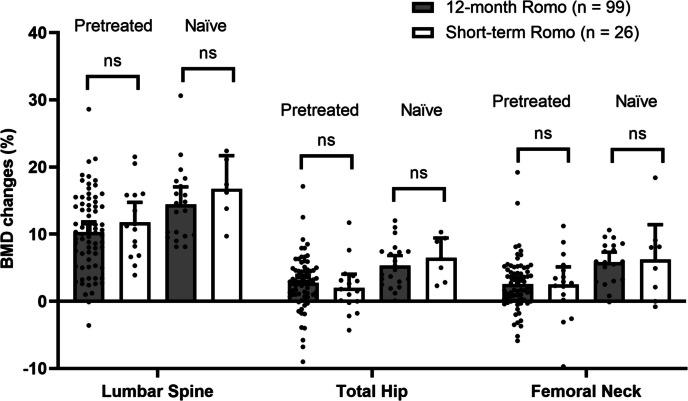
Twenty-six patients (25 postmenopausal women and one man, median age 73 years [interquartile range: 65, 81]) were enrolled from February 2022 to December 2024. They received a median of six romosozumab injections (range: 3 to 10) and were prematurely switched to antiresorptives (14 to denosumab, 11 to zoledronate and one to alendronate) due to possible side effects or adverse events. Over 12 months, BMD increased by 13.5% [8.6, 16.6] at the lumbar spine, 2.9% [0.3, 7.3] at the total hip and 3.2% [0.4, 7.8] at the femoral neck, without significant differences compared with the cohort of 99 patients who received 12 months of romosozumab therapy. In both the short- and full-duration romosozumab treatment groups, significantly lower BMD responses were observed in patients who were pretreated with antiresorptives compared with those who were treatment naïve.
CONCLUSION
In patients who underwent an early switch from romosozumab to antiresorptive therapy, BMD responses during the first year were similar to those in patients who completed the full 12-month romosozumab treatment. However, the subsequent changes in BMD, when all patients are receiving antiresorptive therapy, remain to be determined.
未标注
本多中心回顾性病例系列分析了26例从罗莫单抗(3 - 10个月)提前转换为抗吸收药物的患者的骨密度(BMD)变化。12个月内的BMD增加与完成完整12个月疗程的患者(n = 99)相似。
背景
罗莫单抗通常在转换为抗吸收治疗前给药12个月。本研究分析了过早转换为抗吸收治疗方案的患者的骨密度(BMD)变化。
方法
本多中心回顾性病例系列研究了瑞士四个骨中心对接受3至10个月罗莫单抗治疗,随后进行抗吸收治疗的患者的BMD反应。在开始使用罗莫单抗时以及12个月后再次测量腰椎、全髋和股骨颈的BMD。该研究比较了接受短期罗莫单抗治疗的患者与完成12个月完整疗程的患者队列中的BMD变化。
结果
2022年2月至2024年12月招募了26例患者(25例绝经后女性和1例男性,中位年龄73岁[四分位间距:65, 81])。他们接受罗莫单抗注射的中位数为6次(范围:3至10次),由于可能的副作用或不良事件而提前转换为抗吸收药物(14例转换为地诺单抗,11例转换为唑来膦酸,1例转换为阿仑膦酸钠)。在12个月内,腰椎BMD增加了13.5% [8.6, 16.6],全髋增加了2.9% [0.3, 7.3],股骨颈增加了3.2% [0.4, 7.8],与接受12个月罗莫单抗治疗的99例患者队列相比无显著差异。在短期和长期罗莫单抗治疗组中,与未接受过治疗的患者相比,接受过抗吸收药物预处理的患者的BMD反应显著较低。
结论
在从罗莫单抗提前转换为抗吸收治疗的患者中,第一年的BMD反应与完成12个月完整罗莫单抗治疗的患者相似。然而,当所有患者都接受抗吸收治疗时,BMD的后续变化仍有待确定。
 Zotero 插件