
阴离子表面活性剂十二烷基苯磺酸钠通过NFκB/MAPK途径以STAT3依赖性方式减轻特应性皮炎中的炎症反应。
The anionic surfactant Sodium Dodecyl Benzene Sulfonate alleviates inflammatory responses in atopic dermatitis via NFκB/MAPK pathways in a STAT3-dependent manner.
作者信息
Zhang Han, Li Zizhuo, Mu Zhanglei, Wu You, Zhang Suli, Zhou Yaguang, Zhang Dongdong, Zhao Xiaojing, Xing Weiwei, Wang Yanan, Lin Biwen, Liang Xiaoqiang, Zheng Chunfu, Li Chengxin, Zhang Jianzhong
机构信息
Department of Dermatology, The First Medical Center of Chinese PLA General Hospital, Beijing, 100853, China.
Department of Dermatology, Peking University People's Hospital, Beijing, 100044, China.
出版信息
Sci Rep. 2025 Jul 31;15(1):28019. doi: 10.1038/s41598-025-12776-z.
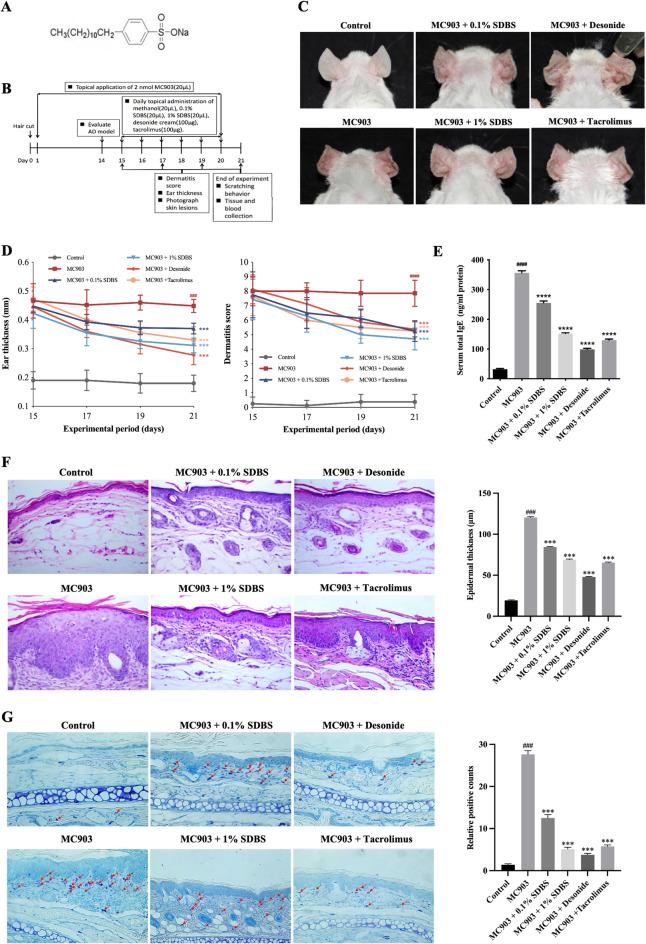
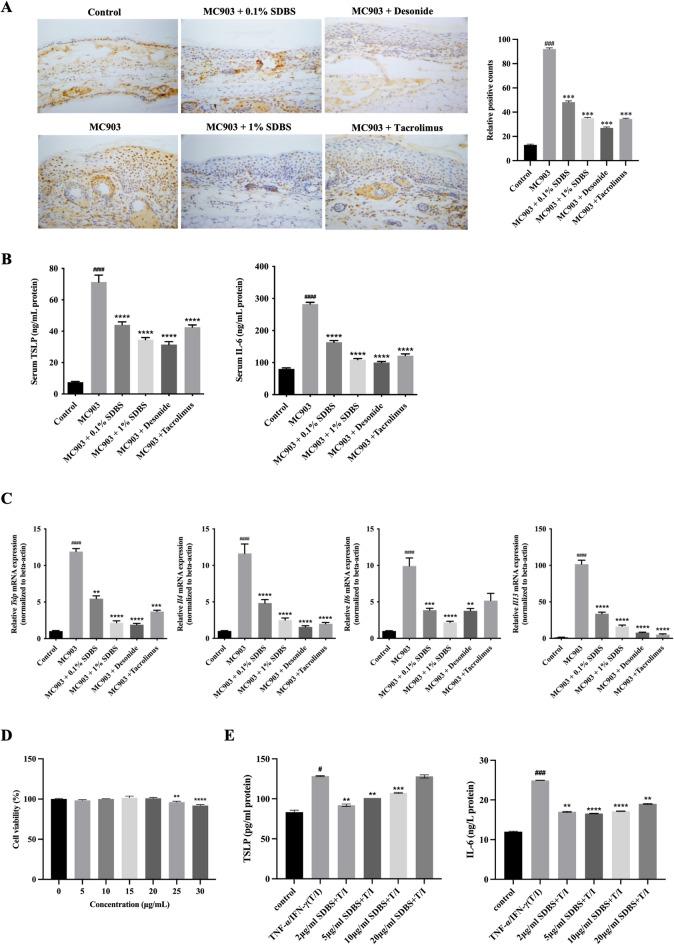
Atopic dermatitis (AD) is a common chronic inflammatory skin disease characterized by chronic inflammation, barrier impairment, and immunoglobulin E-mediated sensitization. Sodium dodecyl benzene sulfonate (SDBS) is a widely used anionic surfactant which are believed to exacerbate AD according to the hygiene hypothesis. However, recent studies have shown that SDBS does not significantly upregulate the expression of key proinflammatory cytokines, which is inconsistent with previous hypotheses. Furthermore, it is not known whether SDBS affect the inflammatory response to AD. Herein, we used mice with MC903-induced AD-like dermatitis and tumor necrosis factor (TNF)-α/interferon (IFN)-γ (T/I)-treated HaCaT cells to investigate the effects of SDBS on AD. We found that topical use of 0.1% and 1% SDBS did not exacerbate dermatitis in mice. Instead, clinical and histological remission of MC903-induced AD-like dermatitis were observed following the administration of both 0.1% and 1% SDBS, where 1% SDBS treatment showed a greater degree of relief compared to 0.1% SDBS. SDBS also reduced the expression of major cytokines involved in the pathogenesis of AD both in vivo and in vitro. Furthermore, our results showed that SDBS alleviated AD via the nuclear factor kappa B/mitogen-activated protein kinase pathways in a signal transducer and activator of transcription 3-dependent manner. In conclusion, our findings suggest for the first time that the surfactant SDBS has anti-inflammatory properties, which raises new possibilities for detergent use among patients with AD.
特应性皮炎(AD)是一种常见的慢性炎症性皮肤病,其特征为慢性炎症、屏障功能受损以及免疫球蛋白E介导的致敏反应。十二烷基苯磺酸钠(SDBS)是一种广泛使用的阴离子表面活性剂,根据卫生假说,人们认为它会加重特应性皮炎。然而,最近的研究表明,SDBS并不会显著上调关键促炎细胞因子的表达,这与之前的假说不一致。此外,尚不清楚SDBS是否会影响对特应性皮炎的炎症反应。在此,我们使用经MC903诱导产生类特应性皮炎的小鼠以及经肿瘤坏死因子(TNF)-α/干扰素(IFN)-γ(T/I)处理的HaCaT细胞,来研究SDBS对特应性皮炎的影响。我们发现,局部使用0.1%和1%的SDBS并不会加重小鼠的皮炎。相反,在给予0.1%和1%的SDBS后,观察到MC903诱导的类特应性皮炎出现临床和组织学缓解,其中1% SDBS治疗组的缓解程度比0.1% SDBS治疗组更大。SDBS在体内和体外还降低了参与特应性皮炎发病机制的主要细胞因子的表达。此外,我们的结果表明,SDBS通过核因子κB/丝裂原活化蛋白激酶途径,以信号转导子和转录激活子3依赖的方式减轻了特应性皮炎。总之,我们的研究结果首次表明,表面活性剂SDBS具有抗炎特性,这为特应性皮炎患者使用洗涤剂带来了新的可能性。



 Zotero 插件