
巴西公共卫生系统内膀胱癌手术程序的趋势:一项为期11年的分析。
Trends in surgical procedures for bladder cancer within the Brazilian public health system: An 11-year analysis.
作者信息
Roesch Heveline R M, Jalalizadeh Mehrsa, de Oliveira Caio, Reis Leonardo O
机构信息
Department of UroScience, School of Medical Sciences, State University of Campinas, Campinas, São Paulo 13083-872, Brazil.
Department of ImmunOncology, School of Life Sciences, Pontifical Catholic University of Campinas, Campinas, São Paulo 13087-571, Brazil.
出版信息
Bladder (San Franc). 2025 Feb 25;12(1):e21200030. doi: 10.14440/bladder.2024.0045. eCollection 2025.
BACKGROUND
Continuous updates to procedures and hospital admissions for bladder cancer (BC) are crucial for understanding trends, particularly within Brazil's public health system. Monitoring these data is vital for informed decision-making.
OBJECTIVE
The objective of the study was to understand the trends in surgical procedures for BC within the Brazilian public health system.
METHODS
Data were collected from the Brazilian Data Center for the Public Health System, focusing on hospital admissions related to bladder surgeries from 2013 to 2023. Information was categorized in terms of procedure urgency, hospitalization duration, costs, and mortality rates.
RESULTS
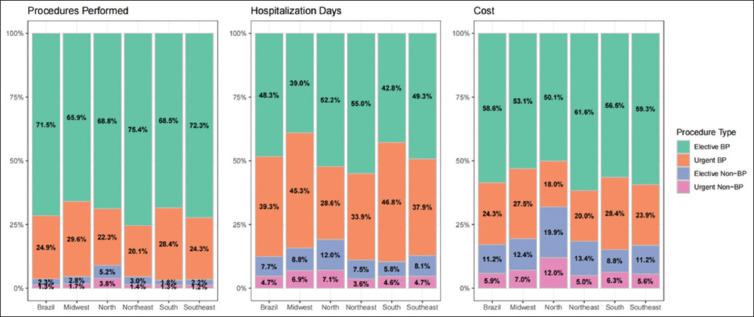
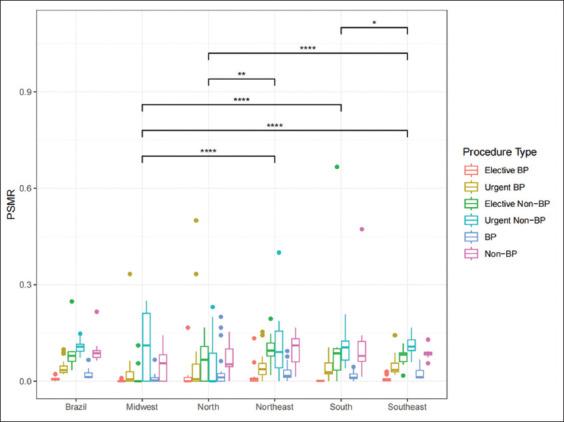
A total of 123,434 BC-related surgical procedures were performed, the majority of which were elective (73.4%) and bladder-preserving (BP, 96.2%). There were 1,710 reported mortalities, with a consistent procedure-specific mortality rate (PSMR) across the 11-year period for all procedures. The average hospitalization duration for elective BP (β = -0.12, < 0.001), elective non-BP (β = -0.46, < 0.001), and urgent non-BP procedures (β = -0.41, = 0.012) steadily decreased. Elective and urgent BPs showed the lowest annual PSMRs (0.66% and 4.25%, respectively), compared to elective and urgent non-BPs (6.93% and 10.72%). The northern and northeastern regions reported significantly fewer cases but higher mortality rates after 2018, despite reduced average hospital stays. While hospital costs for these procedures increased, the standalone costs of surgical interventions remained stable over the 11-year period.
CONCLUSION
BC-related hospital admissions, particularly for BP procedures, have increased, reflecting improved access to healthcare. However, regional disparities in surgical care, mortality rates, and hospital stays persist across Brazil.
背景
膀胱癌(BC)手术程序和住院情况的持续更新对于了解趋势至关重要,尤其是在巴西的公共卫生系统内。监测这些数据对于明智的决策至关重要。
目的
本研究的目的是了解巴西公共卫生系统内膀胱癌手术程序的趋势。
方法
从巴西公共卫生系统数据中心收集数据,重点关注2013年至2023年与膀胱手术相关的住院情况。信息按手术紧急程度、住院时间、费用和死亡率进行分类。
结果
共进行了123,434例与膀胱癌相关的手术,其中大多数为择期手术(73.4%)且保留膀胱(BP,96.2%)。报告了1710例死亡病例,所有手术在11年期间的特定手术死亡率(PSMR)保持一致。择期BP手术(β = -0.12,< 0.001)、择期非BP手术(β = -0.46,< 0.001)和紧急非BP手术(β = -0.41,= 0.012)的平均住院时间稳步下降。与择期和紧急非BP手术(6.93%和10.72%)相比,择期和紧急BP手术的年度PSMR最低(分别为0.66%和4.25%)。北部和东北部地区报告的病例明显较少,但2018年后死亡率较高,尽管平均住院时间有所缩短。虽然这些手术的医院费用增加,但手术干预的独立成本在11年期间保持稳定。
结论
与膀胱癌相关的住院情况,尤其是BP手术的住院情况有所增加,反映了医疗服务可及性的改善。然而,巴西各地在手术治疗、死亡率和住院时间方面的地区差异仍然存在。


 Zotero 插件