
甲状腺结节细针穿刺活检结果为贝塞斯达Ⅲ级或Ⅳ级患者的临床结局——一项回顾性研究
Clinical Outcomes of Patients With Bethesda III or IV Cytology on Fine Needle Aspiration of Thyroid Nodules-A Retrospective Study.
作者信息
Khan Adeel Ahmad, Jasim Noor Khalil Ebrahim, Al-Mannai Najlaa Essa A H, Ata Fateen, Goyal Rajen, Jaber Tania
机构信息
Cleveland Clinic Akron General, Department of Internal Medicine, Akron, Ohio, USA.
Department of Internal Medicine, Hamad Medical Corporation, Doha, Qatar.
出版信息
Endocrinol Diabetes Metab. 2025 Sep;8(5):e70076. doi: 10.1002/edm2.70076.
INTRODUCTION
The appropriate management strategy for patients with thyroid nodules and indeterminate cytology on fine needle aspiration (FNA) remains unclear, especially in centres where molecular testing is not available. In this retrospective study, we aimed to identify factors predicting the risk of malignancy in these patients.
MATERIALS AND METHODS
This retrospective study included consecutive patients with thyroid nodules with Bethesda III/IV cytology who underwent surgical management at Hamad Medical Corporation, Qatar, between 01/01/2015 and 30/08/2023. Patients who did not undergo surgical management were excluded. We performed univariate and multivariate logistic regression analysis to assess the factors predicting the risk of malignancy in this population.
RESULTS
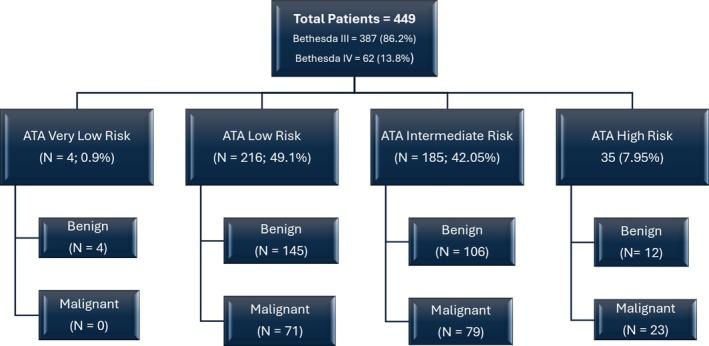
Of 449 patients included in the study, the majority were females (72.2%). The mean (SD) age was 43.7 ± 10.7 years. Arab was the most common ethnicity (56.6%), followed by South-Asian (18.9%) and South-East Asian (17.8%). Sonographic features of thyroid nodules were classified as ATA very low in 0.9%, low-risk in 49.1%, intermediate-risk in 42.05% and high-risk in 7.95%. 86.2% had Bethesda III cytology and 13.8% had Bethesda IV cytology. Histopathology of thyroidectomy specimens confirmed malignancy in 179 (39.9%) patients. The malignancy rate in Bethesda III was 37.9%, while in Bethesda IV it was 51.6%. In multivariate logistic regression analysis, ATA intermediate (OR of 1.57 (1.03-2.4); p = 0.03) and high risk (OR of 3.92 (1.81-8.48); p = 0.001) sonographic patterns were predictive of malignancy.
CONCLUSION
In patients with indeterminate thyroid nodule cytology and in the absence of molecular markers, the ATA sonographic pattern of thyroid nodules can guide decision- making for surgical management vs. surveillance.
引言
对于甲状腺结节且细针穿刺(FNA)细胞学检查结果不确定的患者,合适的管理策略仍不明确,尤其是在无法进行分子检测的中心。在这项回顾性研究中,我们旨在确定预测这些患者恶性风险的因素。
材料与方法
这项回顾性研究纳入了2015年1月1日至2023年8月30日期间在卡塔尔哈马德医疗公司接受手术治疗的连续甲状腺结节且Bethesda III/IV级细胞学检查结果的患者。未接受手术治疗的患者被排除。我们进行了单因素和多因素逻辑回归分析,以评估预测该人群恶性风险的因素。
结果
在纳入研究的449例患者中,大多数为女性(72.2%)。平均(标准差)年龄为43.7±10.7岁。阿拉伯人是最常见的种族(56.6%),其次是南亚人(18.9%)和东南亚人(17.8%)。甲状腺结节的超声特征被分类为美国放射学会(ATA)极低风险的占0.9%,低风险的占49.1%,中等风险的占42.05%,高风险的占7.95%。86.2%的患者为Bethesda III级细胞学检查结果,13.8%的患者为Bethesda IV级细胞学检查结果。甲状腺切除标本的组织病理学证实179例(39.9%)患者为恶性。Bethesda III级的恶性率为37.9%,而Bethesda IV级为51.6%。在多因素逻辑回归分析中,ATA中等风险(比值比为1.57(1.03 - 2.4);p = 0.03)和高风险(比值比为3.92(1.81 - 8.48);p = 0.001)的超声模式可预测恶性。
结论
对于甲状腺结节细胞学检查结果不确定且缺乏分子标志物的患者,甲状腺结节的ATA超声模式可指导手术管理与监测的决策。
 Zotero 插件