
不可切除胰腺癌患者的微创技术与阿片类药物:一项随机对照试验的系统评价和荟萃分析
Minimally invasive techniques versus opioids in patients with unresectable pancreatic cancer: a systematic review and meta-analysis of randomised controlled trials.
作者信息
Rezuș Ioana-Irina, Rancz Anett, Creangă-Murariu Ioana, Ibude Oghosa Clinton, Obeidat Mahmoud, Papp Renáta, Veres Dániel Sándor, Tamba Bogdan-Ionel, Teutsch Brigitta, Hegyi Péter
机构信息
Centre for Translational Medicine, Semmelweis University, Budapest, Hungary.
Department of Radiology, "Grigore T. Popa" University of Medicine and Pharmacy, Iași, Romania.
出版信息
Transl Gastroenterol Hepatol. 2025 Jul 9;10:45. doi: 10.21037/tgh-24-141. eCollection 2025.
BACKGROUND
Pancreatic cancer (PC) has a low chance of resection, and a consistent burden of disease, with pain greatly impacting the quality of life (QoL). We aim to find the most efficient method to treat pain in patients with unresectable PC.
METHODS
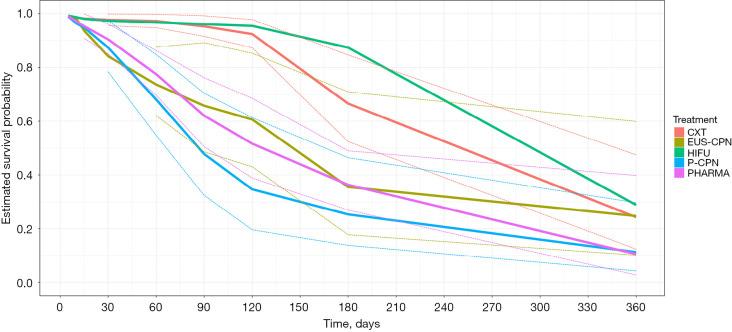
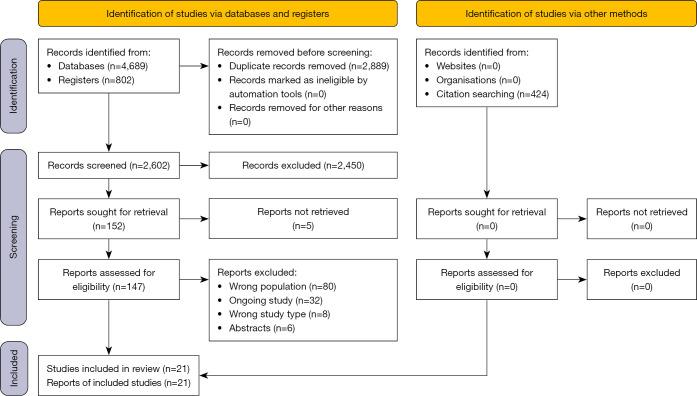
Our study was registered on PROSPERO (CRD42023477094). On the 29 of October 2023, a systematic search was performed, including only randomised controlled trials (RCTs) reporting on patients with unresectable PC-associated pain, QoL, survival, analgesics use, and adverse events (AEs). Different random-effects meta-analyses were performed on the Visual Analog Scale (VAS) and AEs. Survival curves of treatments were estimated based on individual patients' data from the reported Kaplan-Meier curves.
RESULTS
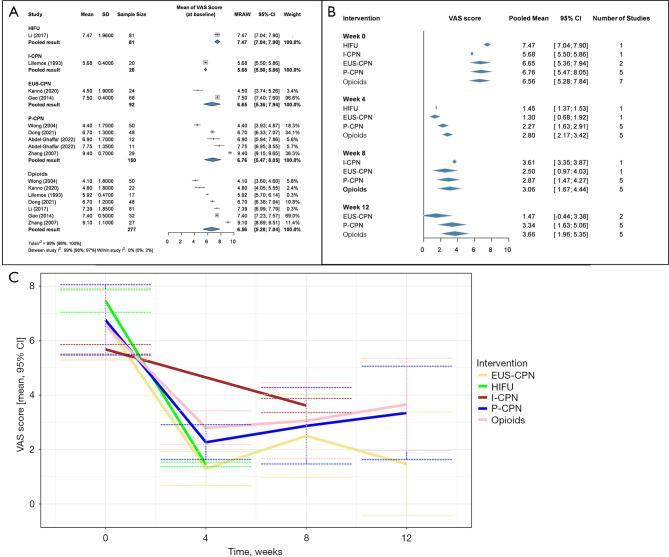
Twenty-one RCTs were eligible. At 4 weeks from a moderate to severe baseline pain level, the VAS score decreased to 2.27 [95% confidence interval (CI): 1.63-2.91] with percutaneous celiac plexus neurolysis (P-CPN), and 2.80 (95% CI: 2.17-3.42) with opioids, while in individual studies to 1.30 (95% CI: 0.68-1.92) with endoscopic ultrasound-guided celiac plexus neurolysis (EUS-CPN), and 1.45 (95% CI: 1.37-1.53) with high-intensity focused ultrasound (HIFU). At 8 and 12 weeks, there was an increase in pain scores for all treatment groups. AEs associated with interventional techniques were transient, the most common being diarrhoea, haemodynamic changes, and procedure-related pain. The median survival time in days was 126.22 (95% CI: 87.21-165.31) for opioids and 86.71 (95% CI: 62.45-136.88) for P-CPN.
CONCLUSIONS
Interventional techniques reduce pain and opioid use with few adverse effects; they should be considered more often and earlier in the management of patients with unresectable PC.
背景
胰腺癌(PC)的可切除机会低,疾病负担持续存在,疼痛对生活质量(QoL)有很大影响。我们旨在找到治疗不可切除胰腺癌患者疼痛的最有效方法。
方法
我们的研究已在PROSPERO(CRD42023477094)上注册。2023年10月29日进行了系统检索,仅纳入报告不可切除PC相关疼痛、生活质量、生存率、镇痛药使用及不良事件(AE)的随机对照试验(RCT)。对视觉模拟量表(VAS)和不良事件进行了不同的随机效应荟萃分析。根据报告的Kaplan-Meier曲线中的个体患者数据估计治疗的生存曲线。
结果
21项RCT符合条件。从中度至重度基线疼痛水平开始4周时,经皮腹腔神经丛神经溶解术(P-CPN)使VAS评分降至2.27[95%置信区间(CI):1.63-2.91],阿片类药物使其降至2.80(95%CI:2.17-3.42),而在个别研究中,内镜超声引导下腹腔神经丛神经溶解术(EUS-CPN)使其降至1.30(95%CI:0.68-1.92),高强度聚焦超声(HIFU)使其降至1.45(95%CI:1.37-1.53)。在8周和12周时,所有治疗组的疼痛评分均有所增加。与介入技术相关的不良事件是短暂的,最常见的是腹泻、血流动力学变化和与操作相关的疼痛。阿片类药物的中位生存天数为126.22(95%CI:87.21-165.31),P-CPN为86.71(95%CI:62.45-136.88)。
结论
介入技术可减轻疼痛并减少阿片类药物使用,且不良反应少;在不可切除PC患者的管理中应更频繁、更早地考虑使用。
 Zotero 插件