
多模态治疗对糖尿病足病患者康复管理的有效性,以提高临床疗效及血液流变学状态
The Effectivity MultiModality Treatment on Rehabilitation Management of Diabetic Foot Disease Patients for Improvement of Clinical Efficacy & Hemorheological Status.
作者信息
Li Shuo, Liu Yan, Chen Yu
机构信息
Department of Endocrinology, Jinan Third People's Hospital, Jinan, Shandong, 250132, People's Republic of China.
Cardiovascular Department, Jinan Hospital of Traditional Chinese Medicine, Jinan, Shandong, People's Republic of China.
出版信息
Diabetes Metab Syndr Obes. 2025 Jul 29;18:2561-2571. doi: 10.2147/DMSO.S526919. eCollection 2025.
OBJECTIVE
To evaluate the effectiveness of a multimodal intervention-comprising rehabilitation management and foot preventive measures-on clinical outcomes, hemorheological parameters, and vascular endothelial function in patients with diabetic foot (DF).
METHODS
This retrospective study included 126 patients admitted to our hospital from February 2023 to April 2024. Patients were divided into a control group (n = 63, receiving routine nursing care) and an intervention group (n = 63, receiving routine care plus rehabilitation management combined with foot preventive measures). Key outcome measures included: (1) clinical efficacy; (2) hemorheological indicators-whole blood low-shear viscosity (WBLSV), high-shear viscosity (WBHSV), fibrinogen (FIB), and erythrocyte deformability index (EDI); (3) vascular endothelial function indicators-endothelin (ET), basic fibroblast growth factor (bFGF), vascular endothelial growth factor (VEGF), and calcitonin gene-related peptide (CGRP); (4) self-management ability-Adult Health Self-Management Scale (AHSMSRS), General Self-Efficacy Scale (GSES); and (5) nursing satisfaction-Newcastle Nursing Service Satisfaction Scale (NSNS).
RESULTS
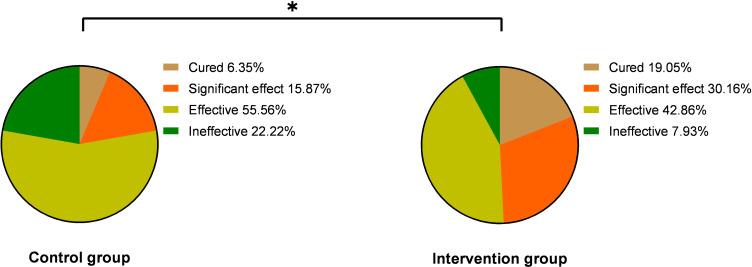
The intervention group had a significantly higher total treatment efficacy rate (92.06% vs 77.78%, P < 0.05). Post-intervention hemorheological parameters (WBLSV, WBHSV, FIB, EDI) and endothelial markers (ET, bFGF, VEGF, CGRP) showed greater improvement in the intervention group (P < 0.05). Similarly, AHSMSRS scores declined and GSES scores improved more markedly in the intervention group (P < 0.05). Nursing satisfaction was also higher (96.83% vs 71.43%, P < 0.05).
CONCLUSION
Compared with routine nursing care alone, the multimodal intervention strategy may improve clinical efficacy, hemorheology, endothelial function, self-management capabilities, and patient satisfaction in diabetic foot care. However, these findings should be interpreted with caution given the retrospective design.
目的
评估包括康复管理和足部预防措施在内的多模式干预对糖尿病足(DF)患者临床结局、血液流变学参数和血管内皮功能的有效性。
方法
这项回顾性研究纳入了2023年2月至2024年4月在我院住院的126例患者。患者被分为对照组(n = 63,接受常规护理)和干预组(n = 63,接受常规护理加康复管理并结合足部预防措施)。主要结局指标包括:(1)临床疗效;(2)血液流变学指标——全血低切粘度(WBLSV)、高切粘度(WBHSV)、纤维蛋白原(FIB)和红细胞变形性指数(EDI);(3)血管内皮功能指标——内皮素(ET)、碱性成纤维细胞生长因子(bFGF)、血管内皮生长因子(VEGF)和降钙素基因相关肽(CGRP);(4)自我管理能力——成人健康自我管理量表(AHSMSRS)、一般自我效能感量表(GSES);(5)护理满意度——纽卡斯尔护理服务满意度量表(NSNS)。
结果
干预组的总治疗有效率显著更高(92.06% 对77.78%,P < 0.05)。干预后,干预组的血液流变学参数(WBLSV、WBHSV、FIB、EDI)和内皮标志物(ET、bFGF、VEGF、CGRP)改善更明显(P < 0.05)。同样,干预组的AHSMSRS评分下降,GSES评分改善更显著(P < 0.05)。护理满意度也更高(96.83% 对71.43%,P < 0.05)。
结论
与单纯常规护理相比,多模式干预策略可能改善糖尿病足护理中的临床疗效、血液流变学、内皮功能、自我管理能力和患者满意度。然而,鉴于本研究的回顾性设计,这些结果应谨慎解读。


 Zotero 插件