
黄芪甲苷IV:胃癌的潜在克星。
Astragaloside IV: a potential nemesis for gastric cancer.
作者信息
Hu Chao, Li Qiong, Gong Song-Nan, Zou Xiao-Jie, Xu Jia-Yue, Ying Hai-Feng, Zheng Lan
机构信息
Department of Traditional Chinese Medicine, Loujiang New City Hospital of Taicang (Taicang Branch of Ruijin Hospital Affiliated with Shanghai Jiao Tong University School of Medicine), Suzhou, China.
Department of Hepatology, Yueyang Hospital of Integrated Traditional Chinese and Westen Medicine, Shanghai University of Traditional Chinese Medicine, Shanghai, China.
出版信息
Front Pharmacol. 2025 Jul 18;16:1636341. doi: 10.3389/fphar.2025.1636341. eCollection 2025.
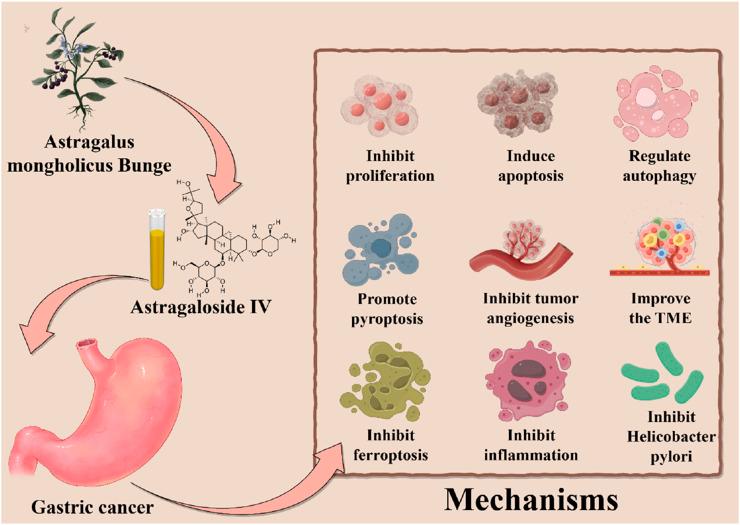
Gastric cancer (GC), a life-threatening malignancy with profound global health impacts, remains a cardinal focus of biomedical research. Recently, astragaloside IV (AS-IV), a bioactive triterpenoid saponin derived from , has garnered substantial attention for its multifaceted anticancer properties in preclinical investigations. This review systematically synthesizes current evidence on the molecular mechanisms underlying AS-IV's inhibitory effects against GC, encompassing programmed cell death pathways (apoptosis, autophagy, pyroptosis, ferroptosis), tumor angiogenesis, tumor microenvironment modulation, and inflammatory signaling networks. Many studies demonstrate that AS-IV can inhibit the development of GC through multi-target and multi-pathway mechanisms, making it a well-deserved nemesis of GC. Notably, although AS-IV has emerged as a potential candidate for GC therapy, it suffers from problems such as single research model, unclear toxic and side effects, and poor bioavailability. These seriously hinder the efficiency of AS-IV in the treatment of GC. In the future, we can design and implement a series of and experiments to further explore and clarify the mechanism of action of AS-IV in the treatment of GC. It is encouraged to carry out a number of high-quality clinical controlled studies to further prove the effectiveness and safety of AS-IV. In addition, we can also use emerging technologies (such as nanotechnology) to improve the bioavailability of AS-IV, bringing more hope to GC patients.
胃癌(GC)是一种对全球健康有深远影响的危及生命的恶性肿瘤,仍然是生物医学研究的主要焦点。最近,黄芪甲苷IV(AS-IV),一种从[来源未提及]中提取的具有生物活性的三萜皂苷,因其在临床前研究中具有多方面的抗癌特性而备受关注。本综述系统地综合了关于AS-IV对GC抑制作用的分子机制的现有证据,包括程序性细胞死亡途径(凋亡、自噬、焦亡、铁死亡)、肿瘤血管生成、肿瘤微环境调节和炎症信号网络。许多研究表明,AS-IV可以通过多靶点、多途径机制抑制GC的发展,使其成为GC当之无愧的克星。值得注意的是,尽管AS-IV已成为GC治疗的潜在候选药物,但它存在单一研究模型、毒副作用不明确和生物利用度差等问题。这些严重阻碍了AS-IV在GC治疗中的效率。未来,我们可以设计并开展一系列[具体实验未提及]和[具体实验未提及]实验,以进一步探索和阐明AS-IV在GC治疗中的作用机制。鼓励开展多项高质量的临床对照研究,以进一步证明AS-IV的有效性和安全性。此外,我们还可以利用新兴技术(如纳米技术)来提高AS-IV的生物利用度,为GC患者带来更多希望。


 Zotero 插件