
视网膜发育需要在视杆光感受器命运决定上游进行活跃的DNA去甲基化。
Active DNA demethylation upstream of rod-photoreceptor fate determination is required for retinal development.
作者信息
Hernández-Núñez Ismael, Urman Alaina, Zhang Xiaodong, Jacobs William, Hoffmann Christy, Harding Ellen G, Chen Shiming, Dawlaty Meelad M, Ruzycki Philip A, Edwards John R, Clark Brian S
机构信息
John F. Hardesty, MD Department of Ophthalmology and Visual Sciences, Washington University School of Medicine, St. Louis, Missouri, United States of America.
Division of Oncology, Department of Medicine, Washington University School of Medicine, St. Louis, Missouri, United States of America.
出版信息
PLoS Biol. 2025 Aug 4;23(8):e3003332. doi: 10.1371/journal.pbio.3003332. eCollection 2025 Aug.
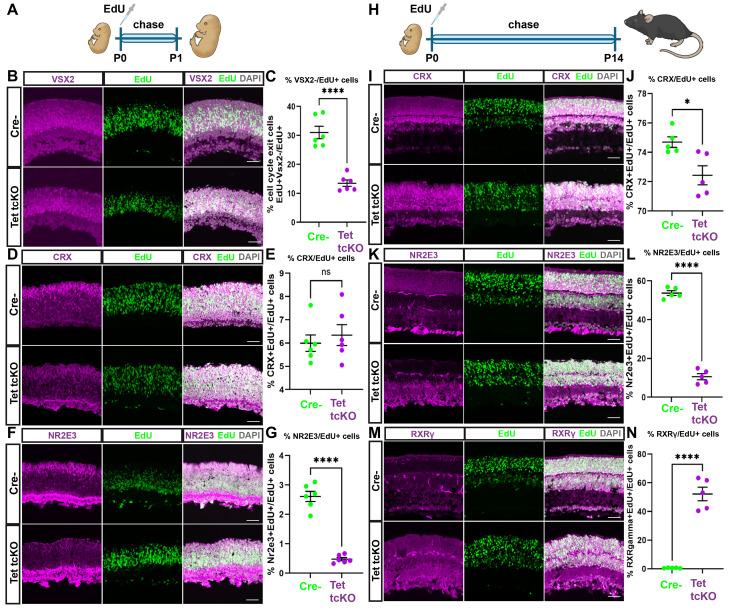
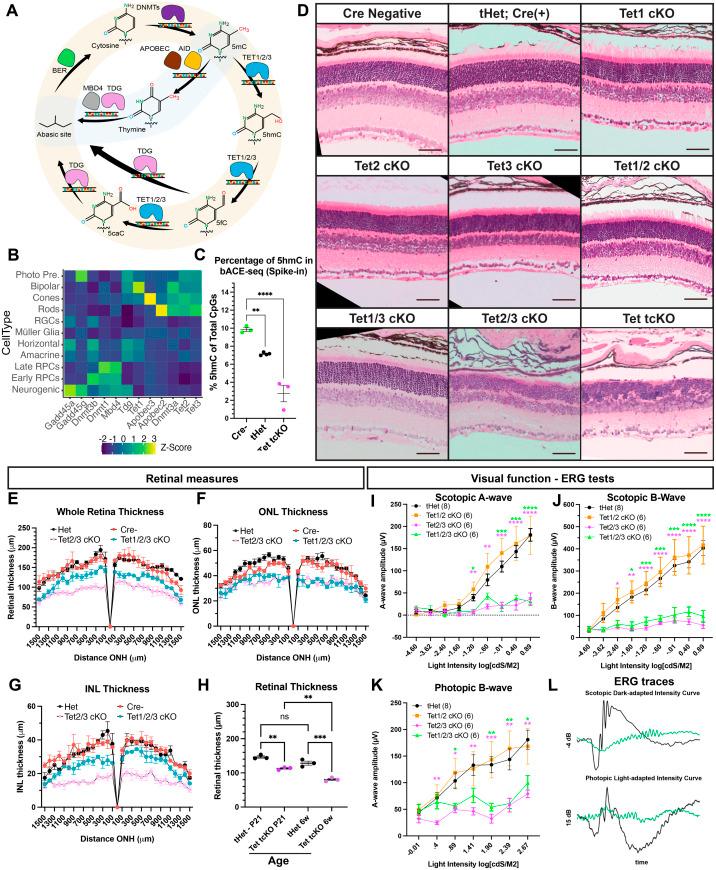
Retinal cell fate specification from multipotent retinal progenitors is governed by dynamic changes in chromatin structure and gene expression. Methylation at cytosines in DNA (5mC) is actively regulated for proper control of gene expression and chromatin architecture. Numerous genes display active DNA demethylation across retinal development; a process that requires oxidation of 5mC to 5-hydroxymethylcytosine (5hmC) and is controlled by the ten-eleven translocation (TET) methylcytosine dioxygenase enzymes. Using an allelic series of conditional TET enzyme mutants in mice, we determine that DNA demethylation is required upstream of NRL and NR2E3 expression for the establishment of rod-photoreceptor fate. Using histological, behavioral, transcriptomic, and base-pair resolution DNA methylation analyses, we establish that inhibition of active DNA demethylation results in global changes in gene expression and methylation patterns that prevent photoreceptor precursors from adopting a rod-photoreceptor fate, instead producing a retina in which all photoreceptors specify as cones. Our results establish the TET enzymes and DNA demethylation as critical regulators of retinal development and cell fate specification, elucidating a novel mechanism required for the specification of rod-photoreceptors.
多能视网膜祖细胞向视网膜细胞命运的特化受染色质结构和基因表达的动态变化调控。DNA中胞嘧啶甲基化(5mC)受到积极调控,以适当控制基因表达和染色质结构。许多基因在视网膜发育过程中表现出活跃的DNA去甲基化;这一过程需要将5mC氧化为5-羟甲基胞嘧啶(5hmC),并由十一-易位(TET)甲基胞嘧啶双加氧酶控制。利用小鼠中条件性TET酶突变体的等位基因系列,我们确定DNA去甲基化在NRL和NR2E3表达上游是建立视杆光感受器命运所必需的。通过组织学、行为学、转录组学和碱基对分辨率的DNA甲基化分析,我们确定抑制活跃的DNA去甲基化会导致基因表达和甲基化模式的全局变化,从而阻止光感受器前体形成视杆光感受器命运,而是产生一个所有光感受器都特化为视锥细胞的视网膜。我们的结果确定了TET酶和DNA去甲基化是视网膜发育和细胞命运特化的关键调节因子,阐明了视杆光感受器特化所需的一种新机制。

 Zotero 插件