
橙皮素与四氢姜黄素联合给药通过抑制CYP1A1酶增强对乳腺癌的细胞毒性:从药代动力学相互作用的角度来看。
Co-administration of nobiletin and tetrahydrocurcumin enhanced the cytotoxicity to breast cancer through inhibiting CYP1A1 enzyme: from the perspective of pharmacokinetic interactions.
作者信息
Song Hongming, Gao Fengqin, Niu Zhaohe, Liu Xiangping, Wang Xingang, Cao Weihong, Wang Haibo
机构信息
Breast Disease Center, The Affiliated Hospital of Qingdao University, No 59 Haier Rd, Qingdao, 266000, Shandong, China.
Department of Oncology Center 3, Qingdao Hiser Hospital Affiliated of Qingdao University (Qingdao Traditional Chinese Medicine Hospital), Qingdao, Shandong, China.
出版信息
Discov Oncol. 2025 Aug 4;16(1):1465. doi: 10.1007/s12672-025-03229-0.
BACKGROUND & OBJECTIVES: The introduction of traditional Chinese medicine to the treatment of breast cancer increases the risk of adverse herb-herb interactions. Both nobiletin and tetrahydrocurcumin (THC) have been demonstrated to inhibit breast cancer progression, which makes them easily co-prescribed. This study evaluated the co-administration of nobiletin and THC, aiming to assess their synergistic effect in inhibiting breast cancer and reveal the potential mechanism.
MATERIALS & METHODS: A single dosage of nobiletin and its co-administration with THC were performed in rats. The pharmacokinetic profiling of nobiletin was analyzed under the two administration strategies. Rat liver microsomes were employed for evaluating the metabolic stability of nobiletin and the activity of CYP1A1 with the probe-substance assay. The cytotoxicity of nobiletin and its combination with THC was evaluated in MCF-7 cells with the help of the CCK8 assay.
RESULTS
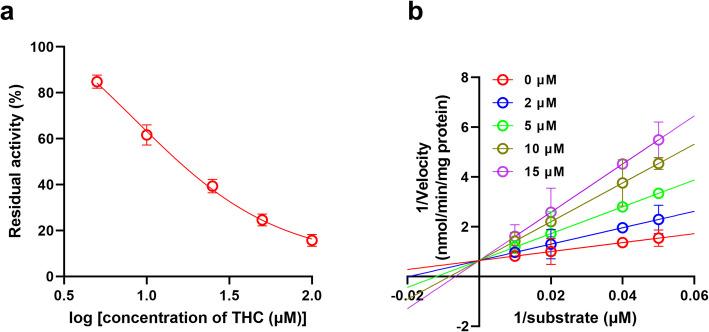
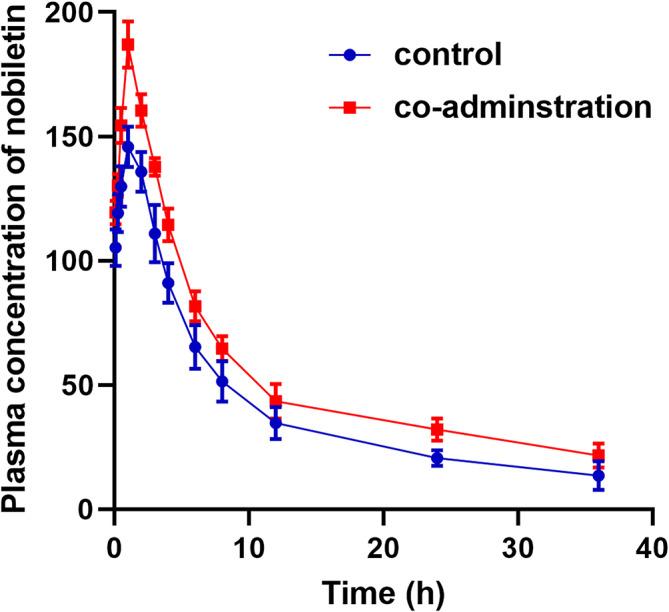
Co-administration strategy significantly changed the pharmacokinetics of nobiletin with the increasing Cmax (187.00 ± 9.27 vs. 145.87 ± 8.16 mg/L), prolonging t (22.01 ± 5.46 vs. 12.16 ± 1.20 h), and decreasing clearance rate (0.039 ± 0.01 vs. 0.062 ± 0.01 L/h/kg). THC increased the metabolic stability of nobiletin and enhanced its inhibitory effect on breast cancer cell growth. Additionally, THC also improved the cytotoxicity of nobiletin to MCF-7 cells, with the IC value decreased from 27.38 to 6.52 µM. Significant inhibition of CYP1A1 was observed under the treatment of THC.
CONCLUSION
Co-administration of nobiletin with THC increased its systemic exposure and enhanced its cytotoxicity to breast cancer. The inhibited activity of CYP1A1 was considered the underlying mechanism of their interaction.
背景与目的
将中药引入乳腺癌治疗会增加不良药物相互作用的风险。橙皮素和四氢姜黄素(THC)均已被证明可抑制乳腺癌进展,这使得它们容易被联合处方。本研究评估了橙皮素与THC的联合使用,旨在评估它们在抑制乳腺癌方面的协同作用,并揭示潜在机制。
材料与方法
在大鼠中进行了单次剂量的橙皮素及其与THC的联合给药。分析了两种给药策略下橙皮素的药代动力学特征。使用大鼠肝微粒体通过探针物质测定法评估橙皮素的代谢稳定性和CYP1A1的活性。借助CCK8测定法评估橙皮素及其与THC组合对MCF-7细胞的细胞毒性。
结果
联合给药策略显著改变了橙皮素的药代动力学,Cmax增加(187.00±9.27对145.87±8.16mg/L),t延长(22.01±5.46对12.16±1.20h),清除率降低(0.039±0.01对0.062±0.01L/h/kg)。THC增加了橙皮素的代谢稳定性并增强了其对乳腺癌细胞生长的抑制作用。此外,THC还提高了橙皮素对MCF-7细胞的细胞毒性,IC值从27.38降至6.52μM。在THC处理下观察到CYP1A1受到显著抑制。
结论
橙皮素与THC联合给药增加了其全身暴露并增强了其对乳腺癌的细胞毒性。CYP1A1活性的抑制被认为是它们相互作用的潜在机制。

 Zotero 插件