
不同类型舞蹈干预对情绪低落大学生自主神经系统的影响。
The effects of different types of dance interventions on the autonomic nervous system of college students with depressed mood.
作者信息
Zhao Ruixue, Li Jiayi, Wang Jiameng
机构信息
Lu Xun Art College, Yan'an University, Yan'an City, Shanxi, China.
Faculty of Physical Education, Yan'an University, Yan'an City, Shanxi, China.
出版信息
Front Psychol. 2025 Jul 21;16:1625090. doi: 10.3389/fpsyg.2025.1625090. eCollection 2025.
PURPOSE
This study aims to compare the regulatory effects of different dance styles (such as modern dance, Chinese classical dance, jazz dance, and ballet) on depressive mood, with a particular focus on their impact on the autonomic nervous system function (e.g., HRV indicators). The goal is to identify the most therapeutically promising form of dance intervention and provide more effective supplementary approaches for individuals experiencing depressive mood.
METHODS
This study involved screening 1,500 university students for Depressive mood out of a total of 10,784 students at the university (Anonymize) ( > 0.05). From the 1,500 individuals identified with depressive mood, 150 were randomly selected for the intervention. These participants were then randomly assigned to five groups: group A (classical dance), group B (ballet), group C (jazz dance), group D (modern dance), and group E (control group). The intervention consisted of dance practice four times weekly for 20 min per session over 12 weeks. Baseline demographic data, including age, gender, height, weight, and Body Mass Index (BMI), were collected, and participants completed the Self-Rating Depression Scale (SDS) test before the intervention began. Data organization was performed using Excel, and SPSS 22.0 was used for analysis.
RESULTS
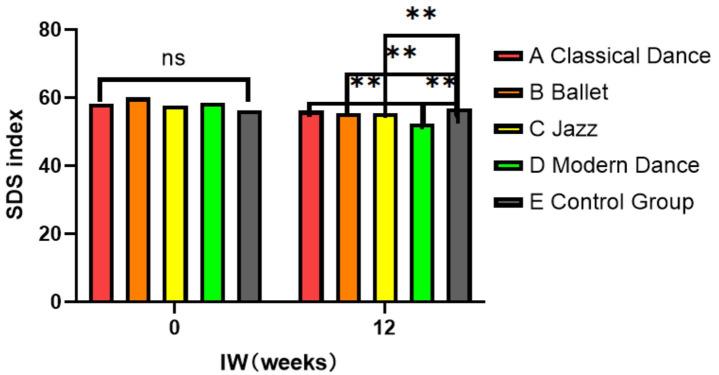
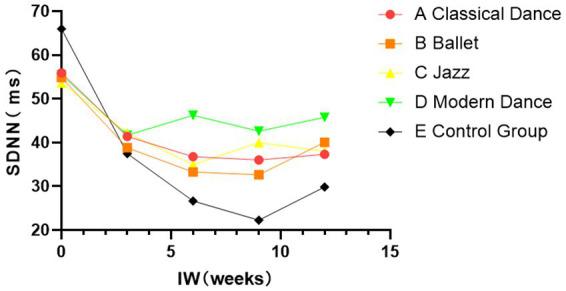
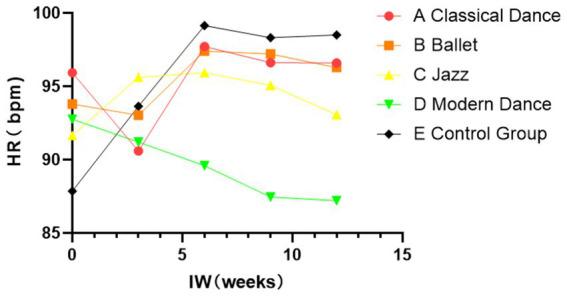
Before the intervention, Heart Rate Variability (HRV) indicators showed no significant differences between groups ( > 0.05). However, during the recovery period, heart rate (HR) was notably higher after modern dance than after the other dance forms. The HRV index was significantly higher than those in the ballet and classical dance groups ( < 0.05). The modern dance group also showed a significant reduction in the SDS index compared to the classical, ballet, and jazz dance groups ( < 0.05).
CONCLUSION
Modern dance may, therefore, be more effective in promoting recovery for individuals with depressive mood than Chinese classical, ballet, or jazz dance.
目的
本研究旨在比较不同舞蹈风格(如现代舞、中国古典舞、爵士舞和芭蕾舞)对抑郁情绪的调节作用,特别关注其对自主神经系统功能(如心率变异性指标)的影响。目标是确定最具治疗前景的舞蹈干预形式,并为抑郁情绪患者提供更有效的辅助方法。
方法
本研究从该大学总共10784名学生中筛选出1500名有抑郁情绪的大学生(匿名)(P>0.05)。从这1500名被确定有抑郁情绪的个体中,随机选择150名进行干预。这些参与者随后被随机分为五组:A组(古典舞)、B组(芭蕾舞)、C组(爵士舞)、D组(现代舞)和E组(对照组)。干预包括每周进行四次舞蹈练习,每次20分钟,共持续12周。收集了包括年龄、性别、身高、体重和体重指数(BMI)在内的基线人口统计学数据,参与者在干预开始前完成了自评抑郁量表(SDS)测试。使用Excel进行数据整理,并使用SPSS 22.0进行分析。
结果
干预前,心率变异性(HRV)指标在各组之间无显著差异(P>0.05)。然而,在恢复期,现代舞后的心率(HR)明显高于其他舞蹈形式后的心率。HRV指数显著高于芭蕾舞和古典舞组(P<0.05)。与古典舞、芭蕾舞和爵士舞组相比,现代舞组的SDS指数也显著降低(P<0.05)。
结论
因此,对于抑郁情绪患者,现代舞可能比中国古典舞、芭蕾舞或爵士舞更有效地促进康复。

 Zotero 插件