
咖啡因调节三阴性乳腺癌细胞中的细胞死亡和端粒酶活性。
Caffeine Modulates Cell Death and Telomerase Activity in Triple-negative Breast Cancer Cells.
作者信息
Amira Qanita Hana, Irdianto Shadira Anindieta, Fadilah Fadilah, Lestari Retno, Fadhillah Fadhillah, Bowolaksono Anom, Dwiranti Astari
机构信息
Department of Biology, Faculty of Mathematics and Natural Sciences, Universitas Indonesia, Depok Campus, Depok, 16424, Indonesia.
Department of Medical Chemistry, Faculty of Medicine, Universitas Indonesia, Jakarta, 10440, Indonesia.
出版信息
Int J Mol Cell Med. 2025 Jul 11;14(2):606-619. doi: 10.22088/IJMCM.BUMS.14.2.606. eCollection 2025.
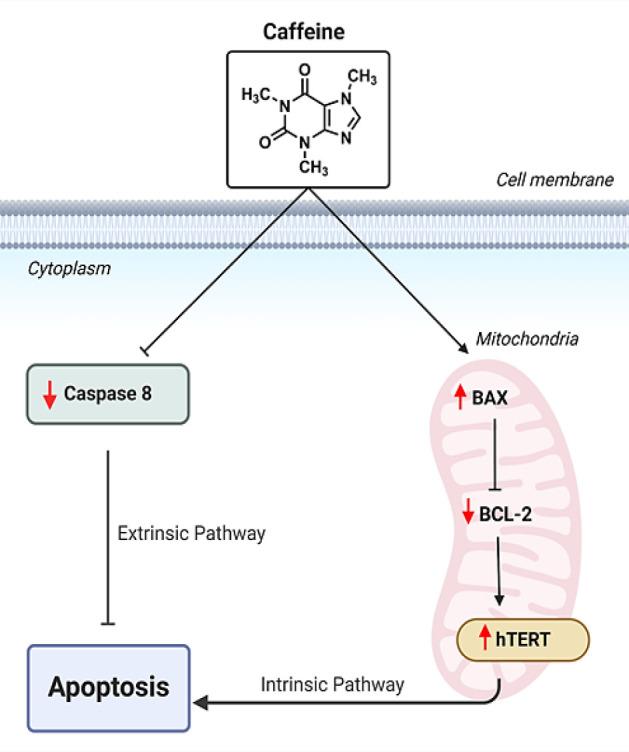
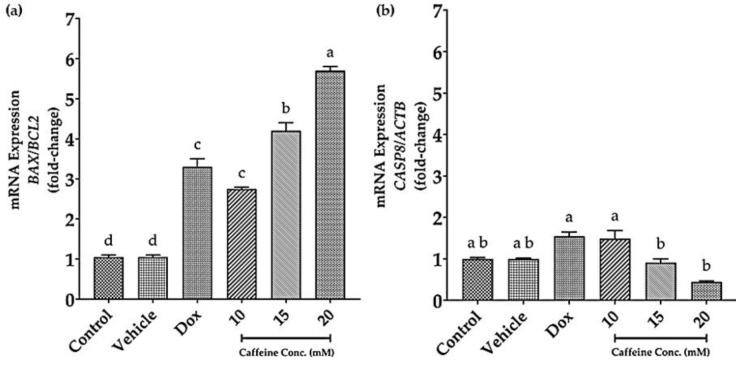
Triple-negative breast cancer (TNBC) is an aggressive subtype defined by the lack of estrogen receptors (ER), progesterone receptors (PR), and HER2 expression, resulting in limited therapeutic options. Given this challenge, this study explores caffeine, a widely consumed stimulant, as a potential anticancer agent, particularly for TNBC. Although caffeine has demonstrated stimulatory and inhibitory effects on telomerase in other cancer types, its influence on telomerase activity in TNBC remains uncharacterized. This study investigates the impact of caffeine concentrations (10, 15, and 20 mM) on cell viability, proliferation, apoptosis, ultrastructure, and the expression of apoptosis-related genes () and telomerase activity () in MDA-MB-231 cells. Our findings showed that caffeine significantly reduces cell viability and induces early apoptosis with a dose-dependent effect. Morphological changes consistent with early apoptosis were observed, and an increased ratio indicated the activation of the intrinsic apoptosis pathway. Additionally, caffeine exhibited upregulation of mRNA expression, which may reflect a compensatory response to cellular stress induced by caffeine. These results underscore the multifaceted effects of caffeine on TNBC cells, highlighting its potential not only as an apoptosis inducer but also as a modulator of telomerase activity. Given its accessibility, low toxicity, and established safety profile, caffeine presents an exciting avenue for further research as a complementary or standalone therapeutic strategy for TNBC.
三阴性乳腺癌(TNBC)是一种侵袭性亚型,其定义为缺乏雌激素受体(ER)、孕激素受体(PR)以及HER2表达,这导致治疗选择有限。鉴于这一挑战,本研究探索了咖啡因这种广泛消费的兴奋剂作为一种潜在的抗癌剂,尤其是对TNBC。尽管咖啡因在其他癌症类型中已显示出对端粒酶的刺激和抑制作用,但其对TNBC中端粒酶活性的影响仍未明确。本研究调查了咖啡因浓度(10、15和20 mM)对MDA-MB-231细胞的细胞活力、增殖、凋亡、超微结构以及凋亡相关基因()和端粒酶活性()表达的影响。我们的研究结果表明,咖啡因显著降低细胞活力并诱导早期凋亡,且具有剂量依赖性效应。观察到与早期凋亡一致的形态学变化,并且升高的 比率表明内源性凋亡途径的激活。此外,咖啡因表现出 mRNA表达上调,这可能反映了对咖啡因诱导的细胞应激的一种补偿反应。这些结果强调了咖啡因对TNBC细胞的多方面影响,突出了其不仅作为凋亡诱导剂而且作为端粒酶活性调节剂的潜力。鉴于其易获取性、低毒性和已确立的安全性,咖啡因作为TNBC的一种辅助或独立治疗策略,为进一步研究提供了一个令人兴奋的途径。



 Zotero 插件