
mRNA加强疫苗接种后抗体动力学建模及针对SARS-CoV-2感染的保护持续时间
Modeling Antibody Kinetics Post-mRNA Booster Vaccination and Protection Durations Against SARS-CoV-2 Infection.
作者信息
Ponce Luis J, Wang Yuqian, Singh Ananya, Chua Hoong Kai, Chen Marc, Hor Pei Xiang, Loh Chiew Yee, Poh Xuan Ying, Rao Suma, Chia Po Ying, Ong Sean W X, Lee Tau Hong, Lin Ray J H, Lim Clarissa, Teo Jefanie, Goh Yun Shan, Ejima Keisuke
机构信息
Lee Kong Chian School of Medicine, Nanyang Technological University, Singapore, Singapore.
School of Biological Sciences, Nanyang Technological University, Singapore, Singapore.
出版信息
J Med Virol. 2025 Aug;97(8):e70521. doi: 10.1002/jmv.70521.
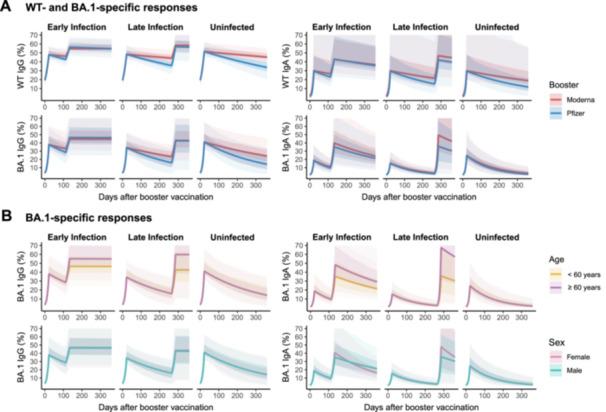
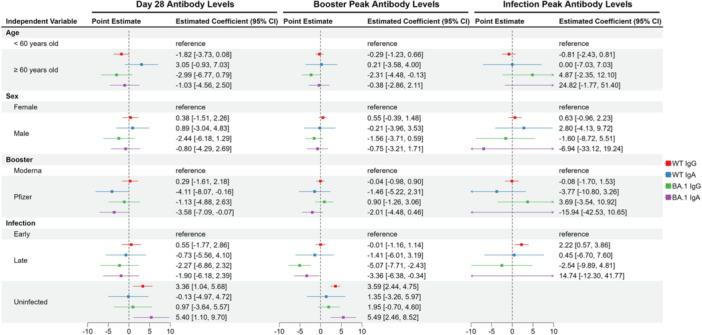
Understanding the dynamics of SARS-CoV-2 antibody levels post-booster vaccination is important to inform their durations of protection. Longitudinal antibody data was collected on the day of booster vaccination, as well as 28, 180, and 360 days after. Using nonlinear mixed effects models, we mapped the kinetics of binding IgA and IgG against wild-type (WT) and Omicron BA.1 spike proteins. Furthermore, we analyzed the association between antibody levels and risk of SARS-CoV-2 vaccine breakthrough infection through survival analyzes, and predicted durations of protection against infection. We found that the antibody response waned more rapidly following the Pfizer/BioNTech BNT162b2 booster compared to the Moderna mRNA-1273 booster. However, individuals boosted with the Pfizer vaccine exhibited a steeper rebound in antibody levels after infection. Faster postinfection antibody growth rates were observed in the elderly, females, and those with late infections. High antibody levels for WT IgG and BA.1 IgA at day 28 post-booster were associated with reduced infection risk; hazard ratios were 0.47 (95% CI [0.22, 0.98]) and 0.36 (95% CI [0.17, 0.78]), respectively, compared to low levels. Time-varying antibody levels showed better survival model fits. At medium COVID-19 case incidence (621 cases per million per day), a binding BA.1 IgA response of at least 20% is needed to sustain 80% protection against infection over 155 days post-booster. Our estimates of protection durations against SARS-CoV-2 infection post-booster vaccination may help inform the ideal frequency of boosters.
了解加强疫苗接种后SARS-CoV-2抗体水平的动态变化对于明确其保护持续时间至关重要。在加强疫苗接种当天以及之后的第28、180和360天收集了纵向抗体数据。我们使用非线性混合效应模型绘制了针对野生型(WT)和奥密克戎BA.1刺突蛋白的结合型IgA和IgG的动力学曲线。此外,我们通过生存分析研究了抗体水平与SARS-CoV-2疫苗突破性感染风险之间的关联,并预测了抗感染的保护持续时间。我们发现,与莫德纳mRNA-1273加强疫苗相比,辉瑞/BioNTech BNT162b2加强疫苗接种后抗体反应下降得更快。然而,接种辉瑞疫苗的个体在感染后抗体水平出现了更急剧的反弹。在老年人、女性以及感染较晚的人群中观察到感染后抗体增长速度更快。加强疫苗接种后第28天,WT IgG和BA.1 IgA的高抗体水平与感染风险降低相关;与低水平相比,风险比分别为0.47(95%置信区间[0.22, 0.98])和0.36(95%置信区间[0.17, 0.78])。随时间变化的抗体水平显示出更好的生存模型拟合。在中等COVID-19病例发病率(每天每百万621例)的情况下,需要至少20%的结合型BA.1 IgA反应才能在加强疫苗接种后155天内维持80%的抗感染保护。我们对加强疫苗接种后抗SARS-CoV-2感染保护持续时间的估计可能有助于确定理想的加强疫苗接种频率。



 Zotero 插件