
评估老年人使用电子健康资源的能力:横断面调查研究。
Assessing the Ability to Use eHealth Resources Among Older Adults: Cross-Sectional Survey Study.
作者信息
Aoun Bernard, Ebbert Jon O, Ramar Priya, Roellinger Daniel L, Philpot Lindsey M
机构信息
Division of Community Internal Medicine Geriatrics and Palliative Care, Department of Quantitative Health Sciences, Mayo Clinic, 200 First Street SW, Rochester, MN, 55905, United States.
出版信息
JMIR Form Res. 2025 Aug 6;9:e70672. doi: 10.2196/70672.
BACKGROUND
Increasing reliance on digital health resources can create disparities among older patients. Understanding health-related, mobility, and socioeconomic factors associated with the use of eHealth technologies is important for addressing inequitable access to health care.
OBJECTIVE
We sought to assess digital health literacy among patients aged ≥65 years and identify factors associated with their ability to access, understand, and use digital health resources.
METHODS
We developed a survey instrument grounded in the Technology Acceptance Model and conducted a cross-sectional, mixed-mode survey of patients aged ≥65 years from an integrated, multispecialty medical center. Digital health literacy was measured using the eHeals health literacy scale, and responses were analyzed across self-rated health, self-reported mobility, and socioeconomic deprivation assessed with the Area Deprivation Index (ADI). Counts (n) and frequencies (%) are reported across response groups, and analyses for differences are performed using the χ2 test for independence or the Fisher exact test.
RESULTS
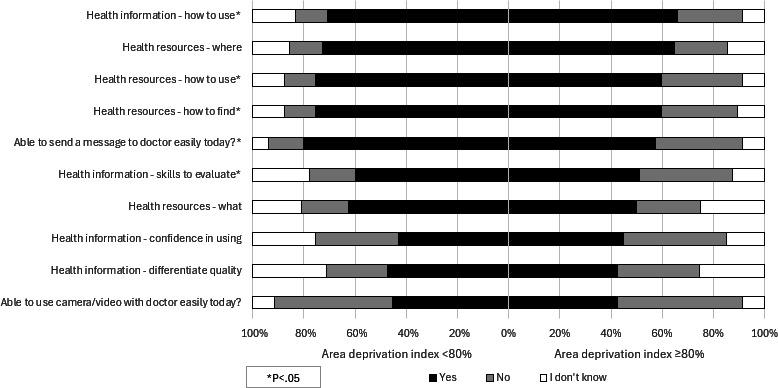
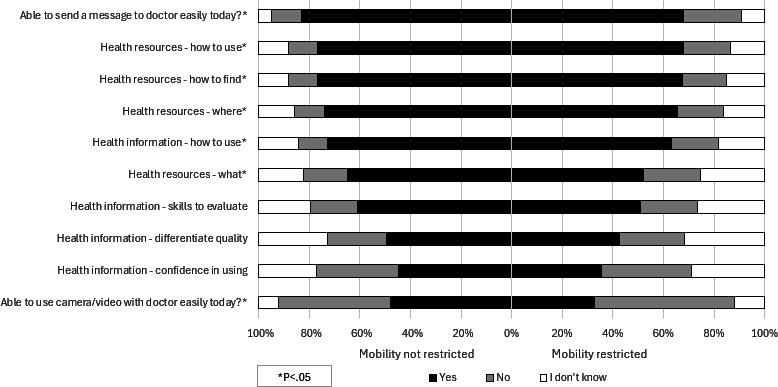
Analyses included 878 responses (response rate=878/2847; 30.8%). There was a significant difference in the distribution of race between responders and nonresponders (P<.001) but no significant differences were observed by age (P=.053) or gender (P=.73). Respondents with lower self-rated health had lower levels of digital health literacy; only 54.2% (n=13/25) participants with poor self-rated health were able to send a message to their doctor compared to 89.5% (n=68/77) of patients with excellent self-rated health. All comparisons across the digital health literacy domains revealed significant differences across self-rated health groups (P<.05). Respondents with mobility restrictions had lower levels of digital health literacy, including lower frequencies of reporting knowledge of what health resources are available on the internet (mobility restricted, n=92/182; 52.0% vs no mobility restriction, n=433/688; 64.7%), knowledge of how to find health resources on the internet (mobility restricted, n=120/182; 67.4% vs no mobility restriction, n=513/688; 76.8%), and ability to use a camera or video with a doctor easily (mobility restricted, n=58/182; 32.6% vs no mobility restriction, n=321/688; 48.0%). Older adults experiencing increased socioeconomic deprivation, as measured by the ADI, reported lower rates of digital health literacy across most categories, including knowledge of how to find health resources on the internet (high ADI, n=28/49; 59.6% vs low ADI, n=551/751; 75.5%) and the ability to send an electronic message to their doctor easily (high ADI, n=27/49; 57.4% vs low ADI, n=584/751; 80.2%).
CONCLUSIONS
Our findings highlight the need for targeted interventions to improve engagement with eHealth among patients aged ≥65 years, who are impacted by poor health, limited mobility, and socioeconomic deprivation. Enhancing digital health literacy can help bridge the gap in access to digital health resources and improve overall health outcomes for this population.
背景
对数字健康资源的日益依赖可能在老年患者中造成差异。了解与电子健康技术使用相关的健康、行动能力和社会经济因素对于解决医疗保健获取不平等问题至关重要。
目的
我们试图评估65岁及以上患者的数字健康素养,并确定与其获取、理解和使用数字健康资源能力相关的因素。
方法
我们基于技术接受模型开发了一项调查问卷,并对一家综合多专科医疗中心的65岁及以上患者进行了横断面混合模式调查。使用电子健康素养量表测量数字健康素养,并根据自我评估健康状况、自我报告的行动能力以及用地区剥夺指数(ADI)评估的社会经济剥夺情况对回答进行分析。各反应组报告计数(n)和频率(%),使用独立性χ²检验或Fisher精确检验进行差异分析。
结果
分析纳入878份回答(回应率=878/2847;30.8%)。回应者和未回应者之间的种族分布存在显著差异(P<.001),但年龄(P=.053)或性别(P=.73)方面未观察到显著差异。自我评估健康状况较差的受访者数字健康素养水平较低;自我评估健康状况差的参与者中只有54.2%(n=13/25)能够给医生发送信息,而自我评估健康状况极佳的患者中这一比例为89.5%(n=68/77)。数字健康素养各领域的所有比较均显示自我评估健康组之间存在显著差异(P<.05)。行动受限的受访者数字健康素养水平较低,包括报告了解互联网上有哪些健康资源的频率较低(行动受限,n=92/182;52.0% 对比无行动受限,n=433/688;64.7%)、了解如何在互联网上查找健康资源的情况(行动受限,n=120/182;67.4% 对比无行动受限,n=513/688;76.8%)以及轻松与医生使用摄像头或视频的能力(行动受限,n=58/182;32.6% 对比无行动受限,n=321/688;48.0%)。根据ADI衡量,经历社会经济剥夺增加的老年人在大多数类别中报告的数字健康素养率较低,包括了解如何在互联网上查找健康资源的情况(高ADI,n=28/49;59.6% 对比低ADI,n=551/751;75.5%)以及轻松给医生发送电子信息的能力(高ADI,n=27/49;57.4% 对比低ADI,n=584/751;80.2%)。
结论
我们的研究结果强调需要有针对性的干预措施,以提高65岁及以上受健康状况差、行动能力有限和社会经济剥夺影响的患者对电子健康的参与度。提高数字健康素养有助于缩小获取数字健康资源的差距,并改善该人群的整体健康结果。

 Zotero 插件