
睡眠模式不佳可能会增加美国成年人腹主动脉钙化的患病率:来自美国国家健康与营养检查调查(2013 - 2014年)的数据。
Poor Sleep Pattern Might Increase the Prevalence of Abdominal Aortic Calcification in US Adults: Data from the NHANES (2013-2014).
作者信息
Chen Yunqing, Xu Shiyong, Duan Mingxia, Shen Liang
机构信息
Department of Infectious Diseases, Affiliated Hospital of Jiaxing University, Jiaxing, Zhejiang, People's Republic of China.
Department of Cardiology, Affiliated Hospital of Jiaxing University, Jiaxing, Zhejiang, People's Republic of China.
出版信息
Vasc Health Risk Manag. 2025 Jul 31;21:571-579. doi: 10.2147/VHRM.S532476. eCollection 2025.
BACKGROUND
Abdominal aortic calcification (AAC) is a reliable predictor of cardiovascular events. Sleep is an essential component of cardiovascular health. This study aimed to assess the association between sleep patterns (including sleep duration, trouble sleeping, and sleep disorders) and the risk of AAC.
METHODS
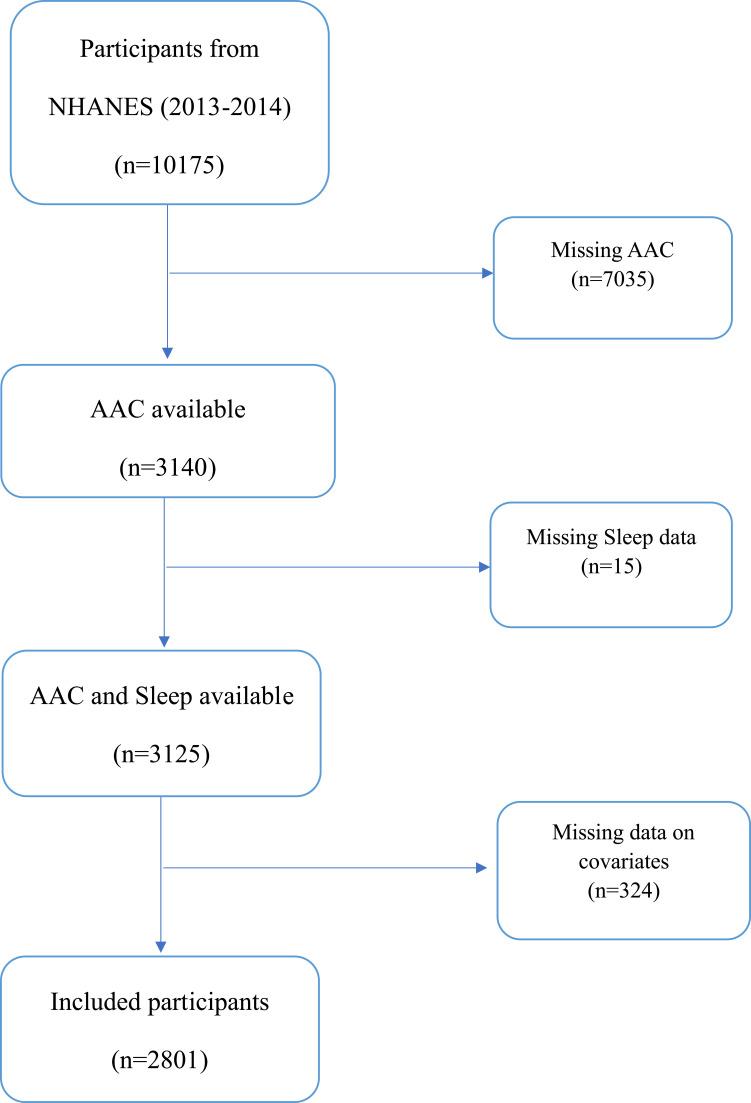
A total of 2801 participants from the 2013 to 2014 National Health and Nutrition Examination Survey (NHANES) 2013-2014 cycle were included in the study. AAC score was assessed using the Kauppila scoring system. Sleep patterns were defined according to the overall sleep score, which was calculated based on the sleep duration, self-reported trouble sleeping, and sleep disorders. Weighted multivariable linear regression models were used to analyze the association between sleep patterns and AAC.
RESULTS
AAC prevalence was higher in older age groups, smokers, those with hypertension or diabetes, and those with less physical activity, lower eGFR, or higher levels of total 25-hydroxyvitamin D, serum uric acid, and serum calcium. Compared with the healthy sleep pattern group, participants in the poor sleep pattern group had a higher prevalence of AAC (odds ratio [OR] = 1.664, 95% CI: 1.286-2.152) and a higher prevalence of severe AAC (OR = 2.179, 95% CI: 1.539-3.087). After adjusting for potential confounders, the poor sleep pattern group remained significantly associated with a higher risk of AAC (OR = 1.657, 95% CI: 1.235-2.222) and severe AAC (OR = 2.374, 95% CI: 1.616-3.488).
CONCLUSION
Sleep patterns were related to the risk of AAC in middle-aged and elderly populations. Poor sleep patterns may increase AAC prevalence.
背景
腹主动脉钙化(AAC)是心血管事件的可靠预测指标。睡眠是心血管健康的重要组成部分。本研究旨在评估睡眠模式(包括睡眠时间、睡眠困难和睡眠障碍)与AAC风险之间的关联。
方法
本研究纳入了2013 - 2014年国家健康与营养检查调查(NHANES)2013 - 2014周期的2801名参与者。使用考皮拉评分系统评估AAC评分。睡眠模式根据总体睡眠评分定义,该评分基于睡眠时间、自我报告的睡眠困难和睡眠障碍计算得出。采用加权多变量线性回归模型分析睡眠模式与AAC之间的关联。
结果
AAC患病率在老年人群、吸烟者、患有高血压或糖尿病者、体力活动较少者、估算肾小球滤过率(eGFR)较低者或25 - 羟基维生素D、血清尿酸和血清钙水平较高者中更高。与健康睡眠模式组相比,睡眠模式较差组的AAC患病率更高(优势比[OR]=1.664,95%置信区间:1.286 - 2.152),重度AAC患病率更高(OR = 2.179,95%置信区间:1.539 - 3.087)。在调整潜在混杂因素后,睡眠模式较差组仍与更高的AAC风险(OR = 1.657,95%置信区间:1.235 - 2.222)和重度AAC风险(OR = 2.374,95%置信区间:1.616 - 3.488)显著相关。
结论
睡眠模式与中老年人群的AAC风险相关。不良的睡眠模式可能会增加AAC患病率。
 Zotero 插件