
基底节区脑出血患者术后肺部感染危险因素的深入分析及预测模型构建:基于国内外前沿临床研究与大数据分析
In-depth analysis of risk factors for postoperative pulmonary infection in patients with basal ganglia haemorrhage and construction of prediction model: based on domestic and international cutting-edge clinical research and big data analysis.
作者信息
Chen Min, Da Longbiao, Huang Chun, Liu Jie, Tang Jian, Zha Zhengjiang
机构信息
Department of Neurosurgery, East Campus of Anqing Municipal Hospital, Anqing, China.
出版信息
Front Med (Lausanne). 2025 Jul 23;12:1627298. doi: 10.3389/fmed.2025.1627298. eCollection 2025.
BACKGROUND
Basal ganglia haemorrhage is a common and serious cerebrovascular disease with a high rate of disability and mortality. Postoperative patients often face many complications, among which pulmonary infection is particularly prominent. Lung infections not only significantly prolong patients' hospital stay and increase healthcare costs, but also greatly affect the prognostic regression of patients, and may even lead to a rapid deterioration of the condition, which is one of the most important causes of death in patients with basal ganglia haemorrhage.
OBJECTIVE
To investigate the high-risk factors for the development of postoperative pulmonary infections in patients with basal ganglia haemorrhage and to develop a predictive model.
METHODS
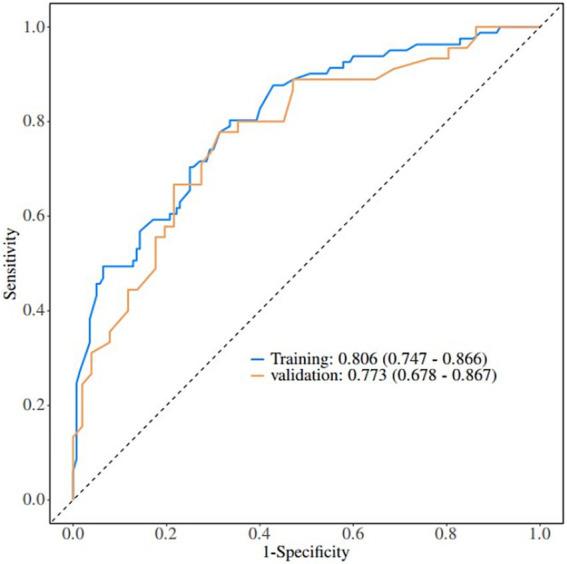
A total of 317 patients were collected in this study, of which 126 patients developed postoperative lung infections; the patients enrolled in this study were randomly divided into a training set and a validation set according to the ratio of 7:3, of which 221 were in the training set and 96 were in the validation set. Past medical history, smoking and alcohol consumption, and relevant information during hospitalisation were collected separately to study the correlation factors affecting the emergence of postoperative lung infection in patients, and to establish a prediction model.
RESULTS
The potentially relevant factors were included in a one-way logistic regression and after analysing the results, a history of smoking, duration of ventilator use, preoperative tracheal intubation, preoperative vomiting, and preoperative GCS (Glasgow Coma Scale) scores were identified as potential risk factors for the development of postoperative pulmonary infections in patients with basal ganglia haemorrhage, < 0.2; The data obtained were further included in a multifactorial review, and smoking history, duration of ventilator use, preoperative tracheal intubation, preoperative vomiting, and preoperative GCS scores were independent risk factors for the development of postoperative pulmonary infections in patients with basal ganglia haemorrhage, < 0.05.
CONCLUSION
The prediction model derived from this study provides a powerful tool for clinicians to identify patients at high risk of postoperative lung infection at an early stage.
背景
基底节区脑出血是一种常见且严重的脑血管疾病,致残率和死亡率很高。术后患者常面临多种并发症,其中肺部感染尤为突出。肺部感染不仅会显著延长患者住院时间、增加医疗费用,还会极大影响患者的预后转归,甚至可能导致病情迅速恶化,是基底节区脑出血患者最重要的死亡原因之一。
目的
探讨基底节区脑出血患者术后肺部感染发生的高危因素并建立预测模型。
方法
本研究共纳入317例患者,其中126例发生术后肺部感染;将本研究纳入的患者按照7:3的比例随机分为训练集和验证集,其中训练集221例,验证集96例。分别收集患者既往病史、吸烟饮酒情况及住院期间相关信息,研究影响患者术后肺部感染发生的相关因素,并建立预测模型。
结果
将可能的相关因素纳入单因素逻辑回归,分析结果后发现,吸烟史、呼吸机使用时长、术前气管插管、术前呕吐及术前格拉斯哥昏迷量表(GCS)评分是基底节区脑出血患者术后肺部感染发生的潜在危险因素,<0.2;将所得数据进一步纳入多因素分析,吸烟史、呼吸机使用时长、术前气管插管、术前呕吐及术前GCS评分是基底节区脑出血患者术后肺部感染发生的独立危险因素,<0.05。
结论
本研究得出的预测模型为临床医生早期识别术后肺部感染高危患者提供了有力工具。


 Zotero 插件