
综述:菌根共生及相关土壤微生物群落在生态恢复中的作用
Review: roles of mycorrhizal symbioses and associated soil microbiomes in ecological restoration.
作者信息
Lethielleux-Juge Christine
机构信息
Irrigation NORCO Inc., Québec, QC, Canada.
出版信息
Front Microbiol. 2025 Jul 23;16:1456041. doi: 10.3389/fmicb.2025.1456041. eCollection 2025.
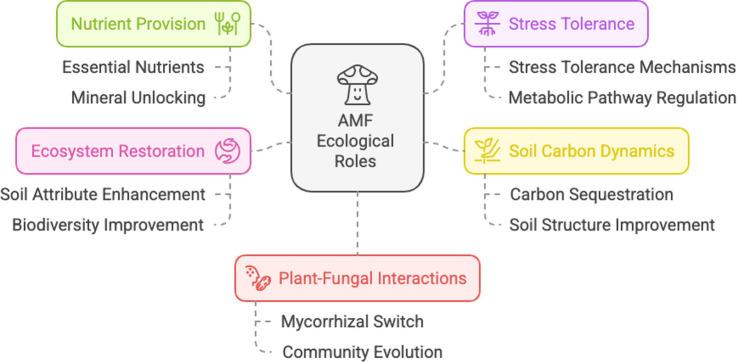
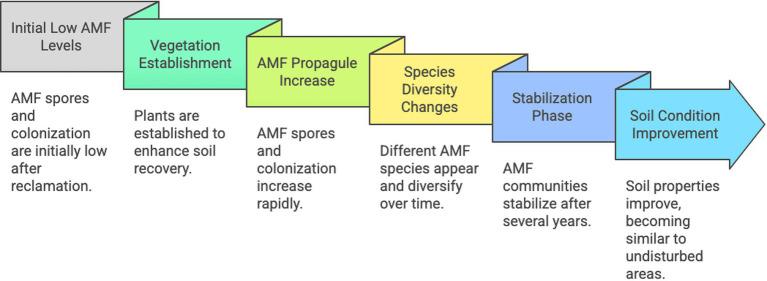
The ecological roles of Arbuscular Mycorrhizal Fungi (AMF) are diverse, providing essential nutrients to host plants, tolerance to stress, and regulation of metabolic pathways, greatly involved in soil C dynamics, unlocking minerals and promoting reactive Fe minerals. Although spores dispersal modes are still not clearly understood, a strong positive relationship exists between intra-and extraradical mycelium at the ecosystem level. AMF are essential in ecosystem restoration by improving soil attributes, above and belowground biodiversity, seedlings survival, growth, and establishment on stressed soils, driving plant succession and preventing plant invasion. AMF inoculants from native and early seral instead of exotics and late seral, consortia instead of few or single species, are more efficient. Plant and AMF communities evolve together after revegetation, fine fescues are among the most resilient species, especially , whose fungal strategies have been recently finely studied. Distinct AMF communities are associated with functionally different plants, which are related to differences in P and C transportomes and genetic variations within the AMF symbiont. Ligneous species react differently to forest soil inoculations according to their arbuscular mycorrhizal symbiosis (AM) or ectomycorrhizal symbiosis (EM) status, and in dual-mycorrhizal plants, costs and benefits are context-dependent, with mycorrhizal switch occurring under various abiotic or biotic factors and resource availability. In mine restoration, root colonization is generally very low during the first year post-reclamation, then increases rapidly before stabilizing. Parallel to plant successions, increased soil parameters, and decreased contaminants, AMF diversity increased and changed, affiliated genera with small spores being completed by or larger spores under southern climates. A similar recovery period was observed for fungal communities in forest restoration, where ectomycorrhizal mycorrhizal fungi (EMF) species dominate, and diversity increased with time post-revegetation, influenced by edaphic variables and tree species. Under heavy metal (HM) contamination, microorganism classes, enzymes, and AMF efficiency vary with time, soil parameters, restoration treatments, plant species, and levels of soil contamination, with Proteobacteria and Actinobacteria being often predominant. Dual applications of specific microbial and AMF species induced synergistic effects on plant growth and soil resilience. Under other contaminants, several AMF and microbial consortia proved to favorize plant growth and nutrient availability and decrease soil toxicity. New quality indicators to compare rehabilitation studies are proposed.
丛枝菌根真菌(AMF)具有多种生态作用,为宿主植物提供必需养分、增强其抗逆性并调节代谢途径,在土壤碳动态、矿物释放和活性铁矿物促进方面发挥着重要作用。尽管孢子传播方式仍未完全明确,但在生态系统层面,根内和根外菌丝之间存在着显著的正相关关系。AMF对于生态系统恢复至关重要,它可以改善土壤特性、增加地上和地下生物多样性、提高幼苗在胁迫土壤中的存活率、促进其生长和定植,推动植物演替并防止植物入侵。使用来自原生和早期演替阶段而非外来和晚期演替阶段的AMF接种剂,以及使用共生体而非少数或单一物种的接种剂,效率更高。植被恢复后,植物和AMF群落共同进化,细羊茅是最具恢复力的物种之一,尤其是其真菌策略最近得到了深入研究。不同的AMF群落与功能不同的植物相关联,这与AMF共生体中磷和碳转运体的差异以及遗传变异有关。木本物种根据其丛枝菌根共生(AM)或外生菌根共生(EM)状态对森林土壤接种的反应不同,在双重菌根植物中,成本和收益取决于具体情况,菌根转换会在各种非生物或生物因素以及资源可用性的影响下发生。在矿山恢复中,开垦后第一年根系定殖率通常很低,随后迅速增加,然后趋于稳定。与植物演替、土壤参数增加和污染物减少并行,AMF多样性增加并发生变化,在南方气候下,小孢子附属属被大孢子属或属取代。在森林恢复中,外生菌根真菌(EMF)物种占主导地位的真菌群落也观察到了类似的恢复期,其多样性随着植被恢复时间的推移而增加,受土壤变量和树种的影响。在重金属(HM)污染下,微生物类别、酶和AMF效率会随时间、土壤参数、恢复处理、植物物种和土壤污染水平而变化,变形菌门和放线菌门通常占主导地位。特定微生物和AMF物种的双重应用对植物生长和土壤恢复力产生协同效应。在其他污染物条件下,几种AMF和微生物共生体被证明有利于植物生长和养分有效性,并降低土壤毒性。本文还提出了用于比较恢复研究的新质量指标。

 Zotero 插件