
基于接种剂提高大豆抗旱性:巴西多地点试验的农艺性能和遥感分析
-based inoculants enhance drought resilience in soybean: agronomic performance and remote sensing analysis from multi-location trials in Brazil.
作者信息
Vasconcelos Julio Cezar Souza, Arantes Caio Simplicio, Gomes Eliane Aparecida, de Oliveira-Paiva Christiane Abreu, de Sousa Sylvia Morais, Speranza Eduardo Antonio, Antunes João Francisco Gonçalves, Lana Ubiraci Gomes de Paula, Cançado Geraldo Magela de Almeida
机构信息
Fundação de Apoio à Pesquisa e ao Desenvolvimento (FAPED), Campinas, São Paulo, Brazil.
Embrapa Maize and Sorghum, Sete Lagoas, Minas Gerais, Brazil.
出版信息
Front Plant Sci. 2025 Jul 23;16:1630127. doi: 10.3389/fpls.2025.1630127. eCollection 2025.
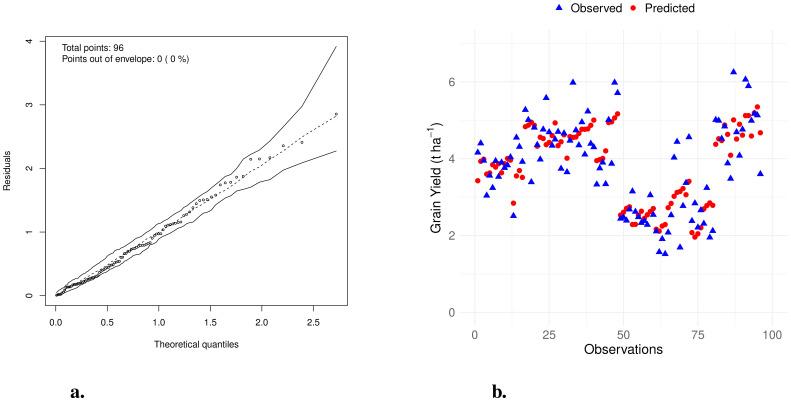
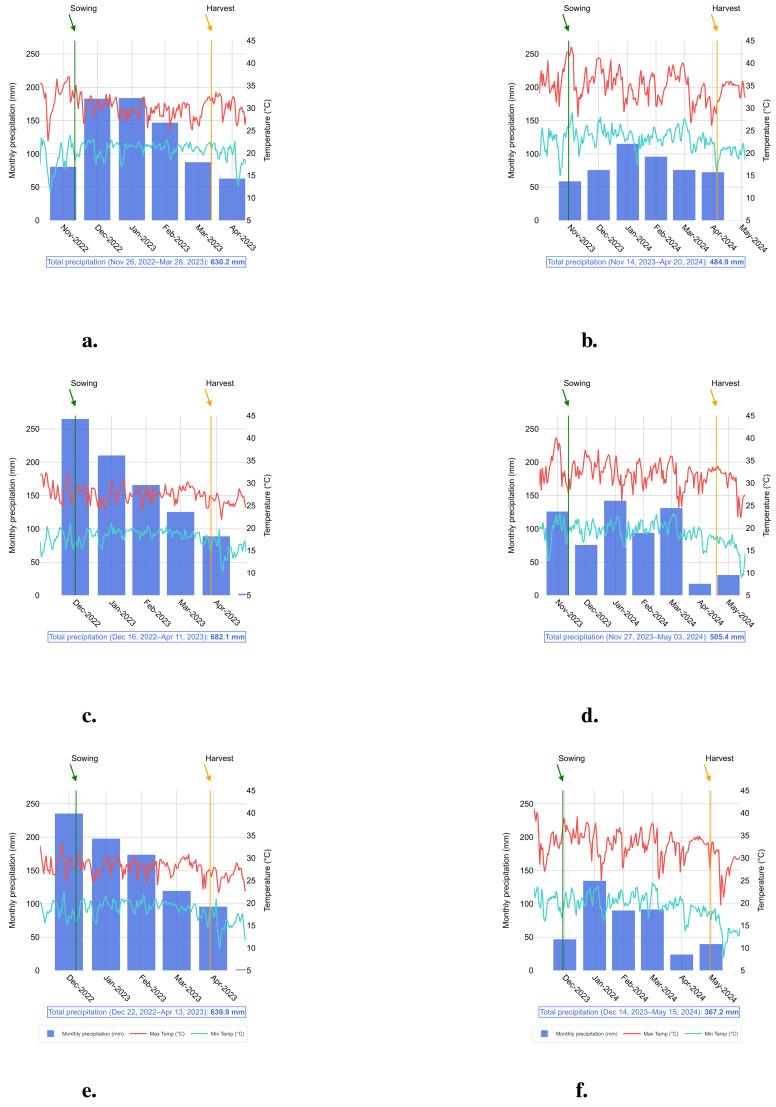
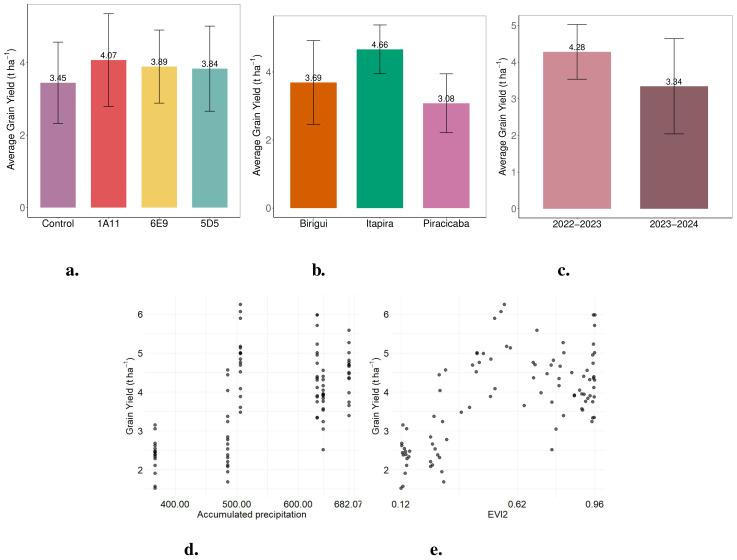
Climate change exacerbates drought stress, posing challenges to global soybean grain yield. This study assesses the effectiveness of microbial inoculants derived from two (strains 5D5, 6E9) and one (strain 1A11), which were previously selected in vitro to promote growth and enhance drought resilience in soybeans ( [L.] Merr.), and evaluated through agronomic metrics and remote sensing. A greenhouse experiment was conducted to evaluate the performance of these inoculants under both irrigated and drought conditions. The inoculants were applied at the dose-range of 1, 2, 3 and 4 mL Kg-1 of seed to identify the optimal dose. The greenhouse results indicated that for many tested doses, the three bacterial strains significantly increased shoot fresh weight, shoot dry weight, and root dry weight compared to control treatments. Multi-location field-trials in Brazil (Birigui, Itapira and Piracicaba) were conducted during the growing seasons of 2022-2023 and 2023-2024, using 3 mL Kg-1 of seed as a reference dose. These field-trials revealed yield improvements of 11.3 to 18% for inoculated treatments, with 1A11 achieving the highest grain yield of 620 Kg ha-1 over the control. However, all three microbial inoculants significantly enhanced soybean development and grain yield relative to non-inoculated controls. Vegetation indices, particularly the Enhanced Vegetation Index 2 (EVI2), derived from PlanetScope satellite and Unmanned Aerial Vehicle (UAV) imagery, demonstrated a high overlap between field data and model predictions, confirming the value of remote sensing as a predictive tool. Climatic variability significantly impacted the yield in field-trials, with 2022-2023 (4.28 t ha-1 outperforming 2023-2024 (3.34 t ha-1) due to higher temperatures (>40 °C) and lower rainfall in the last season. Meanwhile, locations with balanced precipitation, like Itapira, showed superior grain yield. Statistical modeling confirmed inoculant efficacy and EVI2's utility in production measurement. This study emphasizes that microbial inoculants can serve as sustainable strategies to mitigate the impacts of drought. By integrating -based bioinoculants into soybean cultivation and utilizing both agronomic and remote sensing metrics for validation, we can enhance resilience and ultimately support food security amid climate variability.
气候变化加剧了干旱胁迫,给全球大豆产量带来挑战。本研究评估了从两种(菌株5D5、6E9)和一种(菌株1A11)中提取的微生物接种剂的有效性,这些接种剂先前在体外被筛选出来以促进大豆([L.] Merr.)生长并增强其抗旱能力,并通过农艺指标和遥感进行评估。进行了一项温室试验,以评估这些接种剂在灌溉和干旱条件下的性能。接种剂以1、2、3和4 mL Kg-1种子的剂量范围施用,以确定最佳剂量。温室试验结果表明,在许多测试剂量下,与对照处理相比,这三种细菌菌株显著增加了地上部鲜重、地上部干重和根部干重。在巴西的多个地点(比里吉、伊塔皮拉和皮拉西卡巴)于2022 - 2023年和2023 - 2024年生长季节进行了多点田间试验,以3 mL Kg-1种子作为参考剂量。这些田间试验显示接种处理的产量提高了11.3%至18%,其中菌株1A11相对于对照实现了最高产量620 Kg ha-1。然而,相对于未接种的对照,所有三种微生物接种剂均显著促进了大豆生长和提高了产量。从PlanetScope卫星和无人机(UAV)图像得出的植被指数,特别是增强植被指数2(EVI2),表明田间数据与模型预测之间有高度重叠,证实了遥感作为一种预测工具的价值。气候变异性对田间试验产量有显著影响,2022 - 2023年(4.28 t ha-1)由于上一季温度较高(>40°C)和降雨量较低而优于2023 - 2024年(3.34 t ha-1)。同时,降水均衡的地点,如伊塔皮拉,表现出更高的谷物产量。统计建模证实了接种剂的功效以及EVI2在产量测量中的效用。本研究强调微生物接种剂可作为减轻干旱影响的可持续策略。通过将基于 的生物接种剂整合到大豆种植中,并利用农艺和遥感指标进行验证,我们可以增强抗逆性,并最终在气候多变的情况下保障粮食安全。
 Zotero 插件