
开发并验证一种机器学习模型,以预测经皮椎间孔镜椎间盘切除术术后持续疼痛的风险。
Develop and validate a machine learning model to predict the risk of persistent pain after percutaneous transforaminal endoscopic discectomy.
作者信息
Yuan Jun, Fu Jun
机构信息
Department of Orthopedics, Wuhan Hospital of Traditional Chinese Medicine, Wuhan, Hubei, China.
Department of Pain, Hubei Maternal and Child Health Hospital Affiliated to Tongji Medical College, Huazhong University of Science and Technology, Wuhan, Hubei, China.
出版信息
Front Surg. 2025 Jul 23;12:1631651. doi: 10.3389/fsurg.2025.1631651. eCollection 2025.
BACKGROUND
Persistent pain is a common complication following percutaneous transforaminal endoscopic discectomy (PTED) for lumbar disc herniation. Identifying associated risk factors and developing a predictive model are crucial for guiding clinical decisions. This study aims to utilize machine learning models to predict persistent pain, identify key influencing factors, and construct a risk model to assess the likelihood of persistent pain.
METHODS
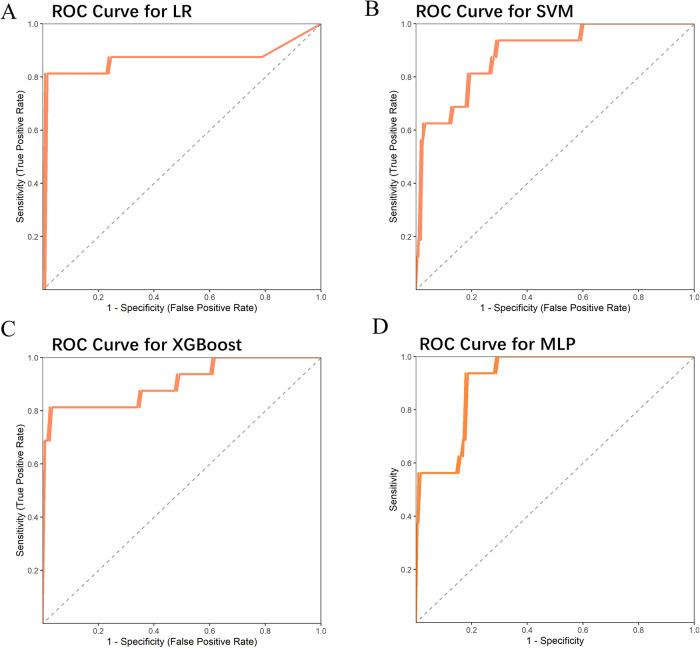
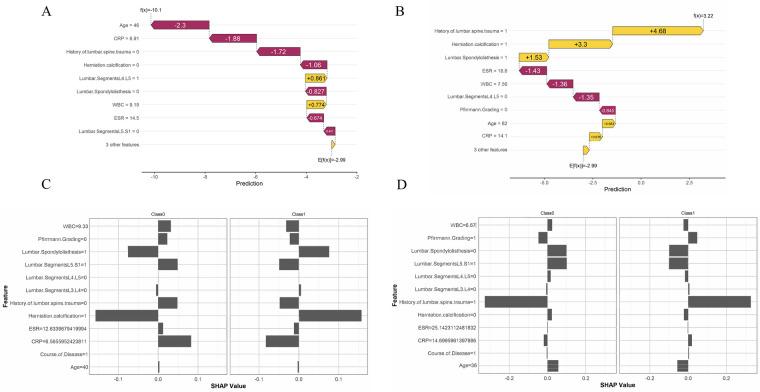
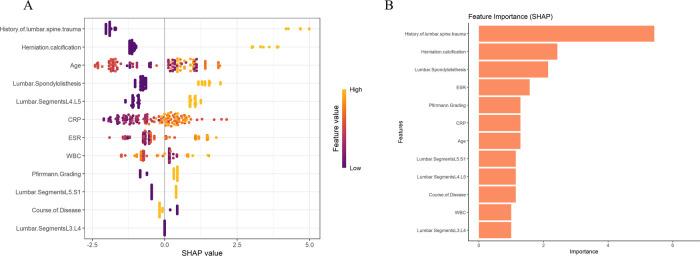
We first compared baseline characteristics and pathological indicators between patients who developed persistent pain and those who did not after PTED. Significant factors were used as input features in four machine learning models: Logistic Regression (LR), Support Vector Machine (SVM), XGBoost, and Multilayer Perceptron (MLP). Each model was optimized through grid search and 10-fold cross-validation. Performance was evaluated using ROC curves, F1 score, accuracy, recall, and precision. Models with AUC values exceeding 0.9, specifically XGBoost and MLP, were selected for SHAP visualization and risk prediction model construction.
RESULTS
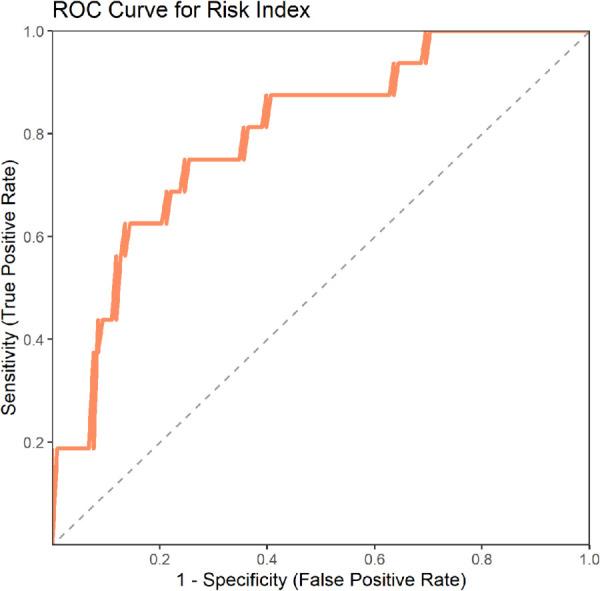
Among the four machine learning models, XGBoost and MLP achieved the best performance, with AUC values of 0.907 and 0.916, respectively. SHAP analysis identified a history of lumbar spine trauma and herniation calcification as key features positively influencing persistent pain risk. Elevated inflammatory markers (e.g., CRP, ESR, and WBC) and older age also significantly impacted predictions. Using the most important features from XGBoost and MLP, a risk prediction model was constructed and externally validated, achieving an AUC of 0.798, indicating good predictive accuracy.
CONCLUSION
History of lumbar spine trauma, herniation calcification, and inflammatory markers are important predictors of persistent pain after PTED. The risk prediction model based on XGBoost and MLP shows high predictive accuracy and can serve as a valuable tool for clinical decision-making.
背景
持续性疼痛是经皮椎间孔镜下椎间盘切除术(PTED)治疗腰椎间盘突出症后的常见并发症。识别相关危险因素并建立预测模型对于指导临床决策至关重要。本研究旨在利用机器学习模型预测持续性疼痛,识别关键影响因素,并构建风险模型以评估持续性疼痛的可能性。
方法
我们首先比较了PTED后出现持续性疼痛的患者与未出现持续性疼痛的患者的基线特征和病理指标。将显著因素用作四种机器学习模型的输入特征:逻辑回归(LR)、支持向量机(SVM)、XGBoost和多层感知器(MLP)。每个模型通过网格搜索和10折交叉验证进行优化。使用ROC曲线、F1分数、准确率、召回率和精确率评估性能。选择AUC值超过0.9的模型,特别是XGBoost和MLP,进行SHAP可视化和风险预测模型构建。
结果
在四种机器学习模型中,XGBoost和MLP表现最佳,AUC值分别为0.907和0.916。SHAP分析确定腰椎创伤史和椎间盘突出钙化是对持续性疼痛风险有正向影响的关键特征。炎症标志物(如CRP、ESR和WBC)升高和年龄较大也对预测有显著影响。利用XGBoost和MLP中最重要的特征构建了风险预测模型并进行外部验证,AUC为0.798,表明具有良好的预测准确性。
结论
腰椎创伤史、椎间盘突出钙化和炎症标志物是PTED后持续性疼痛的重要预测因素。基于XGBoost和MLP的风险预测模型显示出较高的预测准确性,可作为临床决策的有价值工具。
 Zotero 插件