
心脏骤停后的液体平衡:对预后有何影响?来自MIMIC IV数据库的见解。
Fluid balance after cardiac arrest: Any impact on outcome? Insights from the MIMIC IV database.
作者信息
Didier Juliette, Murris Juliette, Schopper Hélène, Guérin Emmanuelle, Flajoliet Nolwen, Amiot Marine, Hermann Bertrand, Germain Stéphane, Cariou Alain, Diehl Jean-Luc, Katsahian Sandrine, Bréchot Nicolas
机构信息
Service de Médecine Intensive-Réanimation, Hôpital Européen Georges-Pompidou, Assistance Publique-Hôpitaux de Paris (AP-HP Centre), Paris, France.
Université Paris Cité, Paris, France.
出版信息
Resusc Plus. 2025 Jul 17;25:101037. doi: 10.1016/j.resplu.2025.101037. eCollection 2025 Sep.
BACKGROUND
Fluid balance is closely associated with outcomes in septic shock. Post-cardiac arrest (CA) shock, which accounts for one-third of deaths after CA, shares many pathophysiological features with sepsis. However, the impact of fluid balance has not been analyzed in this setting. This study aimed to assess the impact of fluid balance on mortality during post-CA shock.
METHODS
This retrospective study used the Medical Information Mart for Intensive Care (MIMIC)-IV database. Fluid balance was quantified during the first 72 h. Multivariate logistic-regression analysis identified factors associated with early (by day 3) mortality.
RESULTS
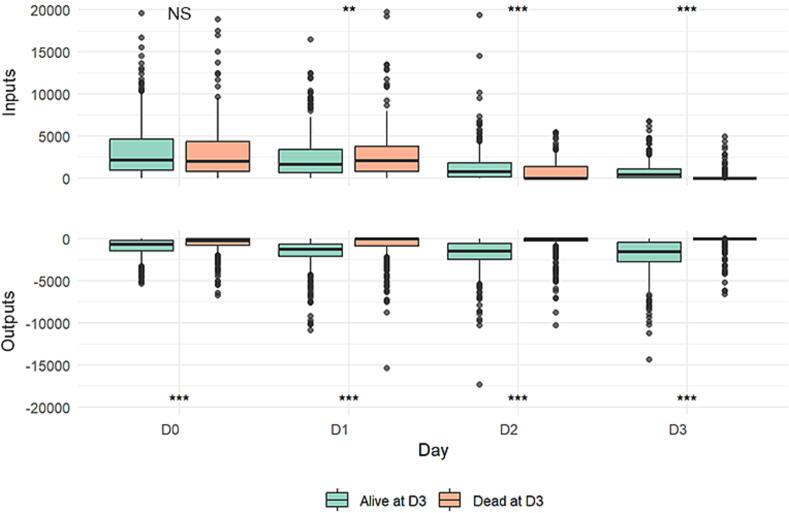
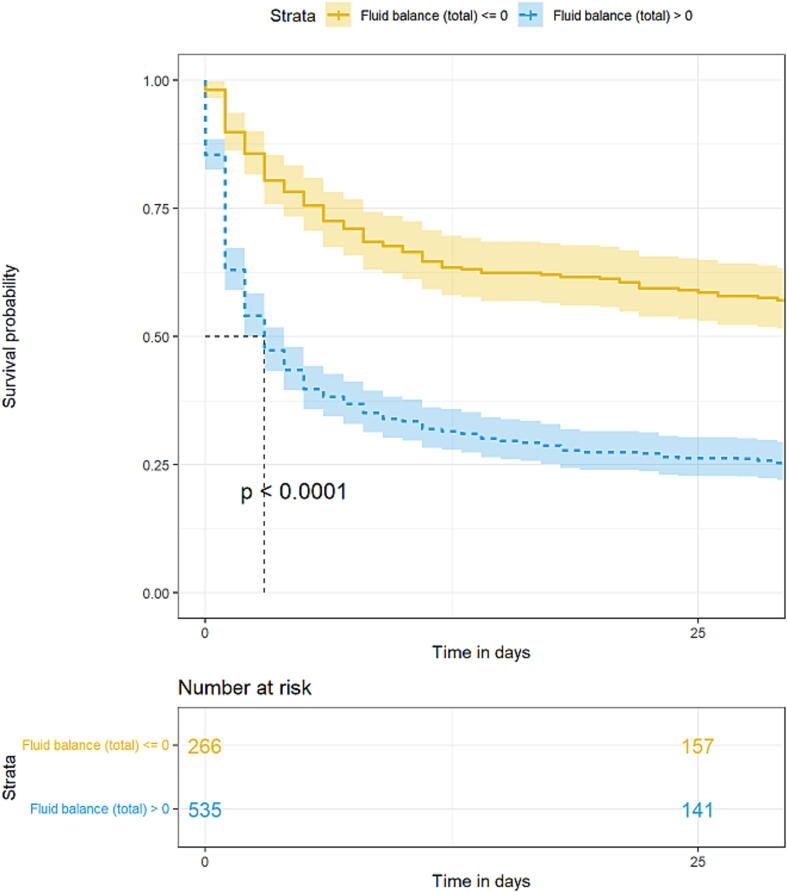
Among the 1800 patients resuscitated from CA, 868 (68 %) developed post-CA shock. Of these, 801 were analyzed; 334 (42 %) died within 3 days. Early non-survivors had a higher median fluid balance (+3289 mL [25th; 75th IQR + 502; +5806]) than early survivors (+930 mL [-2677; +4353]) ( < 0.001). Positive fluid balance independently predicted death by day 3 (OR 2.23, 95 % CI [1.29; 3.14]; = 0.005). Mortality increased significantly with increasing fluid balance, especially from 1000 mL and upwards (OR 4.11, 95 % CI [2.32; 2.47]; < 0.001). Other factors independently associated with early mortality included age >66 years, maximum catecholamines dose, and peak serum lactate.
CONCLUSIONS
These findings confirm that fluid balance is associated with early mortality during post-CA shock.
背景
液体平衡与感染性休克的预后密切相关。心脏骤停(CA)后休克占CA后死亡人数的三分之一,与脓毒症有许多共同的病理生理特征。然而,在这种情况下,尚未分析液体平衡的影响。本研究旨在评估液体平衡对CA后休克期间死亡率的影响。
方法
这项回顾性研究使用了重症监护医学信息集市(MIMIC)-IV数据库。在最初72小时内对液体平衡进行量化。多因素逻辑回归分析确定了与早期(第3天)死亡率相关的因素。
结果
在1800例从CA中复苏的患者中,868例(68%)发生了CA后休克。其中,对801例进行了分析;334例(42%)在3天内死亡。早期非存活者的液体平衡中位数(+3289 mL [第25;75四分位数间距 +502;+5806])高于早期存活者(+930 mL [-2677;+4353])(<0.001)。正液体平衡独立预测第3天的死亡(比值比2.23,95%置信区间[1.29;3.14];=0.005)。随着液体平衡增加,死亡率显著增加,尤其是从1000 mL及以上(比值比4.11,95%置信区间[2.32;2.47];<0.001)。与早期死亡率独立相关的其他因素包括年龄>66岁、最大儿茶酚胺剂量和血清乳酸峰值。
结论
这些发现证实,液体平衡与CA后休克期间的早期死亡率相关。


 Zotero 插件