
输尿管支架中细菌生物膜、结痂与壁面剪应力之间的相互作用:跨尺度综述
The interplay between bacterial biofilms, encrustation, and wall shear stress in ureteral stents: a review across scales.
作者信息
Amado Pedro, Zheng Shaokai, Lange Dirk, Carugo Dario, Waters Sarah L, Obrist Dominik, Burkhard Fiona, Clavica Francesco
机构信息
ARTORG Center for Biomedical Engineering Research, University of Bern, Bern, Switzerland.
Department of Neurology, Inselspital, Bern University Hospital, Bern, Switzerland.
出版信息
Front Urol. 2024 Jan 16;3:1335414. doi: 10.3389/fruro.2023.1335414. eCollection 2023.
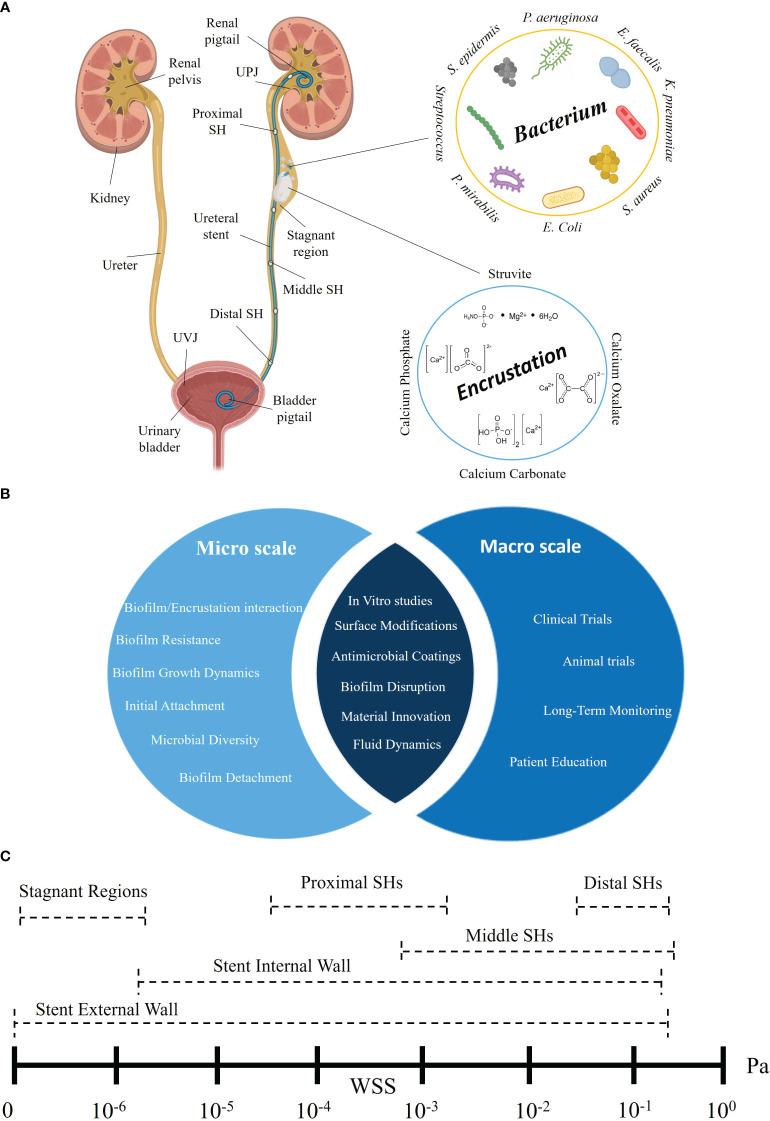
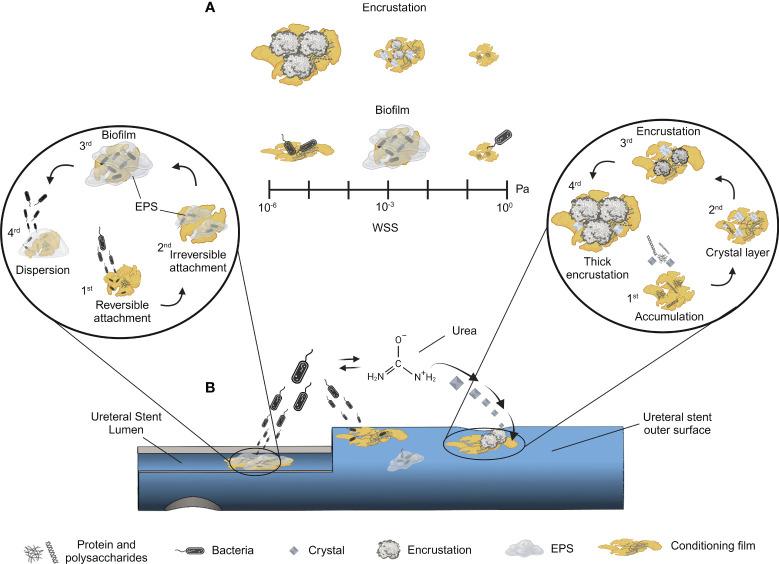
Ureteral stents are hollow tubes that are inserted into the ureter to maintain the flow of urine from the kidney to the bladder. However, the use of these indwelling stents is associated with potential complications. Biofilm, an organized consortium of bacterial species embedded within a self-producing extracellular matrix, can attach to the outer and inner surfaces of ureteral stents. Furthermore, encrustation - defined as the buildup of mineral deposits on the stent surface - can occur independently or in parallel with biofilm formation. Both phenomena can cause stent obstruction, which can lead to obstructive pyelonephritis and make stent removal difficult. Understanding the influence of flow on the development of biofilm and encrustation and the impact of small mechanical environmental changes (e.g., wall shear stress distribution) is key to improve the long-term performance of stents. Identifying the optimal stent properties to prevent early bacterial attachment and/or crystal deposition and their growth, would represent a breakthrough in reducing biofilm-/encrustation-associated complications. This review identifies the most prevalent bacterial strains and crystal types associated with ureteral stents, and the process of their association with the stent surface, which often depends on patient comorbidities, stent material, and indwelling time. Furthermore, we focus on the often-overlooked role of fluid dynamics on biofilm and encrustation development in ureteral stents, across a range of physical scales (i.e., from micro- to macro-scale) with the aim of providing a knowledge base to inform the development of safer and more effective ureteral stents.
输尿管支架是插入输尿管以维持尿液从肾脏流向膀胱的中空管。然而,使用这些留置支架会带来潜在并发症。生物膜是一种嵌入自生细胞外基质中的有组织的细菌群落,可附着在输尿管支架的外表面和内表面。此外,结壳(定义为支架表面矿物质沉积的积累)可独立发生或与生物膜形成同时发生。这两种现象均可导致支架阻塞,进而导致梗阻性肾盂肾炎,并使支架取出困难。了解血流对生物膜和结壳形成的影响以及微小机械环境变化(如壁面剪应力分布)的作用,是改善支架长期性能的关键。确定预防早期细菌附着和/或晶体沉积及其生长的最佳支架特性,将是减少生物膜/结壳相关并发症的一项突破。本综述确定了与输尿管支架相关的最常见细菌菌株和晶体类型,以及它们与支架表面的关联过程,这通常取决于患者的合并症、支架材料和留置时间。此外,我们关注流体动力学在输尿管支架生物膜和结壳形成过程中经常被忽视的作用,涵盖一系列物理尺度(即从微观到宏观尺度),目的是提供一个知识库,为开发更安全、更有效的输尿管支架提供信息。
 Zotero 插件