
孕妇邻苯二甲酸盐暴露、妊娠期长度与早产风险:一项嵌套于随机试验中的前瞻性队列研究。
Maternal phthalate exposure, gestational length, and preterm birth risk: a prospective cohort study nested within a randomised trial.
作者信息
Best Karen P, Yelland Lisa N, Ge Liu, Shi Zumin, Leemaqz Shalem, Gibson Robert, Makrides Maria, Middleton Philippa
机构信息
SAHMRI Women and Kids, South Australian Health and Medical Research Institute, North Adelaide, South Australia.
Adelaide Medical School, The University of Adelaide, Adelaide, South Australia, Australia.
出版信息
BMC Pregnancy Childbirth. 2025 Aug 8;25(1):830. doi: 10.1186/s12884-025-07980-8.
BACKGROUND
Preterm birth (< 37 weeks gestation) is a leading cause of infant morbidity and mortality, yet the underlying causes remain unknown in many cases. Environmental exposures, including endocrine-disrupting chemicals such as phthalates, have been implicated in preterm birth risk. Phthalates are commonly used as plasticisers in consumer products, resulting in widespread human exposure. While some studies suggest an association between maternal phthalate exposure and reduced gestational length, findings remain inconsistent. This study aimed to investigate the relationship between urinary phthalate metabolite concentrations and gestational length in an Australian pregnancy cohort.
METHODS
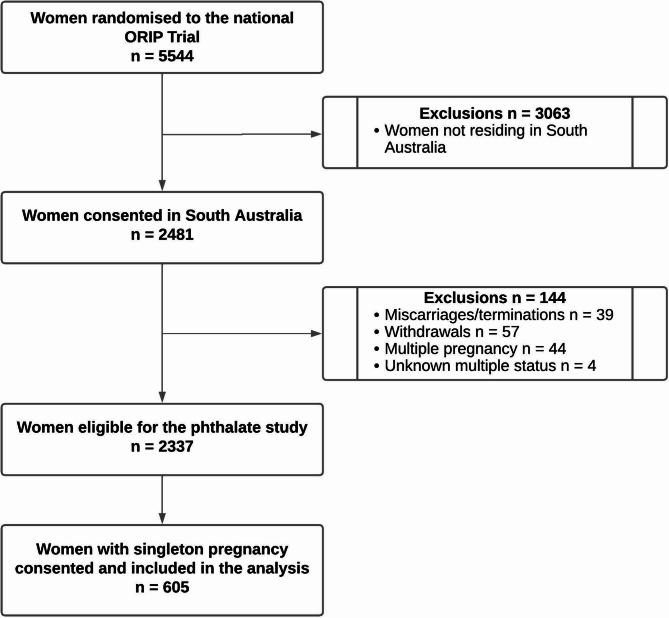
This prospective cohort study was nested within the Omega-3 to Reduce the Incidence of Prematurity (ORIP) trial. A total of 605 women with singleton pregnancies from South Australia provided urine samples between 22- and 26-weeks' gestation for phthalate metabolite analysis. Thirteen phthalate metabolites were quantified using liquid chromatography-tandem mass spectrometry. Gestational age at birth was determined from medical records. Linear regression models assessed associations between phthalate concentrations and gestational length, adjusting for maternal characteristics including age, BMI, socioeconomic status, education, smoking, and alcohol consumption.
RESULTS
Phthalate metabolites were detected in > 99% of urine samples, with the highest concentrations observed for mono-ethyl phthalate (MEP), mono-isobutyl phthalate (MiBP), and mono-butyl phthalate (MBP). There was no evidence of an association between phthalate exposure and gestational length in either unadjusted or adjusted analyses. No significant association was found between phthalate exposure and preterm birth risk.
CONCLUSIONS
Despite widespread phthalate exposure, no clear link was identified between maternal phthalate levels and shortened gestation in this Australian cohort. However, continued surveillance is needed to monitor emerging plasticiser exposures and inform public health policies on maternal and infant health.
TRIAL REGISTRATION NUMBER
Australian New Zealand Clinical Trials Registry number, ACTRN12613001142729. Date of registration: 27/09/2013.
背景
早产(妊娠<37周)是婴儿发病和死亡的主要原因,但在许多情况下其根本原因仍不明。包括邻苯二甲酸盐等内分泌干扰化学物质在内的环境暴露与早产风险有关。邻苯二甲酸盐常用作消费品中的增塑剂,导致人类广泛接触。虽然一些研究表明孕妇邻苯二甲酸盐暴露与孕周缩短之间存在关联,但研究结果仍不一致。本研究旨在调查澳大利亚一个妊娠队列中尿邻苯二甲酸酯代谢物浓度与孕周之间的关系。
方法
这项前瞻性队列研究嵌套在“ω-3降低早产发生率(ORIP)”试验中。来自南澳大利亚的605名单胎妊娠妇女在妊娠22至26周期间提供了尿液样本用于邻苯二甲酸酯代谢物分析。使用液相色谱-串联质谱法定量13种邻苯二甲酸酯代谢物。根据医疗记录确定出生时的孕周。线性回归模型评估邻苯二甲酸酯浓度与孕周之间的关联,并对包括年龄、体重指数、社会经济地位、教育程度、吸烟和饮酒等母亲特征进行校正。
结果
超过99%的尿液样本中检测到邻苯二甲酸酯代谢物,其中邻苯二甲酸单乙酯(MEP)、邻苯二甲酸单异丁酯(MiBP)和邻苯二甲酸单丁酯(MBP)浓度最高。在未校正和校正分析中均没有证据表明邻苯二甲酸酯暴露与孕周之间存在关联。未发现邻苯二甲酸酯暴露与早产风险之间存在显著关联。
结论
尽管邻苯二甲酸酯暴露广泛,但在这个澳大利亚队列中未发现母亲邻苯二甲酸酯水平与孕周缩短之间存在明确联系。然而,需要持续监测以监测新出现的增塑剂暴露情况,并为母婴健康方面的公共卫生政策提供信息。
试验注册号
澳大利亚新西兰临床试验注册号,ACTRN12613001142729。注册日期:2013年9月27日。
 Zotero 插件