
登革热病毒传播的数学建模:通过敏感性和分岔分析探索媒介、垂直和性传播途径。
Mathematical modeling of dengue virus transmission: exploring vector, vertical, and sexual pathways with sensitivity and bifurcation analysis.
作者信息
Ahman Queeneth Ojoma, Aja Remigius Okeke, Omale David, Okpara Patrick Agwu
机构信息
Department of Mathematics/Statistics, Confluence University of Science and Technology, Osara, Nigeria.
Department of Mathematics, Micheal Okpara University of Agriculture, Umudike, Nigeria.
出版信息
BMC Infect Dis. 2025 Aug 8;25(1):999. doi: 10.1186/s12879-025-11435-y.
BACKGROUND
Dengue virus (DENV) remains a critical global health threat, particularly in tropical and subtropical regions. Traditional models primarily focus on mosquito-borne transmission, overlooking alternative pathways such as vertical and sexual transmission. This study develops a comprehensive mathematical model that integrates multiple transmission routes to improve understanding of dengue dynamics and inform effective control strategies.
METHODS
We develop a compartmental SEIR-based model that captures dengue virus transmission through mosquito vectors, vertical (transovarial), and sexual routes. The model undergoes rigorous mathematical analysis to derive equilibrium points and assess their stability. Both local and global sensitivity analyses are performed to identify key drivers of disease dynamics. Additionally, the model is calibrated using weekly dengue incidence data from Delhi, India, to validate its predictive capacity.
RESULTS
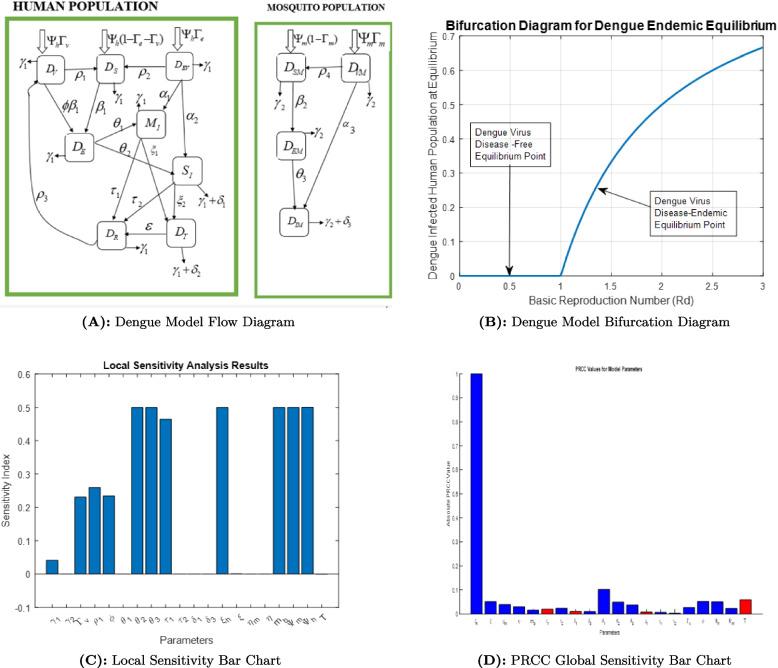
The sensitivity analysis identifies the most influential parameters driving transmission. Although the human-to-human contact rate (sexual transmission) has a high sensitivity index, the actual contribution of sexual transmission to the basic reproduction number ([Formula: see text]) is biologically negligible—approximately 0.01704 out of a total [Formula: see text] of 0.02, i.e., less than 1%. In contrast, mosquito-borne transmission remains the dominant route. The vaccination rate exhibits a negative sensitivity index, indicating its suppressive impact on disease spread. Numerical simulations reveal that dengue can persist even when [Formula: see text], indicating backward bifurcation, which necessitates enhanced intervention strategies beyond just reducing [Formula: see text].
CONCLUSION
The model reveals that dengue can persist even when [Formula: see text], due to backward bifurcation. Although sexual transmission contributes less than 1% to [Formula: see text] under current estimates, vector control and vaccination remain the most critical strategies. Incorporating climate and mobility dynamics in future studies can further enhance model accuracy and policy relevance.
背景
登革病毒(DENV)仍然是全球重大的健康威胁,尤其是在热带和亚热带地区。传统模型主要关注蚊媒传播,而忽略了垂直传播和性传播等其他传播途径。本研究开发了一个综合数学模型,该模型整合了多种传播途径,以增进对登革热动态的理解并为有效的控制策略提供依据。
方法
我们开发了一个基于SEIR的 compartmental模型,该模型涵盖了登革病毒通过蚊媒、垂直(经卵)和性传播途径的传播。对该模型进行了严格的数学分析,以得出平衡点并评估其稳定性。进行了局部和全局敏感性分析,以确定疾病动态的关键驱动因素。此外,使用来自印度德里的每周登革热发病率数据对模型进行校准,以验证其预测能力。
结果
敏感性分析确定了驱动传播的最具影响力的参数。尽管人际接触率(性传播)具有较高的敏感性指数,但性传播对基本再生数([公式:见正文])的实际贡献在生物学上可忽略不计——在总计[公式:见正文]为0.02的情况下约为0.01704,即不到1%。相比之下,蚊媒传播仍然是主要途径。疫苗接种率呈现负敏感性指数,表明其对疾病传播具有抑制作用。数值模拟表明,即使[公式:见正文],登革热仍可能持续存在,这表明存在后向分岔,这就需要采取除降低[公式:见正文]之外的强化干预策略。
结论
该模型表明,由于后向分岔,即使[公式:见正文],登革热仍可能持续存在。尽管根据目前的估计,性传播对[公式:见正文]的贡献不到1%,但病媒控制和疫苗接种仍然是最关键的策略。在未来的研究中纳入气候和流动性动态可以进一步提高模型的准确性和政策相关性。



 Zotero 插件