
计算转移性去势抵抗性前列腺癌治疗中Ac、Lu和Tb辐射剂量及生物学效应的框架。
Framework to calculate Ac, Lu, and Tb radiation dose and biological effect in metastatic castration-resistant prostate cancer treatment.
作者信息
Ghaseminejad Shahin, De Sarno Danny, Bauman Glenn, Lee Ting-Yim
机构信息
Department of Medical Biophysics, Western University, London, Ontario, Canada.
Imaging Program, Robarts Research Institute and Lawson Research Institute, London, Ontario, Canada.
出版信息
Med Phys. 2025 Aug;52(8):e18035. doi: 10.1002/mp.18035.
BACKGROUND
In the treatment of metastatic castration-resistant prostate cancer (mCRPC), the standard radionuclide Lu (β⁻ emitter) is being challenged by alternatives, particularly the α-emitter Ac and Auger electron emitter Tb, due to their superior radiobiological properties. These include higher linear energy transfer (LET) and shorter ranges, which enhance localized cell killing while minimizing off-target effects. While these radionuclides induce DNA damage both in source-cells and neighboring cells (crossfire effect), their distinct radiation profiles provide critical metrics to compare their therapeutic efficacy. By quantifying these differences, especially in micrometastatic settings, the optimal radionuclide for specific clinical scenarios could be selected.
PURPOSE
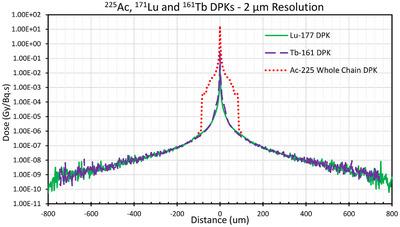
This Study aims to develop a comprehensive pipeline based on Monte Carlo (MC) simulations to compare the therapeutic efficacy of Ac, Lu, and Tb in the treatment of mCRPC based on clinically administered activity (7.4 GBq for Lu, Tb, and 7 MBq for Ac) in a multi-cell model. Besides evaluating the absorbed dose at the cellular level, the Biological Effect Cell Kernel (BECK) method is proposed to compare the radiobiological effect of radionuclides, accounting for the crossfire effect using 3D convolution.
METHODS
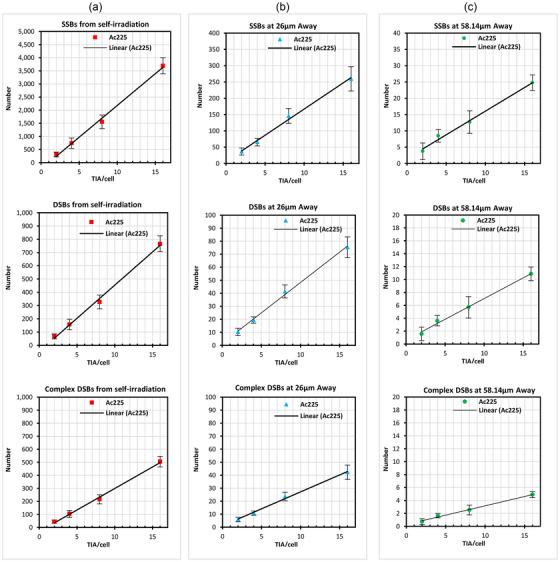
A 2 µm resolution cell model was constructed with a 20 µm cell, an 8 µm nucleus diameter, and a 26 µm center-to-center distance. This configuration resulted in a cellular fraction of 0.24 mL/g, in agreement with that estimated from six prostate cancer patients using CT Perfusion. The prostate time-integrated activity (TIA) in the model was estimated from a patient based on a dynamic 300 MBq F-DCFPyL PET scan after scaling to account for the higher administered activity in therapy. The TOPAS-nBio MC tool was used to calculate the absorbed dose and the DNA breaks in the cell model. To account for the crossfire effect, we created the BECK, an isotropic 3D kernel, demonstrating the DNA breaks in the source-containing cell, and those induced in its neighboring cells. The BECK was convolved with the 3D TIA maps of the cell model to obtain the DNA break maps.
RESULTS
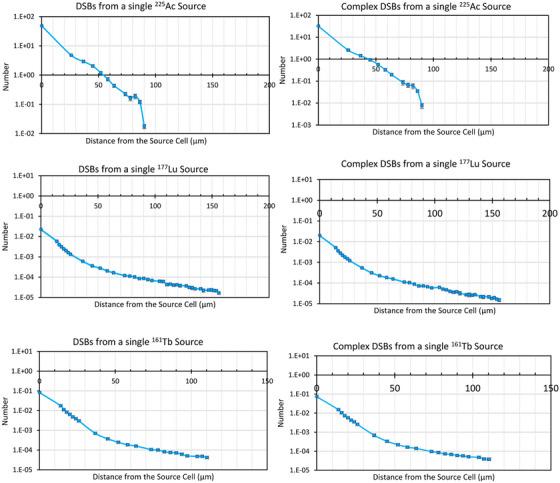
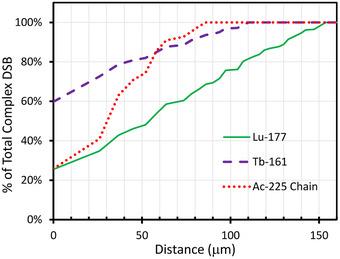
The cellular absorbed dose was higher than the macro-scale dose based on SPECT-derived TIA, by 31.3%, 15.7%, and 39.8% for Ac, Lu, and Tb, respectively. At the single-cell level, Ac induced markedly higher DNA breaks per source - 48 double-strand breaks (DSBs), and 32 complex DSBs, compared to Lu - 0.022 and 0.017, and Tb - 0.083 and 0.073, respectively. Crossfire effects were dominant for Ac and Lu at ∼75% and less pronounced for Tb at ∼41%. The maximum ranges at which 99.99% of the total DNA breaks were observed were approximately 85 µm for Ac, 150 µm for Lu, and 110 µm for Tb.
CONCLUSIONS
DPKs and BECKs of ⁵Ac, ¹⁷⁷Lu, and ¹⁶¹Tb were developed to quantify cellular-level dose distributions and biological efficacy, revealing micrometer-scale heterogeneity accentuated by short-range emissions (α, CEs, AEs). Results demonstrate ¹⁶¹Tb's optimal performance for micrometastases-surpassing ¹⁷⁷Lu's efficacy with lower toxicity than ⁵Ac-while relative biological effectiveness predicts activity requirements: ⁵Ac << ¹⁶¹Tb < ¹⁷⁷Lu.
背景
在转移性去势抵抗性前列腺癌(mCRPC)的治疗中,标准放射性核素镥(β⁻发射体)正受到其他替代物的挑战,尤其是α发射体锕和俄歇电子发射体铽,因为它们具有更优越的放射生物学特性。这些特性包括更高的线能量传递(LET)和更短的射程,这增强了局部细胞杀伤,同时将脱靶效应降至最低。虽然这些放射性核素在源细胞和邻近细胞中都会诱导DNA损伤(交叉火力效应),但它们独特的辐射分布提供了关键指标来比较它们的治疗效果。通过量化这些差异,特别是在微转移情况下,可以选择适合特定临床场景的最佳放射性核素。
目的
本研究旨在开发一种基于蒙特卡罗(MC)模拟的综合流程,以比较锕、镥和铽在多细胞模型中基于临床给药活度(镥和铽为7.4 GBq,锕为7 MBq)治疗mCRPC的疗效。除了评估细胞水平的吸收剂量外,还提出了生物效应细胞内核(BECK)方法来比较放射性核素的放射生物学效应,使用三维卷积考虑交叉火力效应。
方法
构建了一个分辨率为2 µm的细胞模型,细胞直径为20 µm,细胞核直径为8 µm,中心距为26 µm。这种配置导致细胞分数为0.24 mL/g,与使用CT灌注从六名前列腺癌患者估计的值一致。模型中的前列腺时间积分活度(TIA)是根据一名患者在动态300 MBq F-DCFPyL PET扫描后进行缩放估算的,以考虑治疗中更高的给药活度。使用TOPAS-nBio MC工具计算细胞模型中的吸收剂量和DNA断裂。为了考虑交叉火力效应,我们创建了BECK,一个各向同性的三维内核,展示含源细胞中的DNA断裂以及其邻近细胞中诱导的DNA断裂。将BECK与细胞模型的三维TIA图进行卷积以获得DNA断裂图。
结果
基于SPECT衍生的TIA,细胞吸收剂量高于宏观剂量,锕、镥和铽分别高出31.3%、15.7%和39.8%。在单细胞水平上,与镥(分别为0.022和0.017)和铽(分别为0.083和0.073)相比,锕每个源诱导的DNA断裂明显更高——48个双链断裂(DSB)和32个复杂DSB。交叉火力效应在锕和镥中占主导,约为75%,在铽中不太明显,约为41%。观察到99.99%的总DNA断裂的最大范围,锕约为85 µm,镥约为150 µm,铽约为110 µm。
结论
开发了⁵Ac、¹⁷⁷Lu和¹⁶¹Tb的剂量点内核(DPK)和生物效应细胞内核(BECK),以量化细胞水平的剂量分布和生物学疗效,揭示了由短程发射(α、俄歇电子、内转换电子)加剧的微米级异质性。结果表明¹⁶¹Tb在微转移方面具有最佳性能——超过¹⁷⁷Lu的疗效,且毒性低于⁵Ac——而相对生物有效性预测了活度需求:⁵Ac << ¹⁶¹Tb < ¹⁷⁷Lu。





 Zotero 插件