
利用针对胶质母细胞瘤微环境的先天免疫。
Harnessing innate immunity against glioblastoma microenvironment.
作者信息
Zhang Wenbo, Zhang Wanhong, Wu Henghao, Han Xinsheng
机构信息
Department of Neurology, Kaifeng Central Hospital, Xinxiang Medical University, Kaifeng, China.
Department of Neurosurgery, Kaifeng Central Hospital, Kaifeng, China.
出版信息
Front Immunol. 2025 Jul 25;16:1648601. doi: 10.3389/fimmu.2025.1648601. eCollection 2025.
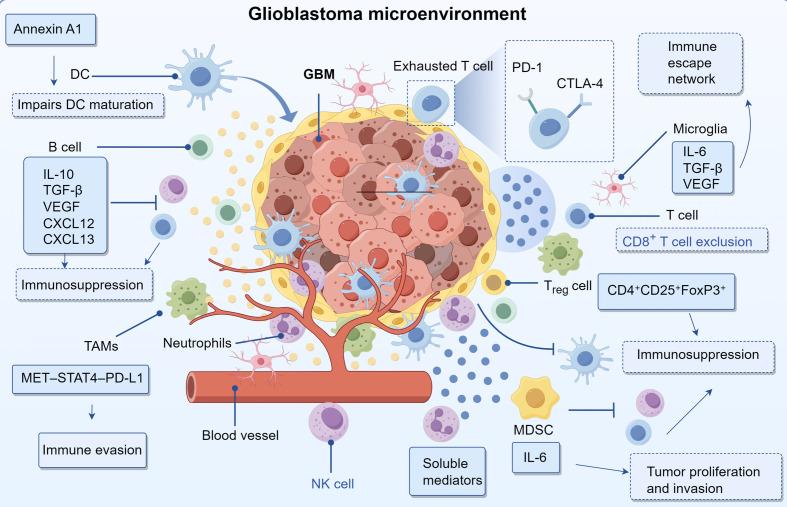
Glioblastoma (GBM) possesses a profoundly immunosuppressive tumor microenvironment (TME) dominated by innate immune mechanisms. Tumor-associated macrophages (TAMs), microglia, and myeloid-derived suppressor cells (MDSCs) constitute the major immunosuppressive axis, promoting tumor progression through cytokine secretion (IL-10, TGF-β), metabolic reprogramming, and inhibition of cytotoxic immunity. These innate immune cells not only facilitate immune evasion but also impair adaptive T-cell responses, limiting the efficacy of current immunotherapies. Emerging evidence highlights the therapeutic potential of targeting innate immunity via TAM repolarization, MDSC depletion, and NK cell activation to reshape the immunosuppressive TME. This review summarizes the pivotal role of innate immunity in GBM pathogenesis and explores novel combinatorial strategies that integrate innate immune modulation with checkpoint blockade, oncolytic virotherapy, and metabolic interventions to overcome therapeutic resistance in this lethal malignancy.
胶质母细胞瘤(GBM)具有由先天免疫机制主导的深度免疫抑制性肿瘤微环境(TME)。肿瘤相关巨噬细胞(TAM)、小胶质细胞和骨髓来源的抑制性细胞(MDSC)构成主要的免疫抑制轴,通过细胞因子分泌(IL-10、TGF-β)、代谢重编程和抑制细胞毒性免疫促进肿瘤进展。这些先天免疫细胞不仅促进免疫逃逸,还损害适应性T细胞反应,限制了当前免疫疗法的疗效。新出现的证据强调了通过TAM重极化、MDSC清除和NK细胞激活来靶向先天免疫以重塑免疫抑制性TME的治疗潜力。本综述总结了先天免疫在GBM发病机制中的关键作用,并探索了将先天免疫调节与检查点阻断、溶瘤病毒疗法和代谢干预相结合的新型联合策略,以克服这种致命恶性肿瘤的治疗耐药性。
 Zotero 插件