
微量营养素与蛋白质能量补充可增强营养不良儿童的疫苗反应:一项系统评价的证据
Micronutrient and protein-energy supplementation enhance vaccine responses in undernourished children: Evidence from a systematic review.
作者信息
Ngoie Mwamba Guillaume, Kabamba Nzaji Michel, Luboya Numbi Oscar, Ali Mapatano Mala, Lusamba Dikassa Paul-Samson
机构信息
Department of Public Health, Faculty of Medicine, University of Kamina, Kamina, DRC, Kamina, 00243, Democratic Republic of the Congo.
Expanded Program on Immunization, Ministry of Health, Kinshasa, DRC, Kinshasa, 00243, Democratic Republic of the Congo.
出版信息
F1000Res. 2025 Jul 18;14:507. doi: 10.12688/f1000research.164227.3. eCollection 2025.
BACKGROUND
Malnutrition impairs immune function and vaccine responses, particularly in low-income settings. This can lead to reduced seroconversion rates and compromised herd immunity in children. Nutritional interventions have been proposed to enhance vaccine immunogenicity, yet evidence remains scattered and context specific.
OBJECTIVE
This systematic review assesses the impact of nutritional interventions-especially vitamin A, zinc supplementation, and protein-energy rehabilitation-on serological responses to routine childhood vaccines among malnourished children in low- and middle-income countries.
METHODS
Following PRISMA guidelines, we searched PubMed, Embase, Cochrane Library, and WHO Global Health Library for studies published between 2000 and 2024. Eligible studies included randomized trials, cohort studies, and systematic reviews reporting on nutritional supplementation and vaccine seroconversion outcomes in malnourished children.
RESULTS
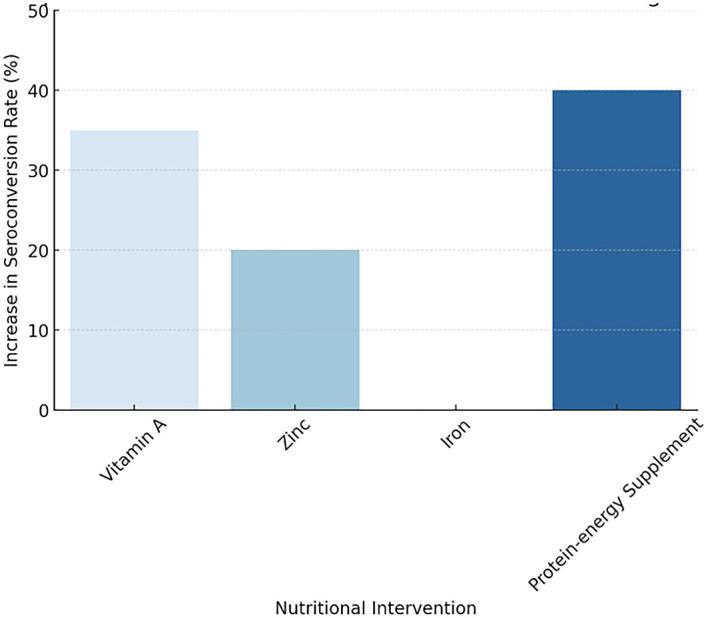
From 3,245 records, 42 studies met the inclusion criteria. Vitamin A supplementation improved measles vaccine seroconversion by 35%, especially among deficient children. Zinc enhanced responses to oral vaccines by 20%. Protein-energy rehabilitation significantly increased seroconversion rates for BCG and measles vaccines, particularly in children recovering from severe acute malnutrition.
CONCLUSION
Nutritional interventions improve vaccine immunogenicity among malnourished children. Integrated strategies combining immunization and nutrition services should be prioritized to address immunity gaps in vulnerable populations.
背景
营养不良会损害免疫功能和疫苗反应,在低收入环境中尤其如此。这可能导致儿童血清转化率降低和群体免疫力受损。已提出营养干预措施以增强疫苗免疫原性,但证据仍然零散且因具体情况而异。
目的
本系统评价评估营养干预措施,特别是维生素A、锌补充剂和蛋白质能量康复,对低收入和中等收入国家营养不良儿童对常规儿童疫苗的血清学反应的影响。
方法
按照PRISMA指南,我们在PubMed、Embase、Cochrane图书馆和世卫组织全球卫生图书馆中检索了2000年至2024年发表的研究。符合条件的研究包括随机试验、队列研究以及关于营养不良儿童营养补充和疫苗血清转化结果的系统评价。
结果
从3245条记录中,42项研究符合纳入标准。补充维生素A使麻疹疫苗血清转化率提高了35%,尤其是在缺乏维生素A的儿童中。锌使口服疫苗的反应提高了20%。蛋白质能量康复显著提高了卡介苗和麻疹疫苗的血清转化率,特别是在从重度急性营养不良中恢复的儿童中。
结论
营养干预可提高营养不良儿童的疫苗免疫原性。应优先考虑将免疫和营养服务相结合的综合策略,以解决弱势群体中的免疫差距。

 Zotero 插件