
影响角膜再支配手术治疗神经营养性角膜炎疗效的因素的系统分析。
Systematic analysis of factors affecting the efficacy of corneal reinnervation surgery in treating neurotrophic keratitis.
作者信息
Kuang Rui, Xu Shuqia, Lin Xunxun, He Bo, Xu Yangbin, Zhu Zhaowei
机构信息
Department of Plastic Surgery, The First Affiliated Hospital of Sun Yat-Sen University, No. 58 Zhongshan Road 2, Guangzhou, 510080, Guangdong, China.
Orthopaedic Trauma and Joint Department, Department of Orthopaedics, The Third Affiliated Hospital of Sun Yat-Sen University, Guangzhou, 510000, China.
出版信息
Eur J Med Res. 2025 Aug 13;30(1):742. doi: 10.1186/s40001-025-02992-8.
OBJECTIVE
This study investigated the efficacy of corneal neurotization (CN) surgery for treating neurotrophic keratitis (NK) and evaluated potential factors affecting treatment outcomes.
METHODS
Literature databases were searched from the inception to January 2024 for retrospective or prospective studies related to corneal neurotization for NK treatment. Data analysis was performed using SPSS 26.0, including analysis of variance, rank sum tests, and multiple regression analysis to determine the efficacy of CN and the impact of patients' age, gender, surgical method, and etiology on surgical outcomes.
RESULTS
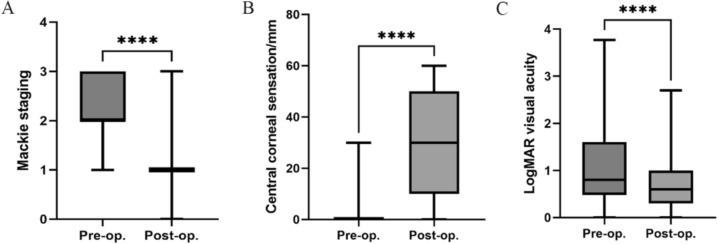
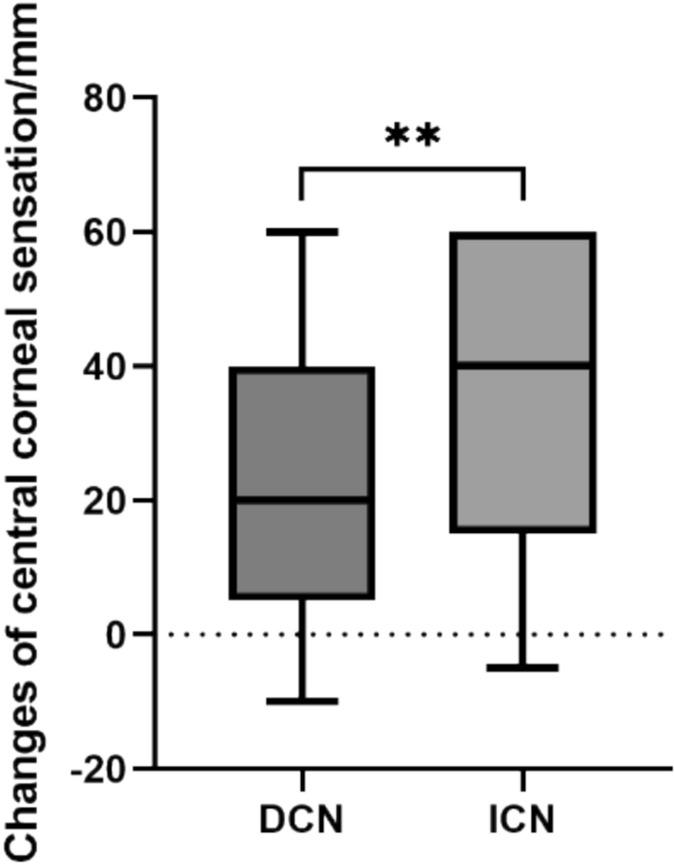
A total of 14 retrospective or prospective studies were included, comprising 191 patients who underwent CN for neurotrophic corneal lesions. CN significantly improved Mackie staging, logMAR visual acuity, and corneal sensation in patients with congenital and acquired NK (p < 0.0001). In young patients (≤ 30 years), improvement in central corneal sensation was more pronounced (p < 0.05), while elder patients (> 30 years) showed more significant visual acuity improvement (p < 0.05). Multiple linear regression analysis also showed that age was associated with the postoperative improvement in logMAR visual acuity: the elder the patients, the more improvement in visual acuity (p < 0.05). Compared to direct corneal neurotization (DCN), indirect corneal neurotization (ICN) showed more significant improvement in central corneal sensation (p < 0.01). And the patients with congenital NK got more improvement of central corneal sensation after CN by comparison with the others with acquired etiologies (p < 0.001). Multiple linear regression analysis suggested that congenital etiology was associated with more significant postoperative improvement in corneal sensation (p < 0.05).
CONCLUSION
CN surgery significantly improves visual acuity, NK Mackie staging, and corneal sensation in NK patients. Age, etiology, and surgical technique may significantly influence treatment outcomes.
目的
本研究探讨角膜神经化(CN)手术治疗神经营养性角膜炎(NK)的疗效,并评估影响治疗效果的潜在因素。
方法
检索自建库至2024年1月的文献数据库,查找与角膜神经化治疗NK相关的回顾性或前瞻性研究。使用SPSS 26.0进行数据分析,包括方差分析、秩和检验和多元回归分析,以确定CN的疗效以及患者年龄、性别、手术方法和病因对手术结果的影响。
结果
共纳入14项回顾性或前瞻性研究,包括191例行CN治疗神经营养性角膜病变的患者。CN显著改善了先天性和获得性NK患者的麦基分期、对数最小分辨角视力(logMAR视力)和角膜感觉(p < 0.0001)。在年轻患者(≤30岁)中,中央角膜感觉的改善更为明显(p < 0.05),而老年患者(>30岁)的视力改善更为显著(p < 0.05)。多元线性回归分析还显示,年龄与术后logMAR视力的改善有关:患者年龄越大,视力改善越明显(p < 0.05)。与直接角膜神经化(DCN)相比,间接角膜神经化(ICN)在中央角膜感觉方面的改善更为显著(p < 0.01)。与其他获得性病因的患者相比,先天性NK患者在CN术后中央角膜感觉的改善更大(p < 0.001)。多元线性回归分析表明,先天性病因与术后角膜感觉的更显著改善有关(p < 0.05)。
结论
CN手术可显著改善NK患者的视力、NK麦基分期和角膜感觉。年龄、病因和手术技术可能显著影响治疗效果。




 Zotero 插件