
治疗时代早发型脊髓性肌萎缩症患儿的神经发育筛查:一项基于优势的队列研究。
Neurodevelopmental screening in children with early-onset spinal muscular atrophy in the treatment era: a strengths-based cohort study.
作者信息
Balaji Lakshmi, Kariyawasam Didu, Herbert Karen, Sampaio Hugo A, Cairns Anita, McGill Brittany C, Kelada Lauren, Woolfenden Susan, Briggs Nancy, Farrar Michelle A
机构信息
Department of Neurology, Sydney Children's Hospital Randwick, Sydney, NSW 2031, Australia.
Discipline of Paediatrics and Child Health, School of Clinical Medicine, UNSW Medicine and Health, University of New South Wales, Sydney, NSW 2031, Australia.
出版信息
Brain Commun. 2025 Jul 21;7(4):fcaf272. doi: 10.1093/braincomms/fcaf272. eCollection 2025.
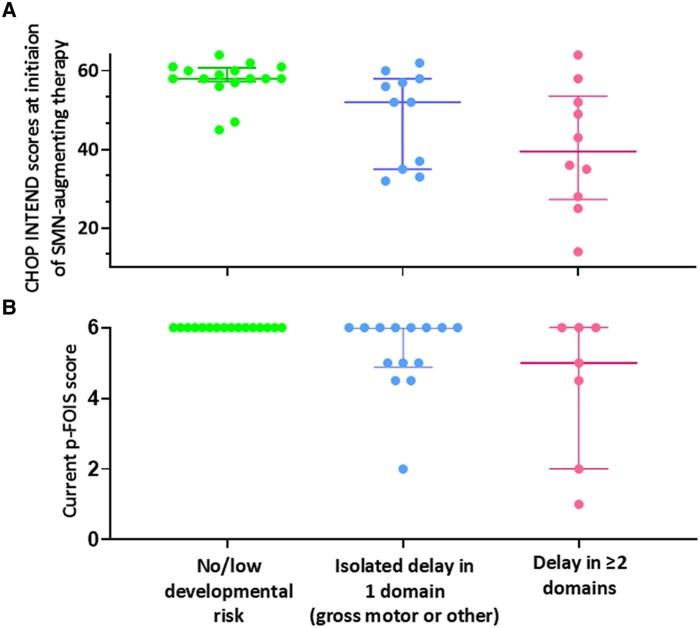
With transformative advances in diagnostic and therapeutic approaches in spinal muscular atrophy, the long-term neurodevelopmental outcomes of children with, or predicted to have, spinal muscular atrophy type 1 are essential to evaluate. In this single-centre cross-sectional study, development in children with/at-risk of spinal muscular atrophy type 1, aged 1-66 months, was assessed using parent-reported Ages and Stages Questionnaires® (ASQ-3™). Risk of autism spectrum disorder (ASD), parental distress, sociodemographic and clinical characteristics were also evaluated. Associations between exploratory variables and developmental risk were analysed within a bioecological model of health. Adaptive least absolute shrinkage and selection operator (LASSO) was used to identify variables most predictive of developmental acquisition. Thirty-seven children with spinal muscular atrophy participated (response rate: 90.2%, girls: 54.0%). Clinical characteristics varied with modality of diagnosis, survival motor neuron 2 () copies and clinical status at initiation of survival motor neuron (SMN)-augmenting therapy. ASQ-3 scores were indicative of no/low developmental risk in 16/37 (43.2%), isolated gross-motor delay consistent with spinal muscular atrophy phenotype in 8/37 (21.6%), isolated non-gross-motor delay in 3/37 (8.1%), and global developmental delay (≥2 domains) in 10/37 (27.0%). The majority of children (21/24, 87.5%) screened negative on Modified Checklist for Autism in Toddlers Revised (M-CHAT-R), indicating low risk of autism spectrum disorder. Almost one-third (32.4%) of parents reported high levels of distress. Factors associated with better developmental performance included three copies, diagnosis through newborn bloodspot screening and clinical silent status, absence of bulbar dysfunction, higher motor function at the time of initiation of SMN-augmenting therapy, parental well-being (absence of mental health condition and no distress) and parental attainment of tertiary education. An absence of a mental health condition in parents and three copy genotype in the child were identified as the strongest predictors of no/low developmental risk, with odds ratios of 4.7 and 1.4, respectively. The study findings demonstrate diverse neurodevelopmental profiles in treated children with/at-risk of spinal muscular atrophy type 1 associated with the magnitude and duration of SMN deficiency. The SMN-associated neurodevelopmental disorders may be amenable to modification by targeting bioecological factors of health. Namely, newborn screening and expedient initiation of SMN-augmenting therapies are central to targeting the neurodevelopmental window in children with/at-risk of spinal muscular atrophy type 1. Best practice includes the incorporation of proactive developmental screening for all children with/at-risk of spinal muscular atrophy type 1, with an integrated model of psychosocial support provided for families.
随着脊髓性肌萎缩症诊断和治疗方法的变革性进展,评估1型脊髓性肌萎缩症患儿或预计患有该病的儿童的长期神经发育结局至关重要。在这项单中心横断面研究中,使用家长报告的《年龄与发育阶段问卷》(ASQ - 3™)评估了1至66个月大的1型脊髓性肌萎缩症患儿或有患病风险儿童的发育情况。还评估了自闭症谱系障碍(ASD)风险、家长苦恼、社会人口统计学和临床特征。在健康的生物生态模型中分析了探索性变量与发育风险之间的关联。采用自适应最小绝对收缩和选择算子(LASSO)来确定最能预测发育获得情况的变量。37名脊髓性肌萎缩症患儿参与研究(应答率:90.2%,女孩占54.0%)。临床特征因诊断方式、存活运动神经元2()拷贝数以及开始存活运动神经元(SMN)增强治疗时的临床状态而异。ASQ - 3评分显示,16/37(43.2%)的患儿无/低发育风险,8/37(21.6%)的患儿存在与脊髓性肌萎缩症表型一致的单纯粗大运动发育延迟,3/37(8.1%)的患儿存在单纯非粗大运动发育延迟,10/37(27.0%)的患儿存在全面发育延迟(≥2个领域)。大多数儿童(21/24,87.5%)在修订版《幼儿自闭症修正检查表》(M - CHAT - R)筛查中呈阴性,表明自闭症谱系障碍风险较低。近三分之一(32.4%)的家长报告苦恼程度较高。与更好的发育表现相关的因素包括三个拷贝、通过新生儿血斑筛查诊断且临床无症状、无延髓功能障碍、开始SMN增强治疗时运动功能较高、家长身心健康(无心理健康问题且无苦恼)以及家长拥有高等教育学历。家长无心理健康问题以及患儿具有三个拷贝基因型被确定为无/低发育风险的最强预测因素,优势比分别为4.7和1.4。研究结果表明,接受治疗的1型脊髓性肌萎缩症患儿或有患病风险儿童存在多种神经发育特征,这与SMN缺乏的程度和持续时间有关。与SMN相关的神经发育障碍可能可通过针对健康的生物生态因素进行改善。也就是说,新生儿筛查和尽早开始SMN增强治疗对于针对1型脊髓性肌萎缩症患儿或有患病风险儿童的神经发育窗口期至关重要。最佳实践包括对所有1型脊髓性肌萎缩症患儿或有患病风险儿童进行主动发育筛查,并为家庭提供综合心理社会支持模型。


 Zotero 插件