
用于超高场磁共振成像临床前应用的多线圈经颅磁刺激
Multi-coil TMS for preclinical applications in ultra-high-field MRI.
作者信息
Souza Victor H, Sinisalo Heikki, Korhonen Juuso T, Paasonen Jaakko, Nyrhinen Mikko, Nieminen Jaakko O, Koponen Maria, Kettunen Mikko, Gröhn Olli, Ilmoniemi Risto J
机构信息
Department of Neuroscience and Biomedical Engineering, Aalto University School of Science, Espoo, Finland.
A. I. Virtanen Institute for Molecular Sciences, University of Eastern Finland, Kuopio, Finland.
出版信息
Imaging Neurosci (Camb). 2025 May 2;3. doi: 10.1162/imag_a_00558. eCollection 2025.
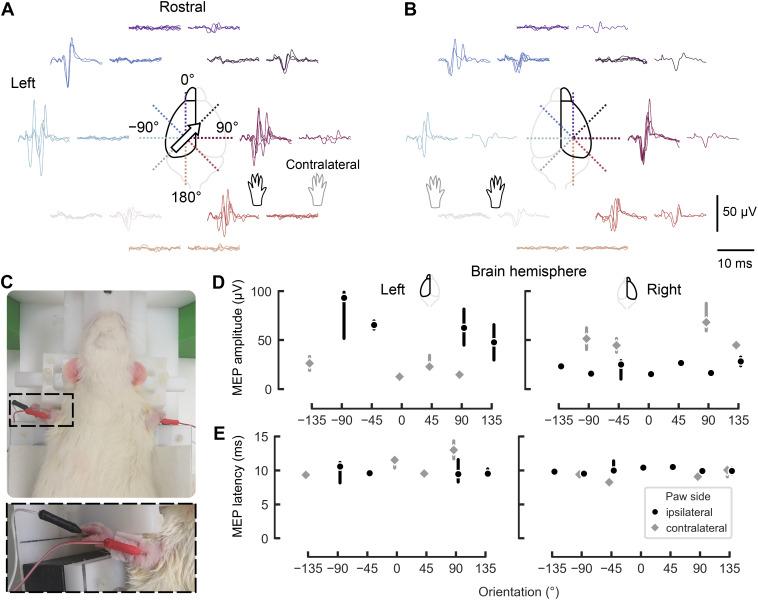
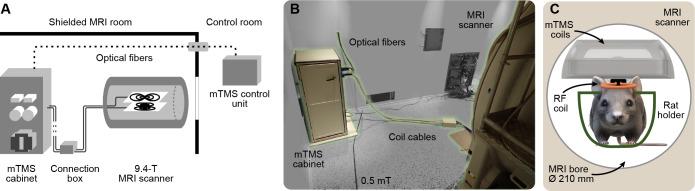
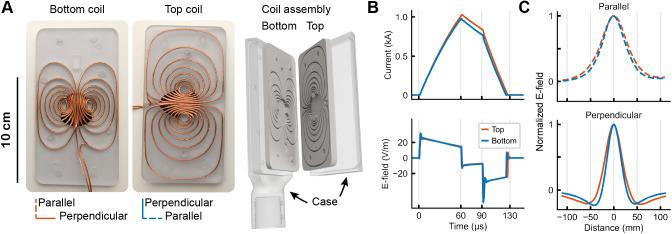
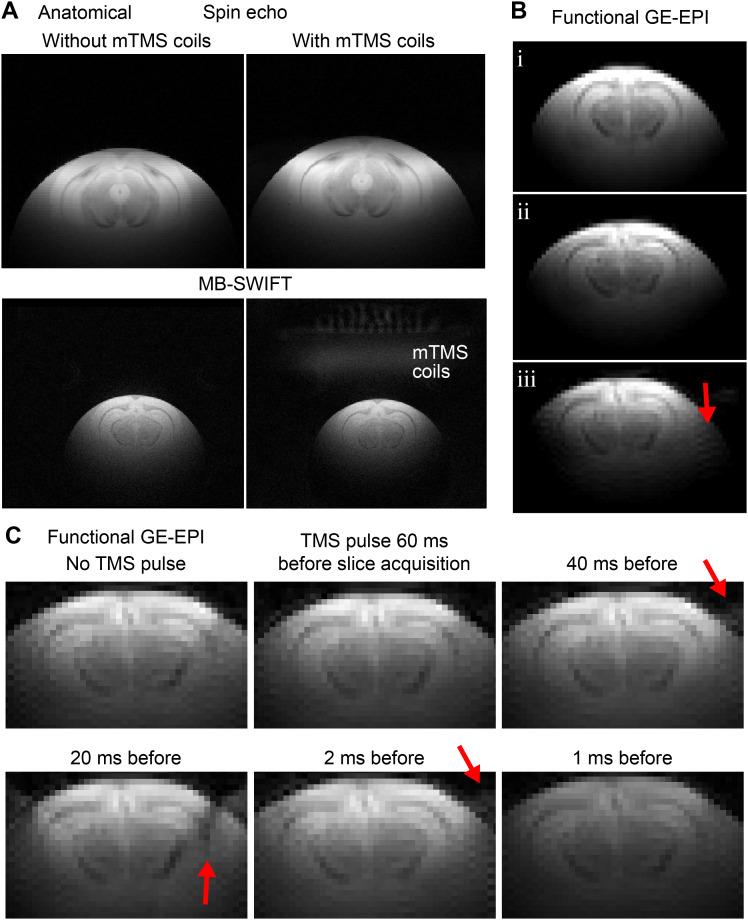
Monitoring cortical responses to neuromodulation on preclinical models can elucidate fundamental mechanisms of brain function. Concurrent brain stimulation and imaging is challenging, usually compromising spatiotemporal resolution, accuracy, and versatility. Here, we report on a non-invasive brain stimulation system with electronic control of neuromodulation parameters in a 9.4-T magnetic resonance imaging (MRI) environment. In the imaging scanner, multi-coil transcranial magnetic stimulation (mTMS) is delivered with a 2-coil array, and the MRI signal is measured with a radiofrequency coil. The mTMS can change the stimulus orientation with 1° resolution in a millisecond. Without physically rotating the coils, we evoked orientation-specific muscle responses after cortical stimulation on an anesthetized rat. The mTMS system was successfully implemented and tested with the small-animal MRI, showing minimal interference with Band B fields and uncompromised image quality. A delay of 40 ms between the stimulation pulse and fMRI acquisition-similar or even shorter than those previously described in humans-led to artifact-free images. Concurrent electronically targeted brain stimulation and neuroimaging provides a valuable tool for exploring whole-brain network functions, endorsing more efficient treatment protocols.
监测临床前模型对神经调节的皮质反应能够阐明脑功能的基本机制。同时进行脑刺激和成像具有挑战性,通常会在时空分辨率、准确性和通用性方面做出妥协。在此,我们报告一种在9.4-T磁共振成像(MRI)环境中对神经调节参数进行电子控制的非侵入性脑刺激系统。在成像扫描仪中,通过双线圈阵列进行多线圈经颅磁刺激(mTMS),并使用射频线圈测量MRI信号。mTMS能够在毫秒内以1°的分辨率改变刺激方向。在不实际旋转线圈的情况下,我们在麻醉大鼠的皮质刺激后诱发了特定方向的肌肉反应。mTMS系统已成功在小动物MRI上实施并测试,显示对B场和B'场的干扰最小且图像质量不受影响。刺激脉冲与功能磁共振成像采集之间延迟40毫秒(与之前在人类中描述的相似甚至更短)可得到无伪影的图像。同时进行电子靶向脑刺激和神经成像为探索全脑网络功能提供了一种有价值的工具,支持更有效的治疗方案。



 Zotero 插件