
氧化代谢与糖酵解代谢:它们在癌症中的相互调节与失调
Oxidative and Glycolytic Metabolism: Their Reciprocal Regulation and Dysregulation in Cancer.
作者信息
Cordani Marco, Rumio Cristiano, Bontempi Giulio, Strippoli Raffaele, Marcucci Fabrizio
机构信息
Department of Biochemistry and Molecular Biology, Faculty of Biological Sciences, Complutense University of Madrid, 28040 Madrid, Spain.
Instituto de Investigación Sanitaria San Carlos (IdISSC), 28040 Madrid, Spain.
出版信息
Cells. 2025 Jul 30;14(15):1177. doi: 10.3390/cells14151177.
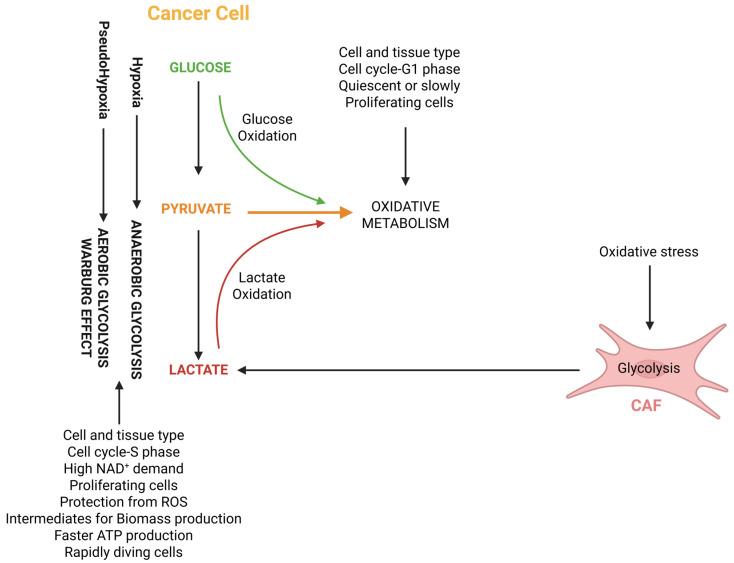
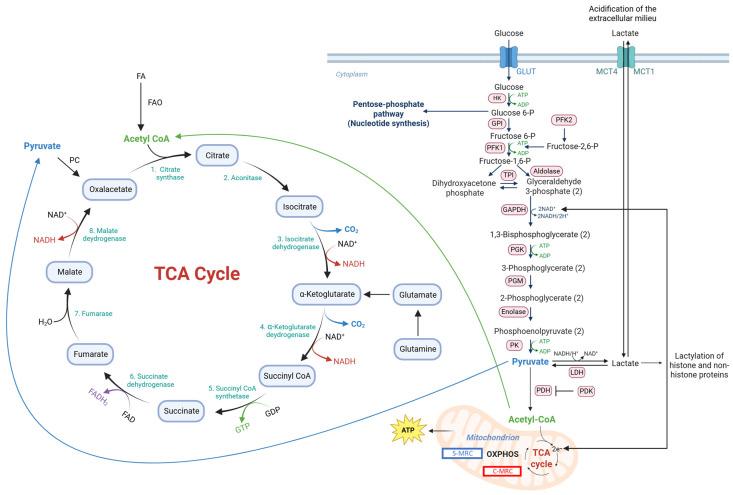
Oxidative and glycolytic metabolism produce energy in the form of ATP and produce intermediates for biomass production. Oxidative metabolism predominates under normoxic conditions and in quiescent or slowly proliferating cells. On the other hand, under hypoxic or pseudohypoxic conditions and in rapidly proliferating cells, glycolysis becomes the predominant pathway. The balance between oxidative and glycolytic metabolism is finely tuned in physiological conditions and becomes dysregulated in many pathological conditions, most notably cancer. In this article we summarize the evidence that has been gathered over the last few years on the mechanisms underlying this balance and the consequences of their dysregulation. We discuss first the non-metabolic factors (mitochondria, cell cycle, cell type, tissue type), then molecules that are at the intersection between glycolytic and oxidative metabolism and those molecules that are inherent to oxidative or glycolytic metabolism that affect the equilibrium between the two energy-producing pathways. Eventually, we discuss pharmacologic or genetic means that allow manipulating this equilibrium. As will be seen, lactic acidosis has taken center stage in this field and lactate has been shown to fuel oxidative metabolism. This suggests that if glycolytic metabolism predominates, as has often been shown in cancer, mechanisms come into work that reestablish a metabolic heterogeneity. Thus, while one pathway may be predominant over the other, it seems as if fail-safe mechanisms are at work that avoid the possibility that it becomes the only energy-producing pathway. Eventually, we discuss possible therapeutic consequences that may derive from this expanding knowledge, in particular, as regards tumor therapy.
氧化代谢和糖酵解代谢以ATP的形式产生能量,并产生用于生物量生产的中间体。氧化代谢在常氧条件下以及在静止或缓慢增殖的细胞中占主导地位。另一方面,在缺氧或假性缺氧条件下以及在快速增殖的细胞中,糖酵解成为主要途径。氧化代谢和糖酵解代谢之间的平衡在生理条件下得到精细调节,而在许多病理条件下,尤其是癌症中,这种平衡会失调。在本文中,我们总结了过去几年中收集到的关于这种平衡背后机制及其失调后果的证据。我们首先讨论非代谢因素(线粒体、细胞周期、细胞类型、组织类型),然后讨论处于糖酵解和氧化代谢交叉点的分子,以及那些氧化或糖酵解代谢所固有的、影响这两种能量产生途径之间平衡的分子。最后,我们讨论允许调节这种平衡的药理学或遗传学方法。可以看出,乳酸酸中毒在该领域已成为焦点,并且已证明乳酸为氧化代谢提供燃料。这表明,如果糖酵解代谢占主导地位,正如在癌症中经常显示的那样,会有机制发挥作用来重新建立代谢异质性。因此,虽然一种途径可能比另一种途径占主导地位,但似乎有故障安全机制在起作用,以避免它成为唯一的能量产生途径的可能性。最后,我们讨论了这一不断扩展的知识可能带来的治疗后果,特别是在肿瘤治疗方面。
 Zotero 插件