
特定的低/内源性复制应激反应通过以适应性方式控制活性氧生成来保护基因组稳定性,并且在转化细胞中失调。
Specific Low/Endogenous Replication Stress Response Protects Genomic Stability via Controlled ROS Production in an Adaptive Way and Is Dysregulated in Transformed Cells.
作者信息
Lopez Bernard S
机构信息
Université Paris-Cité, INSERM U1016, UMR 8104 CNRS, Institut Cochin, 75014 Paris, France.
出版信息
Cells. 2025 Jul 31;14(15):1183. doi: 10.3390/cells14151183.
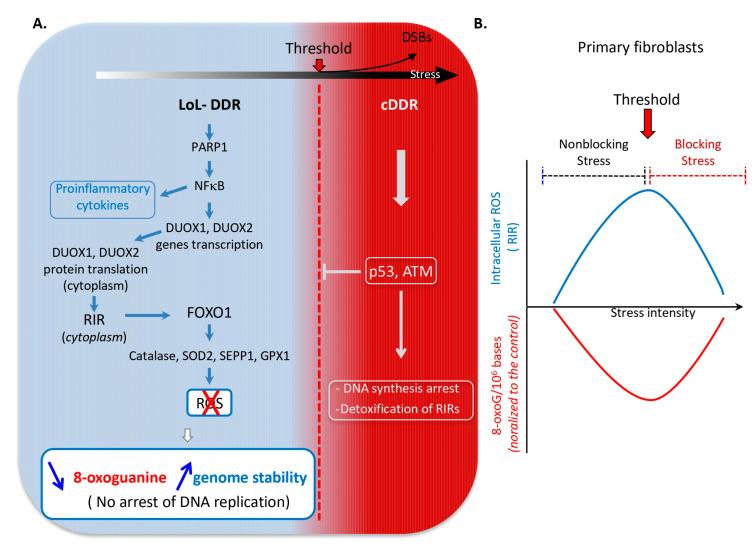
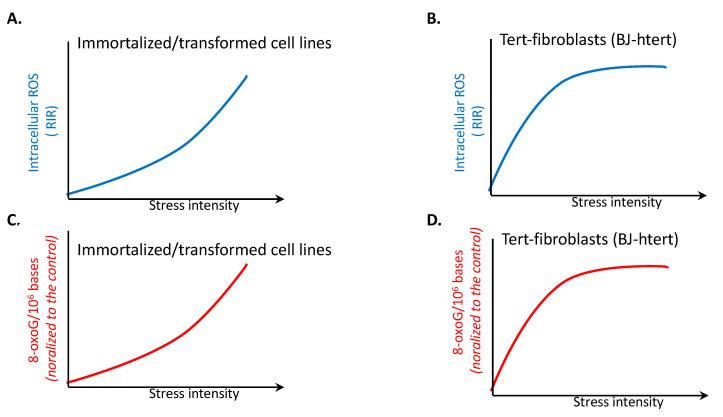
Cells are assaulted daily by stresses that jeopardize genome integrity. Primary human cells adapt their response to the intensity of replication stress (RS) in a diphasic manner: below a stress threshold, the canonical DNA damage response (cDDR) is not activated, but a noncanonical cellular response, low-level stress-DDR (LoL-DDR), has recently been described. LoL-DDR prevents the accumulation of premutagenic oxidized bases (8-oxoguanine) through the production of ROS in an adaptive way. The production of RS-induced ROS (RIR) is tightly controlled: RIR are excluded from the nucleus and are produced by the NADPH oxidases , which are controlled by NF-κB and PARP1; then, RIR activate the FOXO1-detoxifying pathway. Increasing the intensity of RS suppresses RIR via p53 and ATM. Notably, LoL-DDR is dysregulated in cancer cell lines, in which RIR are not produced by NADPH oxidases, are not detoxified under high-level stress, and favor the accumulation of 8-oxoguanine. LoL-DDR dysregulation occurred at an early stage of cancer progression in an in vitro model. Since, conversely, ROS trigger RS, this establishes a vicious cycle that continuously jeopardizes genome integrity, fueling tumorigenesis. These data reveal a novel type of ROS-controlled DNA damage response and demonstrate the fine-tuning of the cellular response to stress. The effects on genomic stability and carcinogenesis are discussed here.
细胞每天都会受到危害基因组完整性的应激因素的侵袭。原代人类细胞以双相方式调整其对复制应激(RS)强度的反应:在应激阈值以下,经典的DNA损伤反应(cDDR)不会被激活,但最近已描述了一种非经典的细胞反应,即低水平应激-DDR(LoL-DDR)。LoL-DDR通过以一种适应性方式产生活性氧(ROS)来防止诱变前氧化碱基(8-氧代鸟嘌呤)的积累。RS诱导的ROS(RIR)的产生受到严格控制:RIR被排除在细胞核外,由NADPH氧化酶产生,NADPH氧化酶受NF-κB和PARP1控制;然后,RIR激活FOXO1解毒途径。增加RS的强度会通过p53和ATM抑制RIR。值得注意的是,LoL-DDR在癌细胞系中失调,在癌细胞系中,RIR不是由NADPH氧化酶产生的,在高水平应激下不能被解毒,并且有利于8-氧代鸟嘌呤的积累。在体外模型中,LoL-DDR失调发生在癌症进展的早期阶段。相反,由于ROS会触发RS,这就建立了一个恶性循环,不断危害基因组完整性,促进肿瘤发生。这些数据揭示了一种新型的ROS控制的DNA损伤反应,并证明了细胞对应激反应的微调。本文讨论了其对基因组稳定性和致癌作用的影响。

 Zotero 插件