
2021年指南前后美国患者与临床医生关于肺癌筛查的讨论。
Patient-clinician discussions on lung cancer screening in the United States before and after 2021 guidelines.
作者信息
Williamson Timothy J, Brymwitt Whitney M, Hirsch Erin A, Reese McKenzie T, Carter-Bawa Lisa
机构信息
Department of Psychological Science, Loyola Marymount University, 1 LMU Drive, Suite 4700, Los Angeles, CA 90045, United States.
Center for Discovery & Innovation, Hackensack Meridian Health, 111 Ideation Way, Nutley, NJ 07110, United States.
出版信息
Transl Behav Med. 2025 Jan 16;15(1). doi: 10.1093/tbm/ibaf039.
BACKGROUND
Screening for lung cancer via low-dose computed tomography of the chest can promote early detection and reduce mortality. However, since the United States Preventive Service Task Force (USPSTF) issued lung cancer screening guidelines in 2013, uptake has been low. The USPSTF revised the guidelines in 2021 to expand eligibility.
PURPOSE
To determine whether patient-clinician discussions about lung cancer screening differs from 2017 to 2022 following 2021 revisions to the guidelines for lung cancer screening.
METHODS
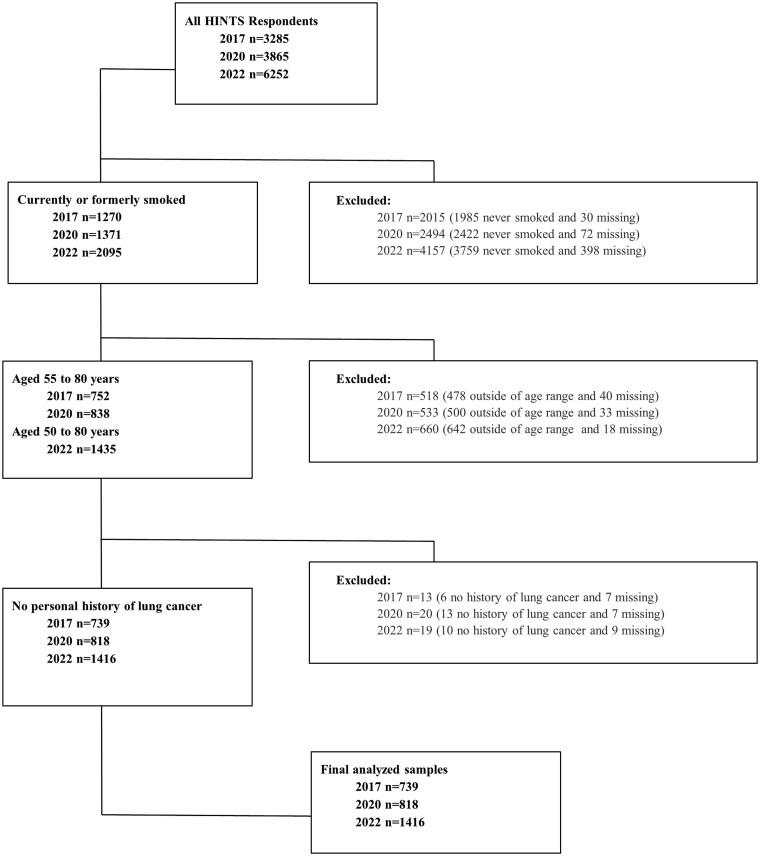
Data were obtained from the Health Information National Trends Survey (2017, 2020, and 2022). Community-dwelling US adults (N = 2973) were in the eligible age range for lung cancer screening (55-80 for 2017 and 2020; 50-80 for 2022), reported current or former smoking, and had no prior history of lung cancer. The primary outcome was self-reported patient-clinician discussions about lung cancer screening within the last 12 months.
RESULTS
The weighted proportion of respondents who discussed lung cancer screening with a healthcare provider was 12.34% in 2017, 13.77% in 2020, and 9.42% in 2022. The odds of reporting screening discussions were significantly lower in 2022 than 2020 (OR = 0.58, 95% CI [0.36, 0.93]). Individuals with insurance (OR = 9.12, 95% CI [2.81, 29.96]) and those who were currently smoking (OR = 2.80, 95% CI [1.89, 4.13]) had higher odds of discussing screening.
CONCLUSIONS
Patient-clinician discussions about lung cancer screening were lower in 2022 than 2020, despite revised guidelines that broadened eligibility. Research should explore strategies to increase awareness of lung cancer screening and prioritize discussions about screening among those who are uninsured and formerly smoked.
背景
通过胸部低剂量计算机断层扫描筛查肺癌可促进早期发现并降低死亡率。然而,自美国预防服务工作组(USPSTF)于2013年发布肺癌筛查指南以来,其接受率一直较低。USPSTF于2021年修订了指南以扩大适用范围。
目的
确定在2021年肺癌筛查指南修订后,2017年至2022年期间患者与临床医生关于肺癌筛查的讨论是否存在差异。
方法
数据来自健康信息国家趋势调查(2017年、2020年和2022年)。居住在社区的美国成年人(N = 2973)处于肺癌筛查的 eligible 年龄范围(2017年和2020年为55 - 80岁;2022年为50 - 80岁),报告有当前或既往吸烟史,且无肺癌既往史。主要结局是在过去12个月内患者自我报告的与临床医生关于肺癌筛查的讨论。
结果
2017年与医疗保健提供者讨论肺癌筛查的受访者加权比例为12.34%,2020年为13.77%,2022年为9.42%。2022年报告筛查讨论的几率显著低于2020年(OR = 0.58,95% CI [0.36, 0.93])。有保险的个体(OR = 9.12,95% CI [2.81, 29.96])和当前吸烟的个体(OR = 2.80,95% CI [1.89, 4.13])讨论筛查的几率更高。
结论
尽管修订后的指南扩大了适用范围,但2022年患者与临床医生关于肺癌筛查的讨论比2020年有所减少。研究应探索提高肺癌筛查意识的策略,并将未参保和既往吸烟者中的筛查讨论作为优先事项。

 Zotero 插件