
使用TriDFusion(3DF)的棕色脂肪组织机器学习nnU-Net V2网络。
Brown adipose tissue machine learning nnU-Net V2 network using TriDFusion (3DF).
作者信息
Lafontaine Daniel, Chahwan Stephanie, Barraza Gustavo, Ucpinar Burcin Agridag, Kayal Gunjan, Gómez-Banoy Nicolás, Cohen Paul, Humm John L, Schöder Heiko
机构信息
Department of Medical Physics, Memorial Sloan Kettering Cancer Center, New York, NY, USA.
Department of Radiology, Memorial Sloan Kettering Cancer Center, New York, NY, USA.
出版信息
EJNMMI Res. 2025 Aug 13;15(1):108. doi: 10.1186/s13550-025-01303-w.
BACKGROUND
Recent advances in machine learning have revolutionized medical imaging. Currently, identifying brown adipose tissue (BAT) relies on manual identification and segmentation on Fluorine- fluorodeoxyglucose positron emission tomography/computed tomography (F-FDG PET/CT) scans. However, the process is time-consuming, especially for studies involving a large number of cases, and is subject to bias due to observer dependency. The introduction of machine learning algorithms, such as the PET/CT algorithm implemented in the TriDFusion (3DF) Image Viewer, represents a significant advancement in BAT detection. In the context of cancer care, artificial intelligence (AI)-driven BAT detection holds immense promise for rapid and automatic differentiation between malignant lesions and non-malignant BAT confounds. By leveraging machine learning to discern intricate patterns in imaging data, this study aims to advance the automation of BAT recognition and provide precise quantitative assessment of radiographic features.
RESULTS
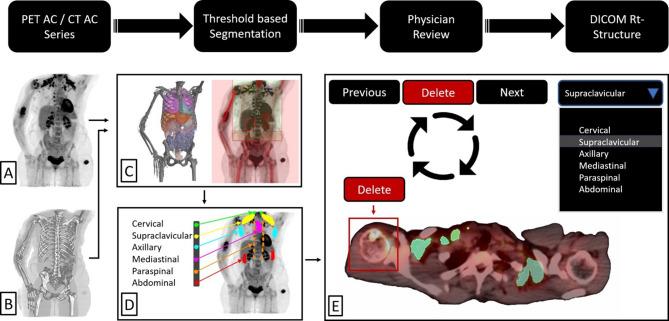
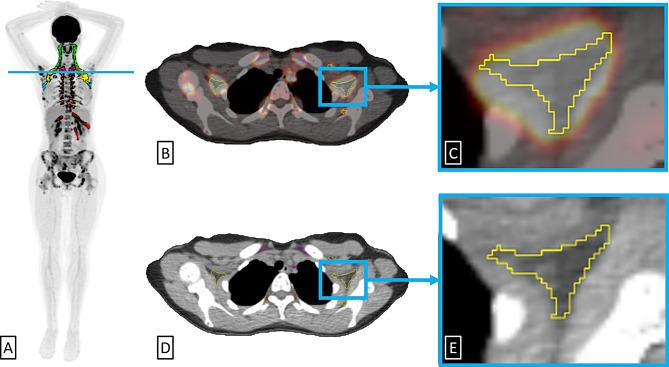
We used a semi-automatic, threshold-based 3DF workflow to segment 317 PET/CT scans containing BAT. To minimize manual edits, we defined exclusion zones via machine-learning-based CT organ segmentation and used those organ masks to assign each volume of interest (VOI) to its anatomical site. Three physicians then reviewed and corrected all segmentations using the 3DF contour panel. The final, edited masks were used to train an nnU-Net V2 model, which we subsequently applied to 118 independent PET/CT scans. Across all anatomical sites, physicians reviewed the network’s automated segmentations to be approximately 90% accurate.
CONCLUSION
Although nnU-Net V2 effectively identified BAT from PET/CT scans, training an AI model capable of perfect BAT segmentation remains a challenge due to factors such as PET/CT misregistration and the absence of visible BAT activity across contiguous slices.
背景
机器学习的最新进展彻底改变了医学成像。目前,识别棕色脂肪组织(BAT)依赖于在氟脱氧葡萄糖正电子发射断层扫描/计算机断层扫描(F-FDG PET/CT)扫描上进行手动识别和分割。然而,这个过程很耗时,尤其是对于涉及大量病例的研究,并且由于观察者的依赖性而容易产生偏差。机器学习算法的引入,如在TriDFusion(3DF)图像查看器中实现的PET/CT算法,代表了BAT检测的重大进展。在癌症护理的背景下,人工智能(AI)驱动的BAT检测对于快速自动区分恶性病变和非恶性BAT混淆物具有巨大的前景。通过利用机器学习来辨别成像数据中的复杂模式,本研究旨在推进BAT识别的自动化,并提供对放射学特征的精确定量评估。
结果
我们使用了一种基于阈值的半自动3DF工作流程来分割317张包含BAT的PET/CT扫描图像。为了尽量减少手动编辑,我们通过基于机器学习的CT器官分割定义了排除区域,并使用这些器官掩码将每个感兴趣体积(VOI)分配到其解剖部位。然后,三名医生使用3DF轮廓面板对所有分割进行了审查和校正。最终编辑后的掩码用于训练nnU-Net V2模型,随后我们将其应用于118张独立的PET/CT扫描图像。在所有解剖部位,医生审查发现该网络的自动分割准确率约为90%。
结论
尽管nnU-Net V2能够有效地从PET/CT扫描中识别出BAT,但由于PET/CT配准错误以及相邻切片中缺乏可见的BAT活性等因素,训练一个能够完美分割BAT的AI模型仍然是一个挑战。



 Zotero 插件