
低聚果糖对孕妇泌尿生殖道感染及分娩结局的影响:孟加拉国的一项随机对照试验
Effects of fructo-oligosaccharides on genitourinary tract infections and birth outcomes in pregnant women: a randomized controlled trial in Bangladesh.
作者信息
Sultana Shamima, Wagatsuma Yukiko, Sharmin Rumana, Ahmed Dilruba, Chowdhury Arif Hasan, Haque Ahshanul, Ahmed Tahmeed, Brüssow Harald, Sarker Shafiqul Alam
机构信息
International Centre for Diarrhoeal Disease Research, Bangladesh (icddr,b), 68 Shaheed Tajuddin Ahmed Sharani, Mohakhali, Dhaka, 1212, Bangladesh.
Institute of Medicine, University of Tsukuba, 1-1-1 Tennodai, Tsukuba, 305-8575, Japan.
出版信息
Trop Med Health. 2025 Aug 13;53(1):106. doi: 10.1186/s41182-025-00788-4.
BACKGROUND
Genitourinary tract infections, including bacterial vaginosis, which is characterized by the loss of Lactobacillus (LAB) in the vaginal microbiota, is a risk factor for low birth weight. The aim of this study was to examine the effects of fructo-oligosaccharide (FOS) supplementation on the incidence of genitourinary tract infections in pregnant women and the birth weights of newborns in Bangladesh.
METHODS
A randomized, double-blinded, placebo-controlled study was conducted in Dhaka, Bangladesh. Women in early pregnancy were randomized to the FOS or placebo groups (105 women per group), and supplements were provided daily until delivery. Stool samples were collected from women at baseline and at 24 and 36 weeks of gestation and from infants at birth for the analysis of LAB and Bifidobacterium by PCR. Vaginal swabs to test for bacterial vaginosis were collected at 18 and 30 weeks of gestation. Anthropometric measurements were taken at birth, and the newborns were followed up for 6 months.
RESULTS
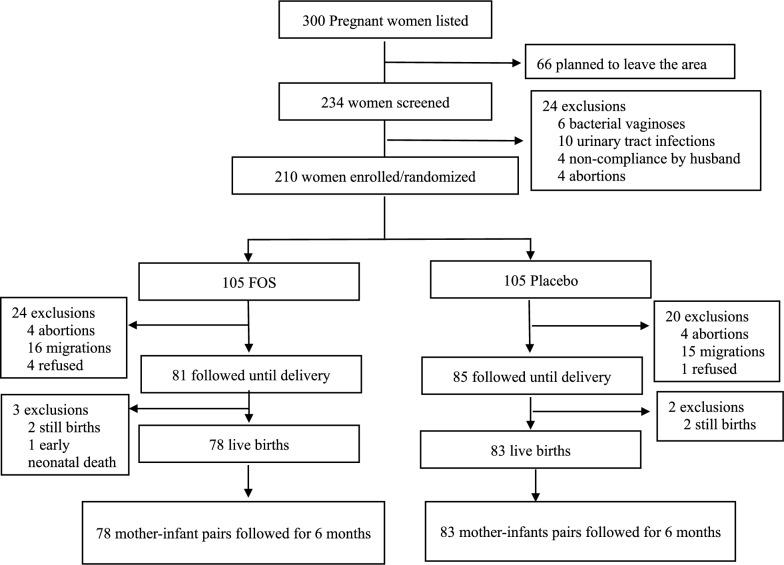
Of the 210 pregnant women, 8 had abortions, 5 refused the study product, 31 migrated, 4 had infants who were stillborn, and the neonate of 1 woman died early. The mean (SD) birth weight was 2799 (381) grams; 27 (17.0%) newborns had low birth weight (15.6% in the FOS group and 19.5% in the placebo group). Birth weight did not differ between the groups after adjusting for gestational week at birth and maternal early pregnancy BMI. Bacterial vaginoses were observed in 4.3% of women in the FOS group and 3.1% of women in the placebo group and were not statistically different between the groups. LAB colonization rates in stools of pregnant women at 24 and 36 gestational weeks did not differ between the groups. However, LAB colonization rate was higher in stools of infants in the FOS group than in those in the placebo group (68.8% in the FOS group and 51.2% in the placebo group, p = 0.024). This difference remained significant after adjusting for maternal age and LAB colonization at baseline (adjusted risk ratio (95% CI) = 1.45 (1.12-1.88), p = 0.005). The rate of Bifidobacterium colonization in the stools of infants did not differ between the groups.
CONCLUSIONS
FOS supplementation did not affect bacterial vaginosis incidence in pregnant women or infant birth weight. A higher rate of Lactobacillus in the stool samples of infants whose mothers received FOS was observed. Further studies are needed to confirm these findings with a large sample size.
TRIAL REGISTRATION
This study was registered at Clinicaltrials.gov (NCT02127225).
背景
包括细菌性阴道病在内的泌尿生殖道感染是低出生体重的一个危险因素,细菌性阴道病的特征是阴道微生物群中乳酸杆菌(LAB)缺失。本研究的目的是检测补充低聚果糖(FOS)对孟加拉国孕妇泌尿生殖道感染发生率及新生儿出生体重的影响。
方法
在孟加拉国达卡进行了一项随机、双盲、安慰剂对照研究。孕早期妇女被随机分为FOS组或安慰剂组(每组105名妇女),每天提供补充剂直至分娩。在基线、妊娠24周和36周时从妇女收集粪便样本,并在出生时从婴儿收集粪便样本,通过聚合酶链反应分析LAB和双歧杆菌。在妊娠18周和30周时收集阴道拭子检测细菌性阴道病。在出生时进行人体测量,并对新生儿进行6个月的随访。
结果
210名孕妇中,8人流产,5人拒绝研究产品,31人迁移,4人产下死胎婴儿,1名妇女的新生儿早夭。平均(标准差)出生体重为2799(381)克;27名(17.0%)新生儿出生体重低(FOS组为15.6%,安慰剂组为19.5%)。在调整出生孕周和母亲孕早期体重指数后,两组之间的出生体重无差异。FOS组4.3%的妇女和安慰剂组3.1%的妇女观察到细菌性阴道病,两组之间无统计学差异。妊娠24周和36周时孕妇粪便中的LAB定植率在两组之间无差异。然而,FOS组婴儿粪便中的LAB定植率高于安慰剂组(FOS组为68.8%,安慰剂组为51.2%,p = 0.024)。在调整母亲年龄和基线时的LAB定植后,这种差异仍然显著(调整后的风险比(95%可信区间)= 1.45(1.12 - 1.88),p = 0.005)。两组婴儿粪便中的双歧杆菌定植率无差异。
结论
补充FOS不影响孕妇细菌性阴道病的发生率或婴儿出生体重。观察到母亲接受FOS的婴儿粪便样本中乳酸杆菌的比例较高。需要进一步的研究以大样本量证实这些发现。
试验注册
本研究在Clinicaltrials.gov(NCT02127225)注册。

 Zotero 插件