
用于放射组学分析的RadiomiX:克服可重复性挑战的自动化方法。
RadiomiX for Radiomics Analysis: Automated Approaches to Overcome Challenges in Replicability.
作者信息
Kotler Harel, Bergamin Luca, Aiolli Fabio, Scagliori Elena, Grassi Angela, Pasello Giulia, Ferro Alessandra, Caumo Francesca, Gennaro Gisella
机构信息
Breast Radiology, Veneto Institute of Oncology IOV-IRCCS, 35128 Padua, Italy.
Department of Mathematics, University of Padova, 35128 Padua, Italy.
出版信息
Diagnostics (Basel). 2025 Aug 5;15(15):1968. doi: 10.3390/diagnostics15151968.
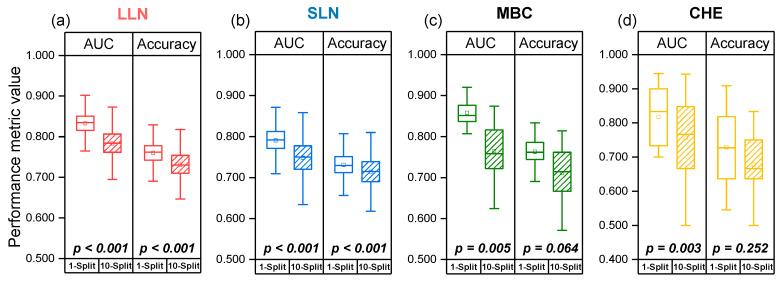
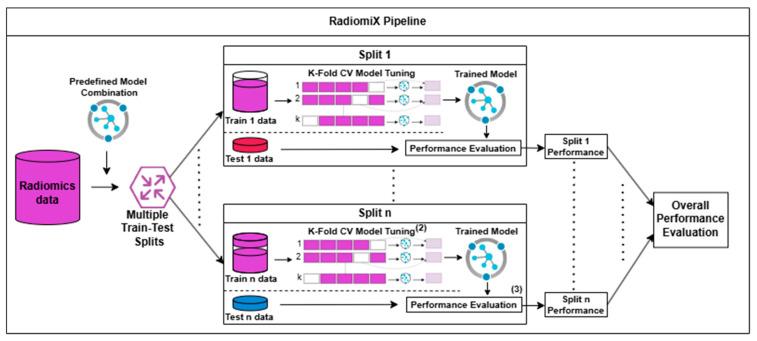
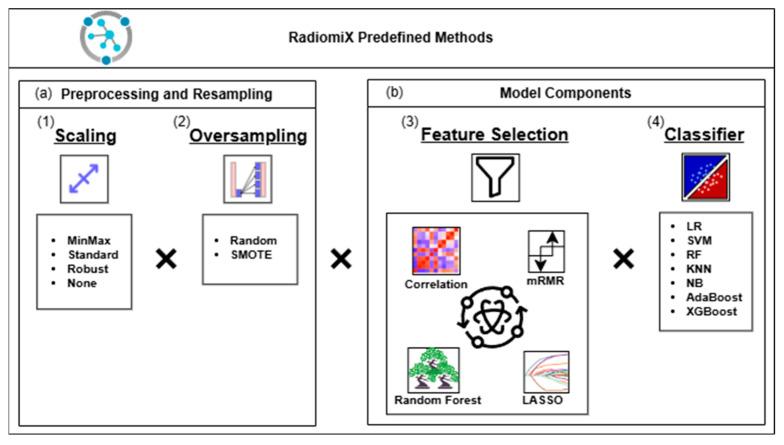
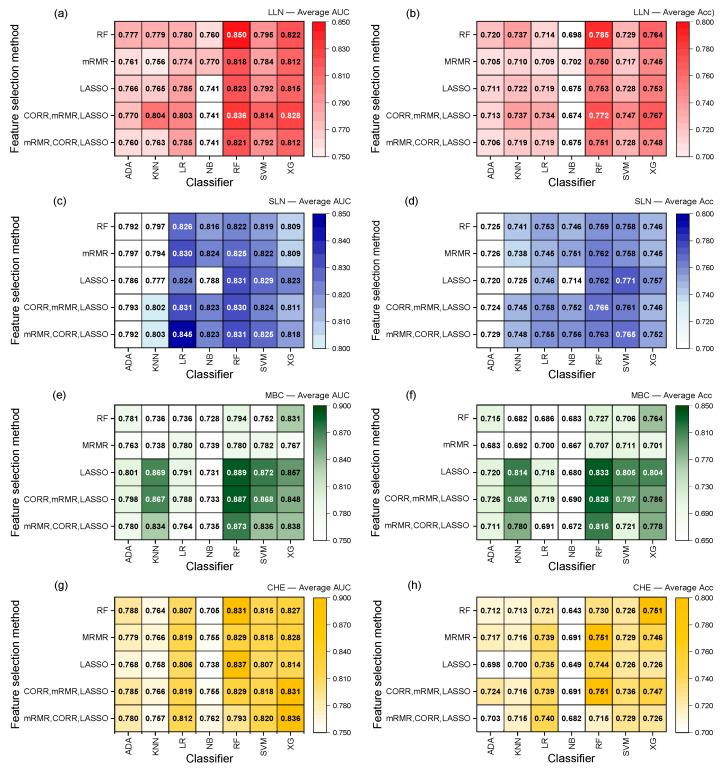
To simplify the decision-making process in radiomics by employing RadiomiX, an algorithm designed to automatically identify the best model combination and validate them across multiple environments was developed, thus enhancing the reliability of results. : RadiomiX systematically tests classifier and feature selection method combinations known to be suitable for radiomic datasets to determine the best-performing configuration across multiple train-test splits and K-fold cross-validation. The framework was validated on four public retrospective radiomics datasets including lung nodules, metastatic breast cancer, and hepatic encephalopathy using CT, PET/CT, and MRI modalities. Model performance was assessed using the area under the receiver-operating-characteristic curve (AUC) and accuracy metrics. RadiomiX achieved superior performance across four datasets: LLN (AUC = 0.850 and accuracy = 0.785), SLN (AUC = 0.845 and accuracy = 0.754), MBC (AUC = 0.889 and accuracy = 0.833), and CHE (AUC = 0.837 and accuracy = 0.730), significantly outperforming original published models ( < 0.001 for LLN/SLN and = 0.023 for MBC accuracy). When original published models were re-evaluated using ten-fold cross-validation, their performance decreased substantially: LLN (AUC = 0.783 and accuracy = 0.731), SLN (AUC = 0.748 and accuracy = 0.714), MBC (AUC = 0.764 and accuracy = 0.711), and CHE (AUC = 0.755 and accuracy = 0.677), further highlighting RadiomiX's methodological advantages. Systematically testing model combinations using RadiomiX has led to significant improvements in performance. This emphasizes the potential of automated ML as a step towards better-performing and more reliable radiomic models.
为了通过使用RadiomiX简化放射组学中的决策过程,开发了一种算法,该算法旨在自动识别最佳模型组合并在多个环境中对其进行验证,从而提高结果的可靠性。RadiomiX系统地测试已知适用于放射组学数据集的分类器和特征选择方法组合,以确定在多个训练-测试分割和K折交叉验证中的最佳性能配置。该框架在四个公开的回顾性放射组学数据集上进行了验证,这些数据集包括肺结节、转移性乳腺癌和肝性脑病,使用了CT、PET/CT和MRI模态。使用接收器操作特征曲线下面积(AUC)和准确性指标评估模型性能。RadiomiX在四个数据集上取得了卓越的性能:肺小结节(LLN,AUC = 0.850,准确性 = 0.785)、实性肺结节(SLN,AUC = 0.845,准确性 = 0.754)、转移性乳腺癌(MBC,AUC = 0.889,准确性 = 0.833)和肝性脑病(CHE,AUC = 0.837,准确性 = 0.730),显著优于最初发表的模型(LLN/SLN的P < 0.001,MBC准确性的P = 0.023)。当使用十折交叉验证重新评估最初发表的模型时,它们的性能大幅下降:LLN(AUC = 0.783,准确性 = 0.731)、SLN(AUC = 0.748,准确性 = 0.714)、MBC(AUC = 0.764,准确性 = 0.711)和CHE(AUC = 0.755,准确性 = 0.677),进一步突出了RadiomiX的方法学优势。使用RadiomiX系统地测试模型组合已带来性能的显著提升。这强调了自动化机器学习作为迈向性能更好、更可靠的放射组学模型的一步的潜力。

 Zotero 插件