
阿贝西利在希腊激素受体阳性/人表皮生长因子受体2阴性乳腺癌患者中的真实世界毒性和有效性研究:一项多机构研究。
Real-World Toxicity and Effectiveness Study of Abemaciclib in Greek Patients with Hormone Receptor-Positive/Human Epidermal Growth Factor Receptor 2-Negative Breast Cancer: A Multi-Institutional Study.
作者信息
Fountzilas Elena, Aravantinou-Fatorou Eleni, Dadouli Katerina, Economopoulou Panagiota, Tryfonopoulos Dimitrios, Vernadou Anastasia, Vorrias Eleftherios, Vagionas Anastasios, Nikolaidi Adamantia, Karageorgopoulou Sofia, Koumarianou Anna, Boukovinas Ioannis, Mauri Davide, Kokkali Stefania, Christopoulou Athina, Tsoukalas Nikolaos, Assi Avraam, Spathas Nikolaos, Kosmidis Paris, Koutras Angelos, Fountzilas George, Psyrri Amanda
机构信息
Department of Medical Oncology, St. Luke's Clinic, 55236 Thessaloniki, Greece.
Medical Oncology, European University Cyprus, Engomi 2404, Cyprus.
出版信息
Cancers (Basel). 2025 Jul 31;17(15):2543. doi: 10.3390/cancers17152543.
BACKGROUND/OBJECTIVES: This study aimed to assess real-world toxicity and efficacy data of patients with early and advanced breast cancer (BC) who received treatment with abemaciclib.
METHODS
This was a prospective/retrospective multi-institutional collection of clinicopathological, toxicity, and outcome data from patients with early or metastatic hormone receptor (HR)-positive, human epidermal growth factor receptor 2 (HER2)-negative BC who received treatment with abemaciclib in combination with endocrine therapy in departments of oncology in Greece. Treatment combinations of abemaciclib with any endocrine therapy were accepted. The primary end point was toxicity rate in all patients of the study.
RESULTS
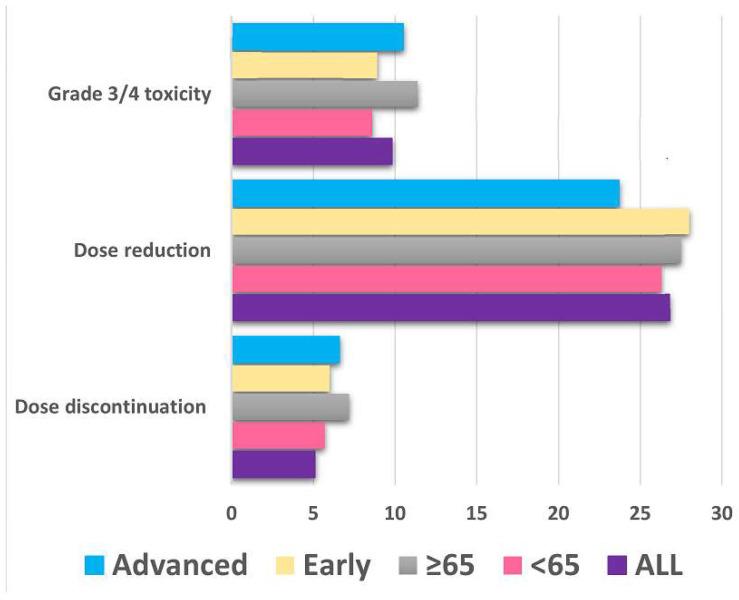
From June/2021 to May/2024, 245 women received abemaciclib/endocrine combination therapy; the median age was 57 years. Of these, 169 (69%) received abemaciclib as adjuvant therapy for early-stage disease, while 76 (31%) were treated for advanced BC. At the time of the data cutoff, 133 (84.7%) patients remained in the 2-year treatment period. The most common adverse event (AE) was diarrhea (51%), primarily Grade ≤ 2. Dose modifications due to AEs were required in 19.2% of cases, while treatment discontinuation occurred in 5.1%. There was no difference in dose modification/discontinuation rates between older patients (>65 years) and the remaining patients. For early-stage BC patients, the 2-year DFS and OS rates were 90.8% and 100%, respectively. In patients with advanced cancer (70, 30.8%), 1-year PFS and OS rates were 78% and 96.3%, respectively.
CONCLUSIONS
This study confirms the safety and effectiveness of abemaciclib in alignment with registrational trials offering valuable insights into toxicity management and clinical outcomes in routine practice without identifying new safety concerns.
CLINICAL TRIAL REGISTRATION
ClinicalTrials.gov NCT04985058.
背景/目的:本研究旨在评估接受阿贝西利治疗的早期和晚期乳腺癌(BC)患者的真实世界毒性和疗效数据。
方法
这是一项前瞻性/回顾性多机构收集的临床病理、毒性和结局数据,来自希腊肿瘤学部门接受阿贝西利联合内分泌治疗的早期或转移性激素受体(HR)阳性、人表皮生长因子受体2(HER2)阴性乳腺癌患者。接受阿贝西利与任何内分泌治疗的联合方案。主要终点是研究中所有患者的毒性发生率。
结果
从2021年6月至2024年5月,245名女性接受了阿贝西利/内分泌联合治疗;中位年龄为57岁。其中,169名(69%)接受阿贝西利作为早期疾病的辅助治疗,而76名(31%)接受晚期乳腺癌治疗。在数据截止时,133名(84.7%)患者仍处于2年治疗期。最常见的不良事件(AE)是腹泻(51%),主要为≤2级。19.2%的病例因AE需要调整剂量,5.1%的患者停止治疗。老年患者(>65岁)和其余患者之间在剂量调整/停药率方面没有差异。对于早期乳腺癌患者,2年无病生存率(DFS)和总生存率(OS)分别为90.8%和100%。在晚期癌症患者(70名,30.8%)中,1年无进展生存率(PFS)和总生存率分别为78%和96.3%。
结论
本研究证实了阿贝西利的安全性和有效性,与注册试验一致,为常规实践中的毒性管理和临床结局提供了有价值的见解,且未发现新的安全问题。
临床试验注册
ClinicalTrials.gov NCT04985058。


 Zotero 插件