
抗草甘膦水稻(L.)基因突变检测方法的建立
Methods Established for Gene Mutation Detection in Glyphosate-Resistant Rice ( L.).
作者信息
Chen Xiuping, Yu Huilin, Huang Chunmeng, Hou Chenhui, Guan Haoyuan, Xie Jiajian
机构信息
State Key Laboratory for Biology of Plant Diseases and Insect Pests, Institute of Plant Protection, Chinese Academy of Agricultural Sciences, Beijing 100193, China.
出版信息
Plants (Basel). 2025 Jul 22;14(15):2256. doi: 10.3390/plants14152256.
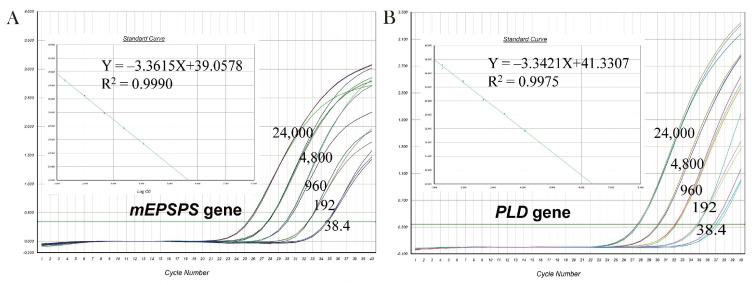
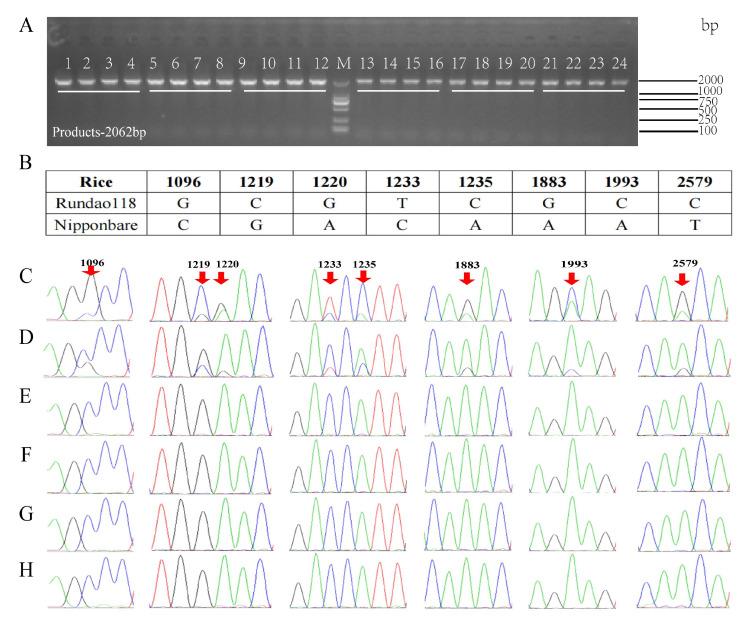
"Rundao118" is a glyphosate-resistant rice; it contains both endogenous wild and mutated 5-enolpyruvylshikimate-3-phosphate synthase ( genes. Conventional qualitative and quantitative detection methods face significant challenges for direct analysis. Here, we describe five detection methods for identifying mutations in this rice line: (1) polymerase chain reaction (PCR) amplification-based Sanger sequencing, (2) next-generation sequencing (NGS) based on PCR amplification, (3) allele-specific PCR (AS-PCR), (4) real-time fluorescent quantitative PCR (qPCR), and (5) blocker displacement amplification (BDA). All five methods effectively identified mutations, with the following detection sensitivities: Sanger, 10%; NGS, 1%; AS-PCR, 0.05%; qPCR, 0.01%; and BDA, 0.1%. Among these, the Sanger, NGS, and BDA methods excelled at the rapid identification of single-nucleotide mutations, making them suitable for precise mutation site characterization and identification. In contrast, the AS-PCR and qPCR methods were more appropriate for large-scale rapid screening of known mutation sites. The detection systems established in this study provide a comprehensive technical solution for rapid identification of mutations in glyphosate-resistant rice. These methods not only enable accurate determination of mutation sequences but also effectively trace mutation origins, offering crucial technical support for both safety regulations and intellectual property protection.
“润稻118”是一种抗草甘膦水稻;它同时含有内源性野生型和突变型5-烯醇丙酮酰莽草酸-3-磷酸合酶基因。传统的定性和定量检测方法在直接分析上面临重大挑战。在此,我们描述了五种用于鉴定该水稻品系中突变的检测方法:(1)基于聚合酶链反应(PCR)扩增的桑格测序法,(2)基于PCR扩增的新一代测序(NGS)法,(3)等位基因特异性PCR(AS-PCR)法,(4)实时荧光定量PCR(qPCR)法,以及(5)阻断剂置换扩增(BDA)法。这五种方法均能有效鉴定突变,其检测灵敏度如下:桑格测序法为10%;新一代测序法为1%;等位基因特异性PCR法为0.05%;实时荧光定量PCR法为0.01%;阻断剂置换扩增法为0.1%。其中,桑格测序法、新一代测序法和阻断剂置换扩增法在快速鉴定单核苷酸突变方面表现出色,适用于精确的突变位点表征和鉴定。相比之下,等位基因特异性PCR法和实时荧光定量PCR法更适合对已知突变位点进行大规模快速筛查。本研究建立的检测系统为快速鉴定抗草甘膦水稻中的突变提供了全面的技术方案。这些方法不仅能够准确测定突变序列,还能有效追溯突变来源,为安全监管和知识产权保护提供了关键的技术支持。


 Zotero 插件