
来自[具体来源未提及]的生物活性查耳酮:对肝癌细胞和神经癌细胞的分离及细胞毒性
Bioactive Chalcones from : Isolation and Cytotoxicity Against Liver and Neural Cancer Cells.
作者信息
Eltahir Ali O E, Sheik Abdul Naeem, Docrat Taskeen F, Bristow Paolo, Chipofya Elias, Luckay Robert C, Nyila Monde A, Marnewick Jeanine L, Ndjoubi Kadidiatou O, Hussein Ahmed A
机构信息
Department of Chemistry, Cape Peninsula University of Technology, Bellville 7535, South Africa.
Department of Biochemistry, Stellenbosch University, Stellenbosch 7600, South Africa.
出版信息
Plants (Basel). 2025 Aug 2;14(15):2389. doi: 10.3390/plants14152389.
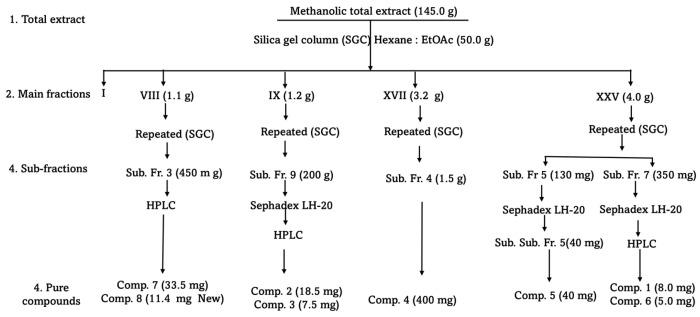
(L.) Klak (Synonym L.) is traditionally used for a variety of medicinal purposes; however, it has been reported to cause liver damage and severe ascites, particularly in sheep and Angora goats in the arid regions of the Western Cape. This study explores its cytotoxic properties to identify potential cytotoxic compound(s) in the plant. The methanolic extract of was re-investigated and subjected to various chromatographic techniques, including preparative HPLC, resulting in the isolation of eight compounds (-). Structural elucidation was primarily based on NMR data. Among the isolated compounds, four were flavanones, one was a flavonone, and three were chalcones. Notably, compound was identified as a new chalcone, while compounds and were reported for the first time from this plant. The toxicity of these isolated compounds was evaluated against the HepG2 and SH-SY5Y cancer cell lines using the MTT assay. We further investigated markers of cell death using spectrophotometric and luminometric methods. Among the isolated compounds, and exhibited cytotoxic activities within the range of 3.0-20.0 µg/mL. Notably, the compounds demonstrated greater cytotoxicity towards liver-derived HepG2 cells compared to the neuronal SH-SY5Y cell line. Compound (2',4'-dihydroxychalcone) was identified as inducing apoptosis through the intrinsic pathway without causing overt necrosis. The findings indicate that the phytochemicals derived from exhibit differential cytotoxic effects based on cell type, suggesting potential for developing novel anticancer agents, particularly compound . Additionally, the identification of compound provides insight into the liver toxicity of this plant observed in sheep in South Africa.
(L.) Klak(同义词L.)传统上用于多种药用目的;然而,据报道它会导致肝损伤和严重腹水,特别是在西开普干旱地区的绵羊和安哥拉山羊中。本研究探索其细胞毒性特性,以确定该植物中潜在的细胞毒性化合物。对 的甲醇提取物进行了重新研究,并采用了各种色谱技术,包括制备型高效液相色谱,从中分离出了8种化合物(-)。结构解析主要基于核磁共振数据。在分离出的化合物中,有4种是黄烷酮,1种是黄酮酮,3种是查耳酮。值得注意的是,化合物 被鉴定为一种新的查耳酮,而化合物 和 是首次从该植物中报道。使用MTT法评估了这些分离化合物对HepG2和SH-SY5Y癌细胞系的毒性。我们进一步使用分光光度法和发光法研究了细胞死亡标记物。在分离出的化合物中, 和 在3.0 - 20.0 µg/mL范围内表现出细胞毒性活性。值得注意的是,与神经元SH-SY5Y细胞系相比,这些化合物对源自肝脏的HepG2细胞表现出更大的细胞毒性。化合物 (2',4'-二羟基查耳酮)被确定通过内在途径诱导细胞凋亡而不引起明显坏死。研究结果表明,源自 的植物化学物质根据细胞类型表现出不同的细胞毒性作用,这表明开发新型抗癌药物具有潜力,特别是化合物 。此外,化合物 的鉴定为在南非绵羊中观察到的这种植物的肝毒性提供了见解。


 Zotero 插件