
基于组学的晚期前列腺癌治疗:迈向精准肿瘤学
Omics-Mediated Treatment for Advanced Prostate Cancer: Moving Towards Precision Oncology.
作者信息
Fatima Yasra, Jobre Kirubel Nigusu, Gomez-Gomez Enrique, Małkiewicz Bartosz, Vlahou Antonia, Mokou Marika, Mischak Harald, Frantzi Maria, Jankowski Vera
机构信息
Department of Biomarker Research, Mosaiques Diagnostics GmbH, 30659 Hannover, Germany.
Institute for Molecular Cardiovascular Research (IMCAR), RWTH Aachen University, 52074 Aachen, Germany.
出版信息
Int J Mol Sci. 2025 Aug 2;26(15):7475. doi: 10.3390/ijms26157475.
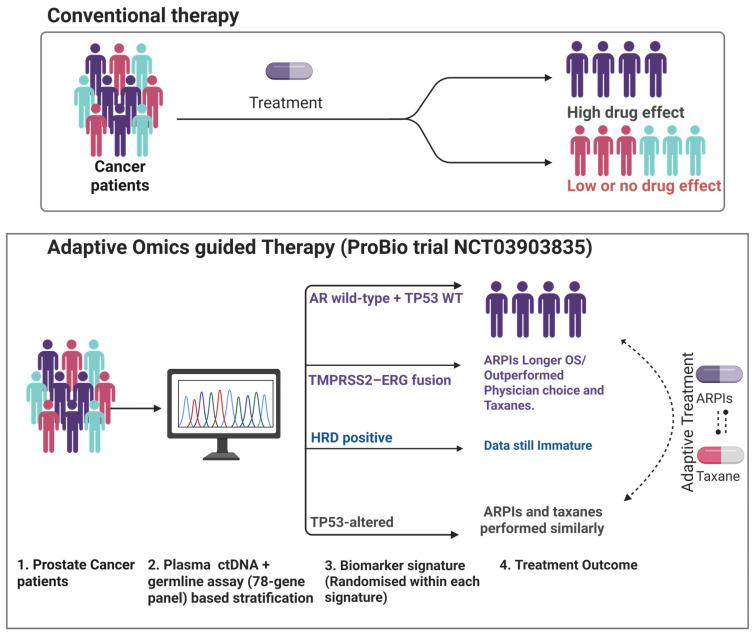
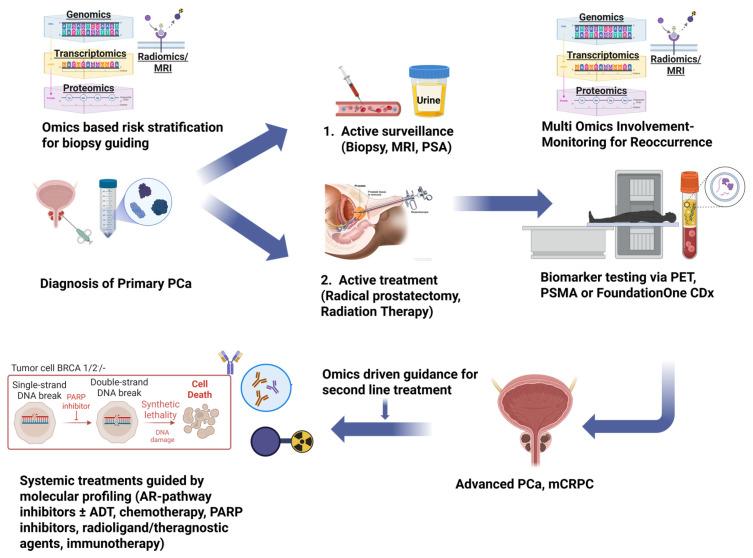
Prostate cancer accounts for approximately 1.5 million new diagnoses and 400,000 deaths every year worldwide, and demographic projections indicate a near-doubling of both figures by 2040. Despite existing treatments, 10-20% of patients eventually progress to metastatic castration-resistant disease (mCRPC). The median overall survival (OS) after progression to mCPRC drops to 24 months, and efficacy drops severely after each additional line of treatment. Omics platforms have reached advanced levels and enable the acquisition of high-resolution large datasets that can provide insights into the molecular mechanisms underlying PCa pathology. Genomics, especially DDR (DNA damage response) gene alterations, detected via tissue and/or circulating tumor DNA, efficiently guides therapy in advanced prostate cancer. Given recent developments, we have performed a comprehensive literature search to cover recent research and clinical trial reports (over the last five years) that integrate omics along three converging trajectories in therapeutic development: (i) predicting response to approved agents with demonstrated survival benefits, (ii) stratifying patients to receive therapies in clinical trials, (iii) guiding drug development as part of drug repurposing frameworks. Collectively, this review is intended to serve as a comprehensive resource of recent advancements in omics-guided therapies for advanced prostate cancer, a clinical setting with existing clinical needs and poor outcomes.
前列腺癌每年在全球范围内导致约150万新发病例和40万例死亡,人口统计学预测表明,到2040年这两个数字将几乎翻倍。尽管有现有的治疗方法,但仍有10%-20%的患者最终进展为转移性去势抵抗性疾病(mCRPC)。进展为mCRPC后的中位总生存期(OS)降至24个月,并且每增加一线治疗后疗效会严重下降。组学平台已达到先进水平,能够获取高分辨率的大型数据集,这些数据集可以深入了解前列腺癌病理的分子机制。通过组织和/或循环肿瘤DNA检测到的基因组学,尤其是DDR(DNA损伤反应)基因改变,有效地指导了晚期前列腺癌的治疗。鉴于最近的进展,我们进行了全面的文献检索,以涵盖最近的研究和临床试验报告(过去五年),这些研究和报告在治疗开发中沿着三条趋同的轨迹整合了组学:(i)预测对已证明具有生存益处的获批药物的反应,(ii)在临床试验中对患者进行分层以接受治疗,(iii)作为药物重新利用框架的一部分指导药物开发。总体而言,本综述旨在作为晚期前列腺癌组学指导治疗的最新进展的全面资源,这是一个存在临床需求且预后不佳的临床环境。


 Zotero 插件