
让乙酰胆碱再次强大!澳大利亚石龙子无视蛇毒,进化出多种抗神经毒素的烟碱型乙酰胆碱受体。
Make Acetylcholine Great Again! Australian Skinks Evolved Multiple Neurotoxin-Proof Nicotinic Acetylcholine Receptors in Defiance of Snake Venom.
作者信息
Chandrasekara Uthpala, Mancuso Marco, Shea Glenn, Jones Lee, Kwiatkowski Jacek, Trembath Dane, Chowdhury Abhinandan, Bertozzi Terry, Gardner Michael G, Hoskin Conrad J, Zdenek Christina N, Fry Bryan G
机构信息
Adaptive Biotoxicology Lab, School of the Environment, University of Queensland, St Lucia, QLD 4072, Australia.
Department of Biological, Geological and Environmental Sciences, University of Catania, Via Etnea, 64, 95131 Catania, CT, Italy.
出版信息
Int J Mol Sci. 2025 Aug 4;26(15):7510. doi: 10.3390/ijms26157510.
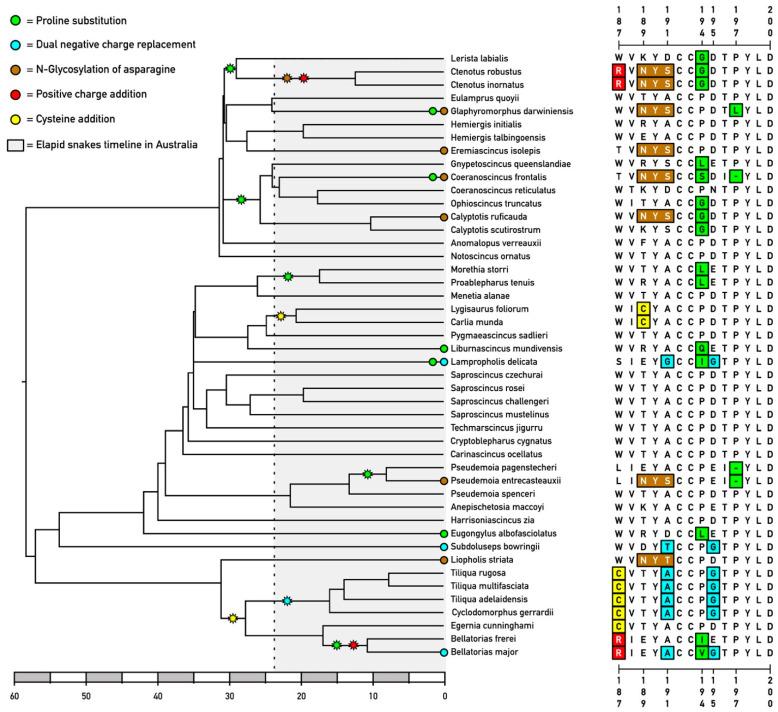
Many vertebrates have evolved resistance to snake venom as a result of coevolutionary chemical arms races. In Australian skinks (family Scincidae), who often encounter venomous elapid snakes, the frequency, diversity, and molecular basis of venom resistance have been unexplored. This study investigated the evolution of neurotoxin resistance in Australian skinks, focusing on mutations in the muscle nicotinic acetylcholine receptor (nAChR) α1 subunit's orthosteric site that prevent pathophysiological binding by α-neurotoxins. We sampled a broad taxonomic range of Australian skinks and sequenced the nAChR α1 subunit gene. Key resistance-conferring mutations at the toxin-binding site (N-glycosylation motifs, proline substitutions, arginine insertions, changes in the electrochemical state of the receptor, and novel cysteines) were identified and mapped onto the skink organismal phylogeny. Comparisons with other venom-resistant taxa (amphibians, mammals, and reptiles) were performed, and structural modelling and binding assays were used to evaluate the impact of these mutations. Multiple independent origins of α-neurotoxin resistance were found across diverse skink lineages. Thirteen lineages evolved at least one resistance motif and twelve additional motifs evolved within these lineages, for a total of twenty-five times of α-neurotoxic venoms resistance. These changes sterically or electrostatically inhibit neurotoxin binding. Convergent mutations at the orthosteric site include the introduction of N-linked glycosylation sites previously known from animals as diverse as cobras and mongooses. However, an arginine (R) substitution at position 187 was also shown to have evolved on multiple occasions in Australian skinks, a modification previously shown to be responsible for the Honey Badger's iconic resistance to cobra venom. Functional testing confirmed this mode of resistance in skinks. Our findings reveal that venom resistance has evolved extensively and convergently in Australian skinks through repeated molecular adaptations of the nAChR in response to the enormous selection pressure exerted by elapid snakes subsequent to their arrival and continent-wide dispersal in Australia. These toxicological findings highlight a remarkable example of convergent evolution across vertebrates and provide insight into the adaptive significance of toxin resistance in snake-lizard ecological interactions.
由于共同进化的化学军备竞赛,许多脊椎动物已经进化出对蛇毒的抗性。在经常遭遇有毒眼镜蛇科蛇类的澳大利亚石龙子(石龙子科)中,毒液抗性的频率、多样性和分子基础尚未得到探索。本研究调查了澳大利亚石龙子对神经毒素抗性的进化,重点关注肌肉烟碱型乙酰胆碱受体(nAChR)α1亚基正构位点的突变,这些突变可阻止α-神经毒素的病理生理结合。我们对广泛分类范围的澳大利亚石龙子进行了采样,并对nAChR α1亚基基因进行了测序。确定了毒素结合位点的关键抗性赋予突变(N-糖基化基序、脯氨酸取代、精氨酸插入、受体电化学状态的变化以及新的半胱氨酸),并将其映射到石龙子系统发育树上。与其他抗毒液类群(两栖动物、哺乳动物和爬行动物)进行了比较,并使用结构建模和结合试验来评估这些突变的影响。在不同的石龙子谱系中发现了α-神经毒素抗性的多个独立起源。13个谱系进化出至少一个抗性基序,在这些谱系中又进化出12个额外的基序,α-神经毒性毒液抗性总共出现了25次。这些变化在空间上或静电上抑制神经毒素结合。正构位点的趋同突变包括引入N-连接糖基化位点,这种位点在从眼镜蛇到獴等多种动物中都有发现。然而,第187位的精氨酸(R)取代在澳大利亚石龙子中也多次进化,这种修饰先前被证明是蜜獾对眼镜蛇毒液具有标志性抗性的原因。功能测试证实了石龙子的这种抗性模式。我们的研究结果表明,在澳大利亚,由于眼镜蛇科蛇类到来并在大陆范围内扩散后施加的巨大选择压力,石龙子通过对nAChR的反复分子适应,广泛且趋同地进化出了毒液抗性。这些毒理学发现突出了脊椎动物中趋同进化的一个显著例子,并为蛇-蜥蜴生态相互作用中毒素抗性的适应性意义提供了见解。


 Zotero 插件