
估算M5豇豆((L.) Walp)突变系形态农艺性状的遗传变异性和遗传力。
Estimating Genetic Variability and Heritability of Morpho-Agronomic Traits of M5 Cowpea ( (L.) Walp) Mutant Lines.
作者信息
Ramolekwa Kelebonye, Pholo-Tait Motlalepula, Parker Travis, Malambane Goitseone, Ngwako Samodimo, Lekgari Lekgari
机构信息
Department of Crop and Soil Sciences, Botswana University of Agriculture and Natural Resources, Private 0027, Gaborone 00267, Botswana.
Faculty of Research and Graduate Studies, Research Centre for Bioeconomy, Botswana University of Agriculture and Natural Resources, Private Bag 0027, Gaborone 00267, Botswana.
出版信息
Int J Mol Sci. 2025 Aug 5;26(15):7543. doi: 10.3390/ijms26157543.
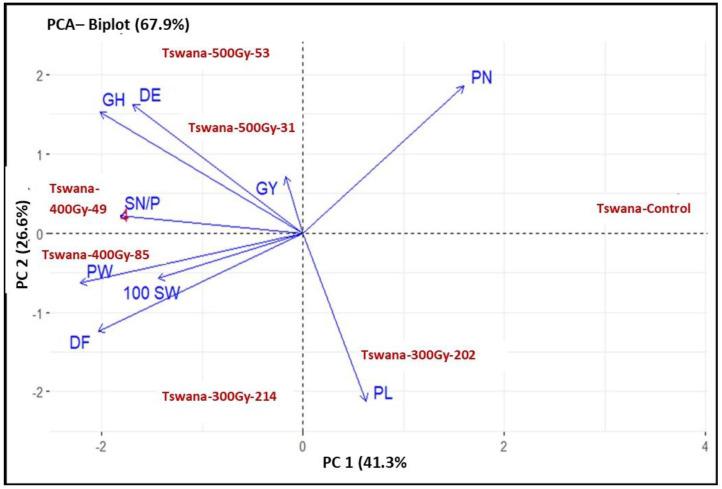
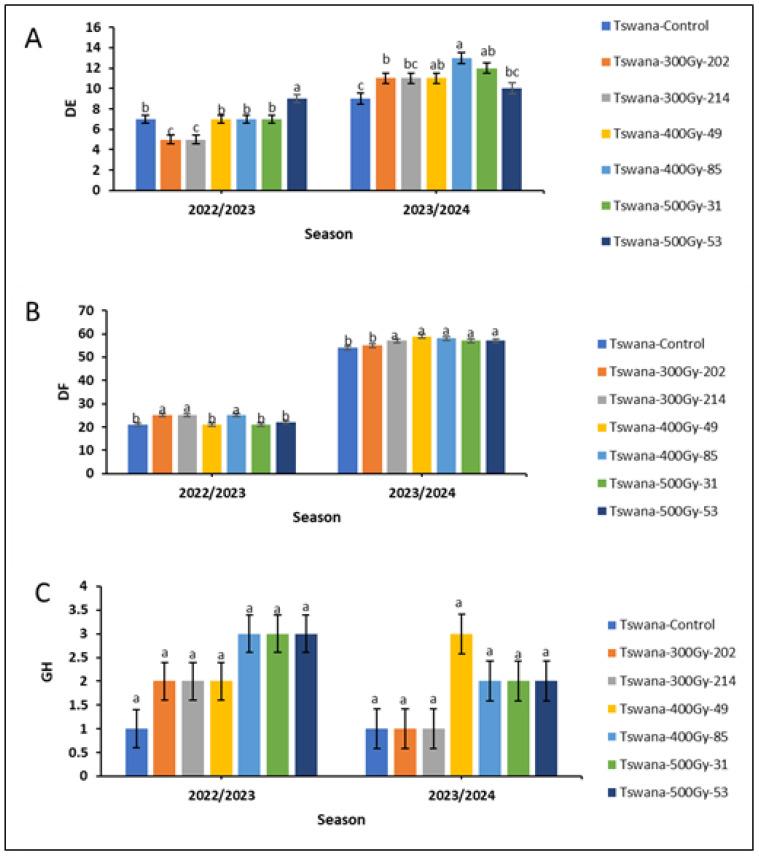
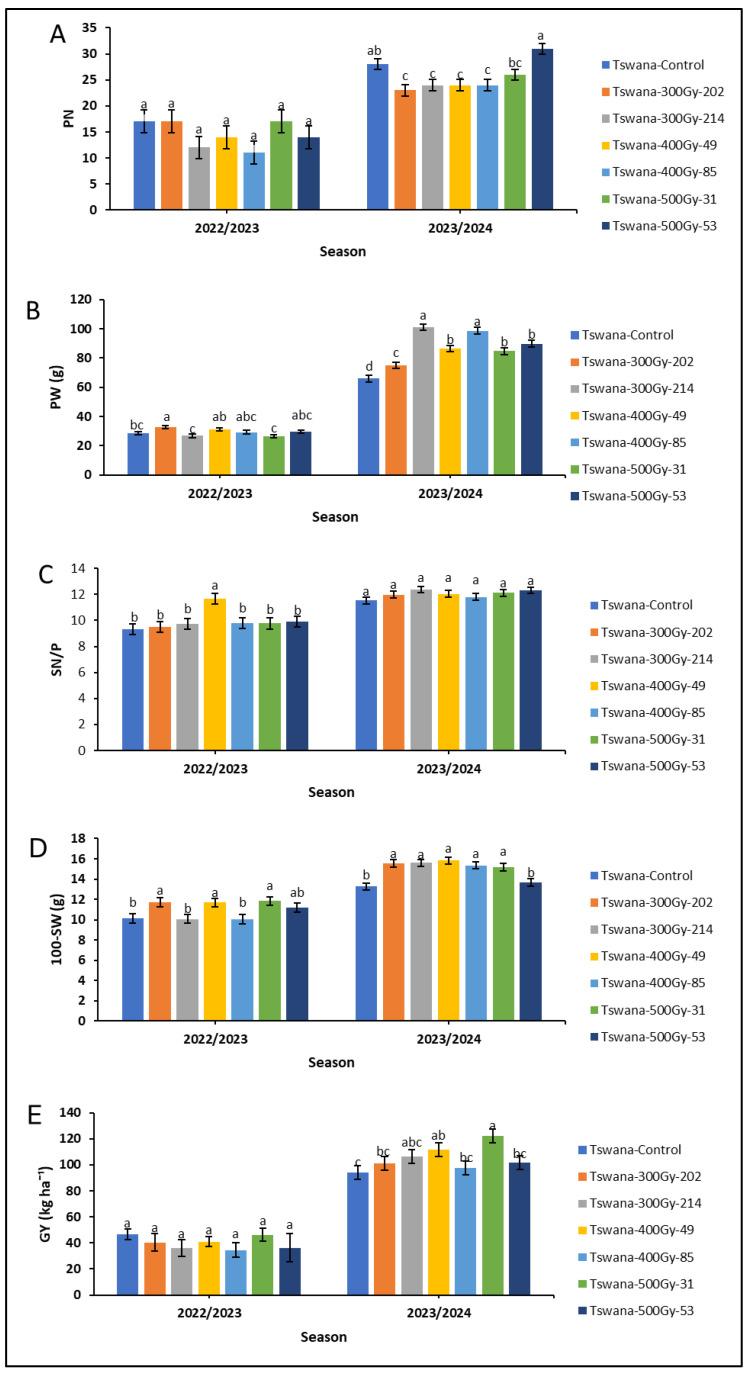
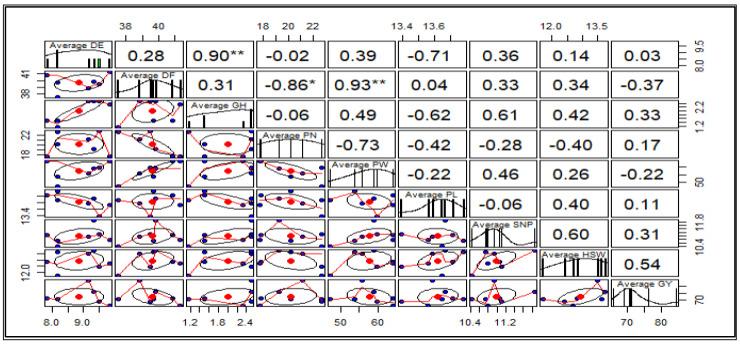
Induced mutation plays an integral part in plant breeding as it introduces new variability among the population. A study was conducted in cowpeas [ (L.) Walp] to assess the yield divergence, heritability, genetic advance, and correlation among the M5 Tswana cowpea mutants. The experiment utilized seven genotypes under rainfed and supplementary irrigation during the 2022/23 and 2023/24 cropping seasons. The mutant lines demonstrated significant variations in days to 50% emergence (DE) and days to 50% flowering (DF). Tswana emerged earlier (5-7 days) and flowered in 21-54 days across the two seasons, compared to some of the mutant lines. The yield and yield components varied among some mutant lines and the control. Most importantly, mutants outperformed the Tswana control for some of these traits, indicating potential for genetic improvement. An analysis of genetic parameters revealed minimal environmental influences on some of the observed traits (GH, PN, GY), while others showed little environmental impact. Variation in heritability (H) and genetic advance (GA%) between the two seasons limited the contribution of genotypic effects in the expression of the studied traits. Correlation analysis revealed strong and significant positive associations between DE and GH, as well as between DF and PW. Most traits, except DF and PW, were positively correlated with grain yield (GY), although the correlations were not significantly different. Cluster analysis grouped the genotypes into four distinct clusters. Principal component analysis (PCA) revealed the superiority of mutant lines (Tswana-300Gy-214, Tswana-400Gy mutant lines, and Tswana-500Gy-31) in their association with improved GY, pod weight (PW), 100-seed weight (100-SW), and seed number per pod (SN/P). Interestingly, the Tswana control formed a separate cluster and diverged from the mutants in PCA, suggesting that induced mutagenesis effectively targeted genes controlling the traits considered in this study.
诱变在植物育种中起着不可或缺的作用,因为它能在种群中引入新的变异性。在豇豆[(L.)Walp]上开展了一项研究,以评估M5 茨瓦纳豇豆突变体之间的产量差异、遗传力、遗传进展及相关性。该试验在2022/23年和2023/24年种植季节,对7个基因型进行了雨养和补充灌溉处理。突变系在50%出苗天数(DE)和50%开花天数(DF)上表现出显著差异。与一些突变系相比,茨瓦纳在两个季节中出苗更早(5 - 7天),且在21 - 54天内开花。一些突变系与对照之间的产量及产量构成因素存在差异。最重要的是,在其中一些性状上,突变体的表现优于茨瓦纳对照,表明具有遗传改良潜力。对遗传参数的分析表明,环境对一些观察到的性状(GH、PN、GY)影响极小,而其他性状受环境影响较小。两个季节之间遗传力(H)和遗传进展(GA%)的变化限制了基因型效应在研究性状表达中的贡献。相关性分析表明,DE与GH之间以及DF与PW之间存在强烈且显著的正相关。除DF和PW外,大多数性状与籽粒产量(GY)呈正相关,尽管相关性无显著差异。聚类分析将基因型分为四个不同的类群。主成分分析(PCA)表明,突变系(茨瓦纳 - 300Gy - 214、茨瓦纳 - 400Gy突变系和茨瓦纳 - 500Gy - 31)在与提高GY、荚重(PW)、百粒重(100 - SW)和每荚粒数(SN/P)的关联方面具有优势。有趣的是,茨瓦纳对照形成了一个单独的类群,并且在PCA中与突变体不同,这表明诱变有效地靶向了控制本研究中所考虑性状的基因。

 Zotero 插件