
波兰中度至重度银屑病患者队列中白细胞介素-17抑制剂长期真实世界疗效的比较分析
Comparative Analysis of the Long-Term Real-World Efficacy of Interleukin-17 Inhibitors in a Cohort of Patients with Moderate-to-Severe Psoriasis Treated in Poland.
作者信息
Kruczek Wiktor, Frątczak Aleksandra, Litwińska-Inglot Iga, Polak Karina, Pawlus Zuzanna, Rutecka Paulina, Bergler-Czop Beata, Miziołek Bartosz
机构信息
Students' Scientific Association at the Department of Dermatology, School of Medicine in Katowice, Medical University of Silesia, 20/24 Francuska St., 40-067 Katowice, Poland.
Department of Dermatology, School of Medicine in Katowice, Medical University of Silesia, 20/24 Francuska St., 40-067 Katowice, Poland.
出版信息
J Clin Med. 2025 Aug 1;14(15):5421. doi: 10.3390/jcm14155421.
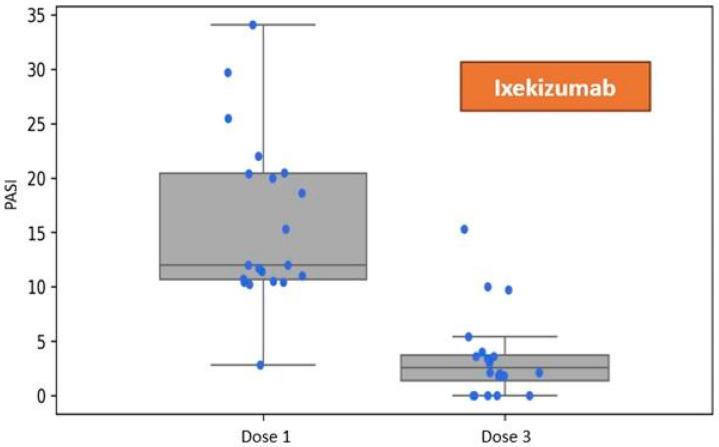
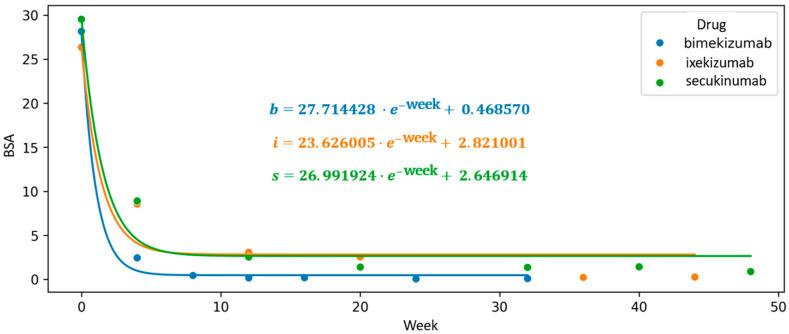
: Bimekizumab, secukinumab, and ixekizumab are IL-17-targeting biologics approved for the treatment of moderate-to-severe plaque psoriasis. While secukinumab and ixekizumab selectively inhibit IL-17A, bimekizumab targets both IL-17A and IL-17F, potentially providing greater anti-inflammatory efficacy. This study aimed to compare the real-world effectiveness, safety, and tolerability of these agents in a Polish dermatology center between 2019 and 2024. : We conducted a retrospective analysis of 98 patients meeting at least one of the following criteria: PASI ≥ 10, BSA ≥ 10, DLQI ≥ 10, or involvement of special areas with inadequate response or contraindications to ≥2 systemic therapies. Patients with prior exposure only to IL-17 inhibitors were excluded. PASI, BSA, and DLQI scores were recorded at baseline, week 4, and week 12. Due to differences in dosing schedules, outcomes were aligned using standardized timepoints and exponential modeling of continuous response trajectories. Mixed-effects ANOVA was used to assess the influence of baseline factors (age, BMI, PsA status) on treatment outcomes. Adverse events were documented at each monthly follow-up visit. : Bimekizumab showed the greatest effect size for PASI reduction (Hedges' g = 3.662), followed by secukinumab (2.813) and ixekizumab (1.986). Exponential modeling revealed a steeper response trajectory with bimekizumab (intercept = 0.289), suggesting a more rapid PASI improvement. The efficacy of bimekizumab was particularly notable in patients who were previously treated with IL-23 inhibitors. All three agents demonstrated favorable safety profiles, with no serious adverse events or discontinuations. The most frequent adverse events were mild and included upper respiratory tract infections and oral candidiasis. : This real-world analysis confirmed that IL-17 inhibitors effectively improved PASI, BSA, and DLQI scores in moderate-to-severe psoriasis. Bimekizumab demonstrated the most rapid early improvements and a higher modeled likelihood of complete clearance, without significant differences at week 12. All agents were well tolerated, underscoring the need for further individualized, large-scale studies.
比美吉珠单抗、司库奇尤单抗和依奇珠单抗是获批用于治疗中度至重度斑块状银屑病的靶向白细胞介素-17(IL-17)的生物制剂。司库奇尤单抗和依奇珠单抗选择性抑制IL-17A,而比美吉珠单抗同时靶向IL-17A和IL-17F,可能具有更强的抗炎效果。本研究旨在比较2019年至2024年期间在波兰一家皮肤科中心使用这些药物的真实疗效、安全性和耐受性。
我们对98例符合以下至少一项标准的患者进行了回顾性分析:银屑病面积和严重程度指数(PASI)≥10、体表面积(BSA)≥10、皮肤病生活质量指数(DLQI)≥10,或特殊部位受累且对≥2种系统治疗反应不佳或有禁忌证。排除仅曾使用过IL-17抑制剂的患者。在基线、第4周和第12周记录PASI、BSA和DLQI评分。由于给药方案不同,使用标准化时间点和连续反应轨迹的指数模型对结果进行校准。采用混合效应方差分析评估基线因素(年龄、体重指数、银屑病关节炎状态)对治疗结果的影响。在每月的随访中记录不良事件。
比美吉珠单抗降低PASI的效应量最大(赫奇斯g值=3.662),其次是司库奇尤单抗(2.813)和依奇珠单抗(1.986)。指数模型显示比美吉珠单抗的反应轨迹更陡峭(截距=0.289),表明PASI改善更快。比美吉珠单抗在曾接受IL-23抑制剂治疗的患者中疗效尤为显著。所有三种药物的安全性均良好,未出现严重不良事件或停药情况。最常见的不良事件为轻度,包括上呼吸道感染和口腔念珠菌病。
这项真实世界分析证实,IL-17抑制剂可有效改善中度至重度银屑病患者的PASI、BSA和DLQI评分。比美吉珠单抗显示出最快的早期改善效果和更高的完全清除模拟可能性,在第12周时无显著差异。所有药物耐受性良好,这突出表明需要进一步开展个体化的大规模研究。





 Zotero 插件