
RANKL/OPG轴与小儿炎症性肠病中的骨密度
RANKL/OPG Axis and Bone Mineral Density in Pediatric Inflammatory Bowel Disease.
作者信息
Olczyk Mariusz, Frankowska Agnieszka, Tkaczyk Marcin, Socha-Banasiak Anna, Stawerska Renata, Łupińska Anna, Gaj Zuzanna, Głowacka Ewa, Czkwianianc Elżbieta
机构信息
Department of Paediatrics, Immunology and Nephrology, Polish Mother's Memorial Hospital Research Institute, Medical University of Lodz, 90-419 Lodz, Poland.
Department of Gastroenterology, Allergology and Pediatrics, Polish Mother's Memorial Hospital Research Institute, 93-338 Lodz, Poland.
出版信息
J Clin Med. 2025 Aug 1;14(15):5440. doi: 10.3390/jcm14155440.
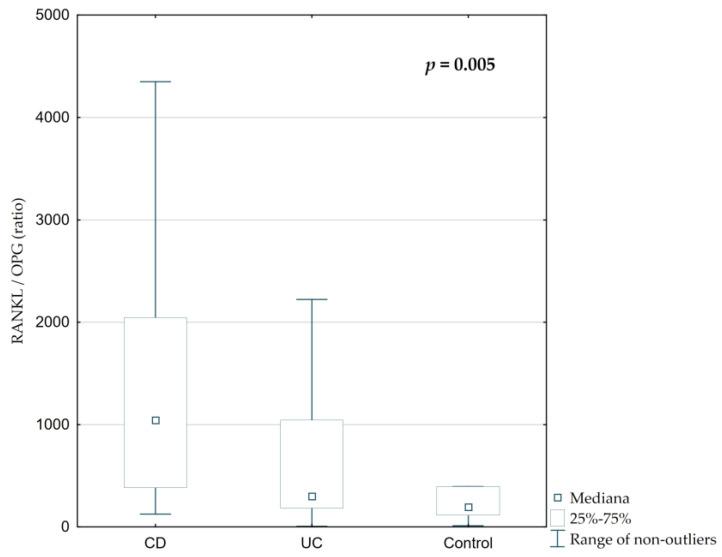
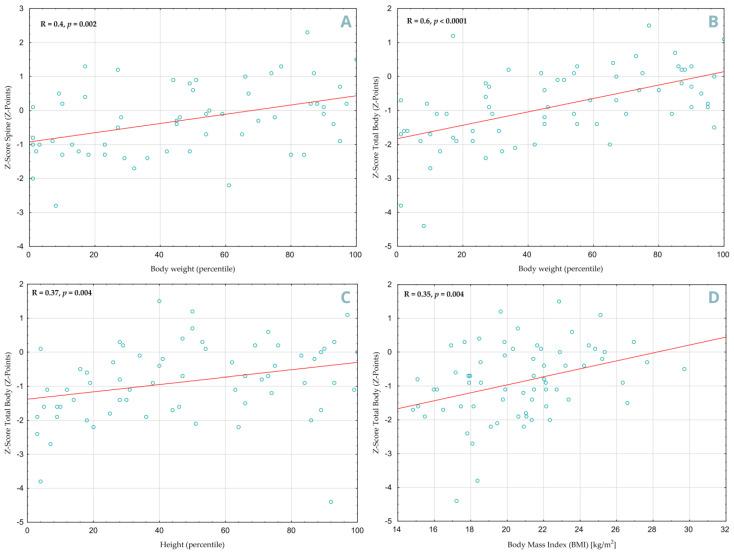
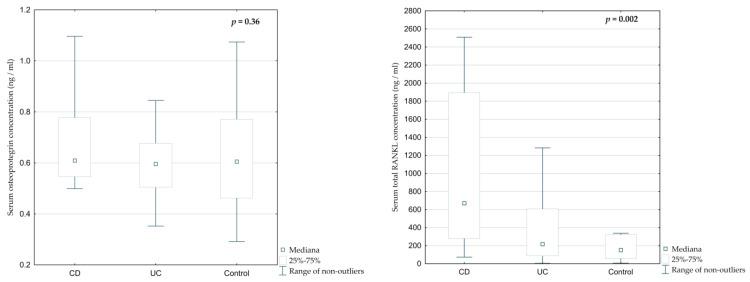
: Inflammatory bowel diseases (IBD), such as Crohn's disease (CD) and ulcerative colitis (UC), may impair bone metabolism, particularly in children. The RANKL/OPG axis, as a key regulator of bone turnover, may contribute to these disturbances. However, data in the pediatric population remain limited. : A single-center, prospective observational study included 100 children aged 4-18 years, with a comparable number of girls and boys. Among them, 72 had IBD (27 CD, 45 UC) and 28 were healthy controls. Anthropometric, biochemical, and densitometric assessments were performed, including serum levels of RANKL and OPG, and markers of inflammation and bone turnover. : Children with CD had significantly lower height and weight percentiles compared to UC and controls. Serum RANKL and the RANKL/OPG ratio were significantly elevated in IBD patients, particularly in CD ( < 0.01). Total body BMD Z-scores were lower in IBD compared to controls ( = 0.03). Low BMD was found in 14.7% of UC and 26.3% of CD patients. In both groups, over 30% had values in the "gray zone" (-1.0 to -2.0). A positive correlation was observed between height and weight and bone density ( < 0.01). Higher OPG was associated with lower body weight ( < 0.001), while increased RANKL correlated with osteocalcin ( = 0.03). Patients receiving biological therapy had significantly lower BMD. : Pediatric IBD is associated with significant alterations in the RANKL/OPG axis and reduced bone density. These findings support early screening and suggest RANKL/OPG as a potential biomarker of skeletal health.
炎症性肠病(IBD),如克罗恩病(CD)和溃疡性结肠炎(UC),可能会损害骨代谢,尤其是在儿童中。核因子κB受体活化因子配体/骨保护素(RANKL/OPG)轴作为骨转换的关键调节因子,可能导致这些紊乱。然而,儿科人群的数据仍然有限。
一项单中心前瞻性观察性研究纳入了100名4至18岁的儿童,男女人数相当。其中,72例患有IBD(27例CD,45例UC),28例为健康对照。进行了人体测量、生化和骨密度评估,包括血清RANKL和OPG水平以及炎症和骨转换标志物。
与UC和对照组相比,CD患儿的身高和体重百分位数显著更低。IBD患者血清RANKL和RANKL/OPG比值显著升高,尤其是CD患者(<0.01)。与对照组相比,IBD患者的全身骨密度Z值更低(=0.03)。14.7%的UC患者和26.3%的CD患者存在低骨密度。在两组中,超过30%的患者骨密度值处于“灰色区域”(-1.0至-2.0)。观察到身高、体重与骨密度之间存在正相关(<0.01)。较高的OPG与较低的体重相关(<0.001),而RANKL升高与骨钙素相关(=0.03)。接受生物治疗的患者骨密度显著更低。
儿科IBD与RANKL/OPG轴的显著改变和骨密度降低有关。这些发现支持早期筛查,并提示RANKL/OPG作为骨骼健康的潜在生物标志物。


 Zotero 插件